


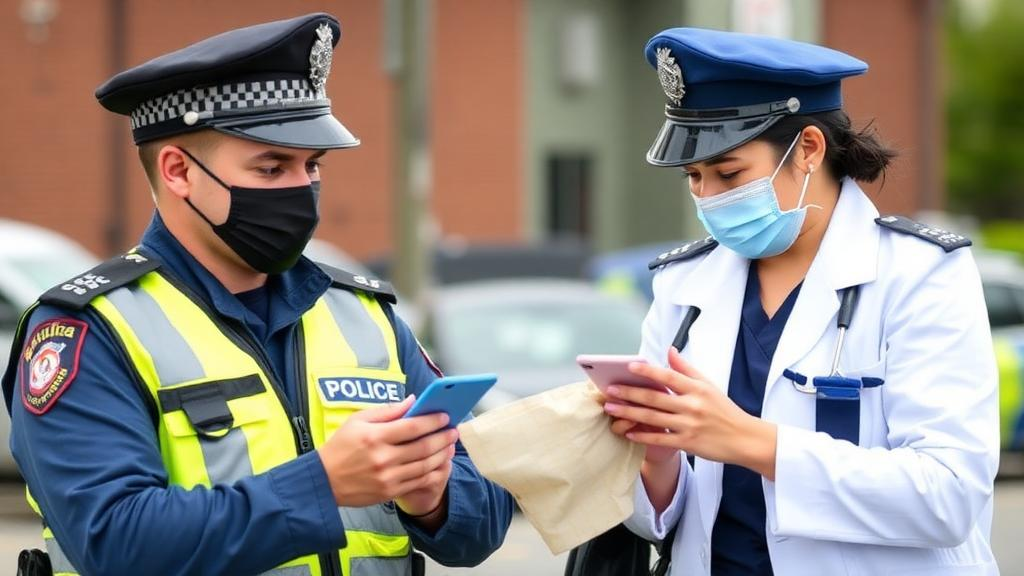
When a child or young person spirals into a mental health crisis, the first professionals through the door are too often police officers armed with little more than training, instinct, and the legal power to detain. A new synthesis of international evidence suggests that this default arrangement may be doing active harm, and that models in which police and mental health clinicians respond jointly can transform the experience of crisis care for young people and their families. The study, published in BMC Psychiatry, is among the most comprehensive attempts yet to explain not just whether co-response models work, but how, why, for whom, and under what conditions.
The research, led by Sarah Parry of Pennine Care NHS Foundation Trust and the University of Manchester, together with colleagues at Manchester Metropolitan University, the University of Oxford, and Lancaster University, took the form of a realist review. Unlike a conventional systematic review, which asks whether an intervention works on average, a realist synthesis asks a more granular question: what mechanisms fire in what contexts to produce which outcomes? The team followed the RAMESES reporting standards, searching six academic databases alongside grey literature, and screened 6,174 records down to 45 articles that met their inclusion criteria. Crucially, the evidence base was not left to speak for itself. The researchers refined their initial findings through 32 semi-structured interviews with professionals and people with lived experience of youth mental health crises, testing whether the theoretical account matched reality on the ground.
The scope of the review was deliberately broad. It covered emergency responses for individuals aged 0 to 25, drawing on diverse study designs and stakeholder perspectives, and encompassed the bewildering alphabet soup of models that have emerged internationally: mobile crisis teams, crisis intervention teams, police and clinical early response schemes such as PACER and its multi-agency variant A-PACER, psychiatric emergency response teams, co-response teams, and juvenile mobile crisis programmes. What unites these models is a shared premise: mental health crises are complex, multifaceted events that demand fast responses and multidisciplinary expertise, and no single service, however well intentioned, can meet that demand alone.
The analytical engine of the study was the context–mechanism–outcome configuration, or CMOC. This realist technique breaks down an intervention into the situational contexts that trigger particular reasoning in participants, which in turn produces observable outcomes. Fourteen such configurations were developed and grouped into three thematic domains: the experiences and outcomes of young people and their caregivers, the experiences of the workforce and the quality of cross-agency collaboration, and the organisational impacts and implementation factors that determine whether a model survives beyond its pilot phase. This structure allows the review to move beyond blunt verdicts and explain the causal texture of crisis response.
The findings on what works are strikingly consistent. Effective co-response models were characterised by calm, participatory communication, in which young people were engaged as partners in decisions about their care rather than treated as problems to be managed. Cross-agency collaboration was the second pillar: when police officers and clinicians genuinely worked together, drawing on each other’s expertise in real time, the response was better calibrated to the developmental and clinical needs of the child. The third pillar sat at the system level, in the form of stable funding and interoperable information systems that allowed different agencies to share the information needed for safe, informed decisions. Where these enablers were present, the synthesis found reduced trauma, fewer emergency department presentations, and improved decision-making for patient care.
The contrast with police-only responses was stark. Without clinical support, the review found, police-led interventions heightened distress among young people and increased the use of restrictive practices, including physical restraint and detention. For a child in crisis, the arrival of uniformed officers can itself be traumatising, particularly for young people from communities with strained relationships with law enforcement. The presence of a clinician changes the calculus: it signals that the crisis is being treated as a health event rather than a public order problem, and it brings de-escalation skills and clinical judgement into the moment when they matter most.
Yet the review is candid about the fragility of these gains. Effectiveness varied across contexts, and persistent concerns surround equity, sustainability, and the quality of the underlying research. Overarching factors, including stigma around mental illness, ethical concerns about coercion and consent, and the legal frameworks governing police powers, shaped both implementation and outcomes. In England, for example, Section 136 of the Mental Health Act 1983 gives police the power to remove a person from a public place to a place of safety for assessment, and recent policy shifts such as the Right Care Right Person approach have sought to redefine the boundary between policing and health care. The review suggests that such boundary-drawing succeeds or fails depending on whether health services have the capacity to absorb the demand that shifts their way.
The workforce domain of the synthesis carries important lessons for service designers. Co-response models ask police officers and clinicians to work across professional cultures with different training, different legal powers, and often different instincts about risk. The review indicates that collaboration is not achieved simply by placing two professionals in the same vehicle; it depends on shared understanding, mutual respect, and organisational structures that support joint decision-making. Where those conditions are absent, joint response can degenerate into parallel response, with each professional defaulting to their own playbook and the young person receiving the worst of both worlds.
The organisational findings are equally sobering for policymakers tempted to launch a co-response scheme as a quick fix. The synthesis found that these models can offer safer, trauma-responsive and equitable crisis care for young people only when embedded within well-resourced, clearly governed systems. Stable funding emerged as a make-or-break enabler, reflecting a familiar pattern in which pilot projects demonstrate promise and then collapse when short-term grants expire. Interoperable data systems were similarly essential, allowing clinicians to arrive informed rather than dependent on fragmentary accounts relayed over the radio. Without robust governance and data infrastructure, the review warns, even well-designed models struggle to sustain long-term impact.
The authors conclude with a clear set of priorities: sustained investment and coordinated strategies to strengthen co- and joint-response crisis systems for young people, integrating mental health expertise at every level, fostering genuine police–clinician collaboration, adopting trauma-responsive and culturally responsive practices, and ensuring the governance and data systems that allow services to learn and improve. Funded by the National Institute for Health and Social Care Research under the Care Responders Study, and approved by the Greater Manchester Research Ethics Committee, the review arrives at a moment when health systems internationally are rethinking who should answer a mental health crisis call. Its central message is both hopeful and demanding: the alternative to police-led crisis response exists, it works, and it is neither cheap nor simple, but for young people in their worst moments, the evidence suggests it is worth every pound and every hour of cross-agency negotiation it requires.
Subject of Research: Police–clinician joint and co-response models for youth mental health crisis care
Article Title: The care responders study: a realist synthesis of police–clinician joint and co-response models for youth mental health crises
Article References: Parry, S., Eve, Z., Oakes, L., Wong, G., Galvan, P., Akhtar, A., Edwards, S., & Lobban, F. (2026). The care responders study: a realist synthesis of police–clinician joint and co-response models for youth mental health crises. BMC Psychiatry. https://doi.org/10.1186/s12888-026-08572-2
Image Credits: AI Generated
DOI: 10.1186/s12888-026-08572-2
Keywords: youth mental health, co-response models, police, crisis intervention, realist review, mental health practitioners, trauma-responsive care, emergency services, cross-agency collaboration, restrictive interventions, health services research, BMC Psychiatry
Cite Scienmag News
Glenn Wilkins. (October 10, 2026). When Police and Clinicians Answer Crisis Calls Together, Young People Fare Better. Scienmag. https://scienmag.com/when-police-and-clinicians-answer-crisis-calls-together-young-people-fare-better/
Glenn Wilkins. "When Police and Clinicians Answer Crisis Calls Together, Young People Fare Better." Scienmag, 10 October 2026, https://scienmag.com/when-police-and-clinicians-answer-crisis-calls-together-young-people-fare-better/. Accessed 10 October 2026.
Glenn Wilkins. "When Police and Clinicians Answer Crisis Calls Together, Young People Fare Better." Scienmag. October 10, 2026. https://scienmag.com/when-police-and-clinicians-answer-crisis-calls-together-young-people-fare-better/


