


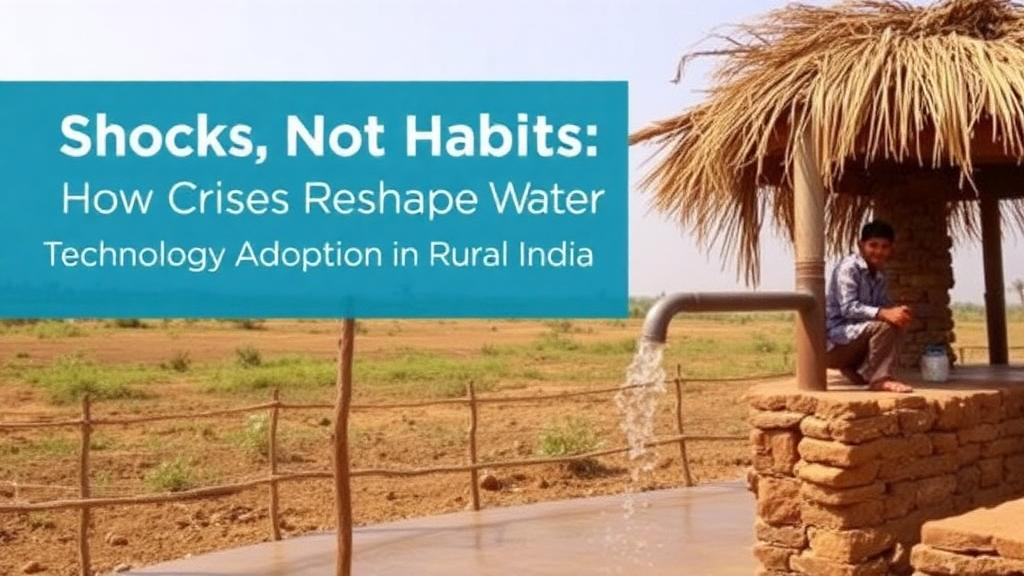
When a community water purification plant is installed in a rural Indian village, the hardest part of the engineering has often already been done. The membranes, filters and pipes are in place; the water quality targets are defined. What determines whether the technology actually gets used, however, is far less predictable. A new study published in Discover Sustainability argues that the missing ingredient is time itself — specifically, the shocks and upheavals that sweep through communities while development programmes are still trying to change their behaviour.
The research, conducted by Mithun Raj and Maneesha Vinodini Ramesh of Amrita Vishwa Vidyapeetham together with Saket Pande of Delft University of Technology, draws on survey data from 54 rural communities in India. Rather than treating the social and political environment as a fixed backdrop, the team asked a more dynamic question: do external events — political transitions, national missions, public health crises, natural hazards — actually change the psychological machinery that drives households to adopt community-based water purification technology? Their answer is a clear yes, and it challenges the linear behavioural models that underpin much of water security planning.
The analytical core of the study is a two-stage exploratory regression framework. In essence, the researchers first examined how standard psychological determinants — trust, risk perception and social norms — predicted adoption across the pooled dataset. They then re-examined those relationships within the periods defined by distinct external events, testing whether the strength and even the direction of the associations shifted. This design allowed them to separate what they call active contextual moderators from static factors: variables that do not merely sit in the background but actively rewire the pathways between what people believe and what they do.
The results are striking in their asymmetry. Different categories of exogenous events were associated with divergent behavioural pathways. A policy shift, such as the rollout of a large-scale national initiative like the Jal Jeevan Mission, did not influence adoption in the same way as a natural hazard or a public health emergency. In some cases the predictive strength of a psychological driver grew markedly during a shock; in others it weakened or reversed in sign. Trust in the technology and its operators, the perceived risks of untreated or purified water, and the pull of what neighbours and community leaders were doing all proved to be unstable quantities — sensitive to the moment in which they were measured.
This instability is what the authors describe as emergent behaviour. In complex systems, emergence refers to patterns that arise from the interaction of many components and cannot be predicted by examining any single component in isolation. Applied here, the idea is that technology adoption in a village is not the simple sum of individual attitudes. It is a collective outcome that co-evolves with the shocks the community experiences. A flood, an election or a national campaign does not just add or subtract a fixed amount of motivation; it changes the rules by which motivation translates into action.
The practical implications reach well beyond India’s water sector. Development programmes routinely invest heavily in identifying the psychological levers of behaviour change — building trust, communicating risk, harnessing social norms — and then assume those levers will keep working as designed. The study’s findings suggest that assumption is fragile. An intervention calibrated during a period of stability may lose its predictive power the moment a crisis arrives, and one designed in the shadow of a crisis may misfire once normality returns. Flexibility, the authors conclude, is not a luxury but a requirement: water security interventions must be able to adapt as community responses vary alongside systemic volatility.
To capture this, the team proposes an Enhanced Theory of Change, a framework that explicitly distinguishes active contextual moderators from static factors and models adoption as a non-linear, emergent response rather than a straight-line progression. In conventional programme design, a theory of change typically maps inputs to outputs through a chain of assumed causal steps. The enhanced version instead treats the causal chain itself as something that can be reconfigured by external events, with the magnitude and direction of established psychological associations shifting as conditions change. This makes the framework less elegant on paper but considerably more honest about how behaviour unfolds in the real world.
The study also carries a methodological message for researchers. Exploratory regression applied in stages — first across the whole sample, then within event-defined windows — offers a template for detecting these shifts without requiring enormous datasets or exotic machinery. It is an approach that other teams studying technology adoption, from cookstoves to solar irrigation pumps, could adapt to test whether their own behavioural predictors are as stable as they assume. The authors’ collaboration, part of the Joint Center of Excellence in Water Sustainability between Amrita Vishwa Vidyapeetham and Delft University of Technology and supported by the E4LIFE International Ph.D. Fellowship Program, reflects the blend of field immersion and hydrological modelling that such work demands.
For the communities themselves, the stakes are concrete. Community-based water purification is a cornerstone of safe drinking water strategies in rural India, and a plant that stands idle because adoption stalled after an unanticipated shock represents wasted investment and continued exposure to waterborne disease. Understanding that a natural hazard can erode trust, or that a national mission can amplify the influence of social norms, gives programme designers a way to anticipate these turning points rather than discover them in retrospective evaluations. Timing, sequencing and the capacity to re-engage a community after a disruption become as important as the technology itself.
The broader lesson is one that resonates across sustainability science: context is not scenery. The environments in which behaviour change is attempted are volatile systems, punctuated by shocks that can redirect the very pathways interventions are built upon. By modelling adoption as an emergent, non-linear response — and by treating events like policy shifts and natural hazards as active moderators rather than noise — this study offers a more realistic, and ultimately more useful, picture of how rural communities come to embrace the technologies meant to secure their water. In a decade that will test water systems with climate extremes and political change alike, that realism may prove to be the most valuable technology of all.
Subject of Research: How exogenous events and emergent behaviour shape community adoption of water purification technology in rural India
Article Title: Emergent behaviour and the adoption of community-based water purification technology in rural India
Article References: Raj, M., Pande, S., & Ramesh, M. V. (2026). Emergent behaviour and the adoption of community-based water purification technology in rural India. Discover Sustainability. https://doi.org/10.1007/s43621-026-04452-7
Image Credits: AI Generated
DOI: 10.1007/s43621-026-04452-7
Keywords: water purification, rural India, technology adoption, emergent behaviour, exogenous shocks, trust, risk perception, social norms, Jal Jeevan Mission, theory of change, water security, behavioral economics
Cite Scienmag News
Violet Maxwell. (October 10, 2026). Shocks, Not Habits: How Crises Reshape Water Technology Adoption in Rural India. Scienmag. https://scienmag.com/shocks-not-habits-how-crises-reshape-water-technology-adoption-in-rural-india/
Violet Maxwell. "Shocks, Not Habits: How Crises Reshape Water Technology Adoption in Rural India." Scienmag, 10 October 2026, https://scienmag.com/shocks-not-habits-how-crises-reshape-water-technology-adoption-in-rural-india/. Accessed 10 October 2026.
Violet Maxwell. "Shocks, Not Habits: How Crises Reshape Water Technology Adoption in Rural India." Scienmag. October 10, 2026. https://scienmag.com/shocks-not-habits-how-crises-reshape-water-technology-adoption-in-rural-india/


