


One of the most persistent frustrations in climate policy is the gap between intention and outcome. Governments design incentives for energy saving, promote public transport, and encourage plant-rich diets, yet the same policy can flourish in one country and falter in another. A new study published in PLOS Climate by Guanyu Yang, Amy Rodger, Elif Naz Çoker and David Shipworth offers a data-driven explanation for why this happens, and a systematic framework for fixing it. Analysing the environmental behaviours of more than 17,000 respondents across 61 regions in nine OECD countries, the researchers show that populations are far from homogeneous, that socio-demographic labels are poor predictors of who behaves sustainably, and that the regional context in which people live shapes their behaviour in ways national averages completely obscure.
The research team focused on three sectors that contribute substantially to greenhouse gas emissions and where individual behaviour change can have the greatest impact: energy use in the home, transport choices, and food consumption. These are also the sectors in which international policy learning and transfer are most common, as governments routinely borrow instruments that have succeeded elsewhere, from carbon taxes to appliance efficiency standards. The problem, the authors argue, is that such transfers often rest on an implicit assumption that populations behave alike, or that a handful of socio-demographic characteristics such as age, income and education can stand in for actual behavioural patterns. When those assumptions fail, policies underperform and public money is wasted.
To test these assumptions rigorously, the researchers employed Multilevel Latent Class Analysis, a statistical technique that identifies unobserved groups of people who share similar behavioural profiles without the analyst predefining what those groups should look like. The multilevel structure of the method is crucial: it simultaneously classifies individuals and accounts for the fact that those individuals are nested within regions and countries, allowing the team to detect both the behavioural segments themselves and the way those segments are distributed geographically. Applied to the survey data, the technique revealed distinct population segments in each of the three sectors, ranging from highly sustainable to markedly unsustainable patterns of behaviour.
The headline finding is sobering. Less sustainable behavioural patterns were prevalent across all three sectors in every country examined, meaning that in energy, transport and food alike, the largest or most common groups of people exhibited relatively unsustainable habits. Yet the picture was not uniformly bleak, and it was certainly not uniform. The energy sector in particular displayed notable heterogeneity, with a wider variety of behavioural profiles than the other two sectors. This suggests that household energy behaviour is shaped by a more diverse set of circumstances, practices and constraints than, say, dietary choices, and that energy policy may therefore require finer targeting than policies aimed at transport or food.
Perhaps the most consequential result for policy design is what the study found about socio-demographics. Conventional segmentation approaches, which sort people by income bracket, education level or age cohort, assume these characteristics reliably predict environmental behaviour. The analysis showed that they do not, at least not consistently. Socio-demographic characteristics failed to predict segment membership reliably across countries and sectors, undermining a foundation on which much targeted policy communication rests. A wealthy, highly educated urbanite in one country may fall into a profligate energy-use segment, while a demographically similar person elsewhere may be among the most sustainable. If policymakers cannot infer behaviour from demographics, they need direct behavioural evidence, which is precisely what latent class methods provide.
The study also uncovered a striking pattern of behavioural consistency within individuals. People who engaged in sustainable behaviours in one sector were more likely to do so in the others, and, symmetrically, unsustainable behaviours were positively associated across sectors as well. In other words, environmental behaviour tends to cluster within people rather than existing in isolated silos. This has an important implication: interventions that successfully shift behaviour in one domain may create momentum in others, and coordinated cross-sector interventions are likely to be more effective than sector-by-sector campaigns. A household that adopts efficient heating may be more receptive to messages about low-carbon travel or reduced meat consumption, and policies that treat these domains together could exploit that correlation.
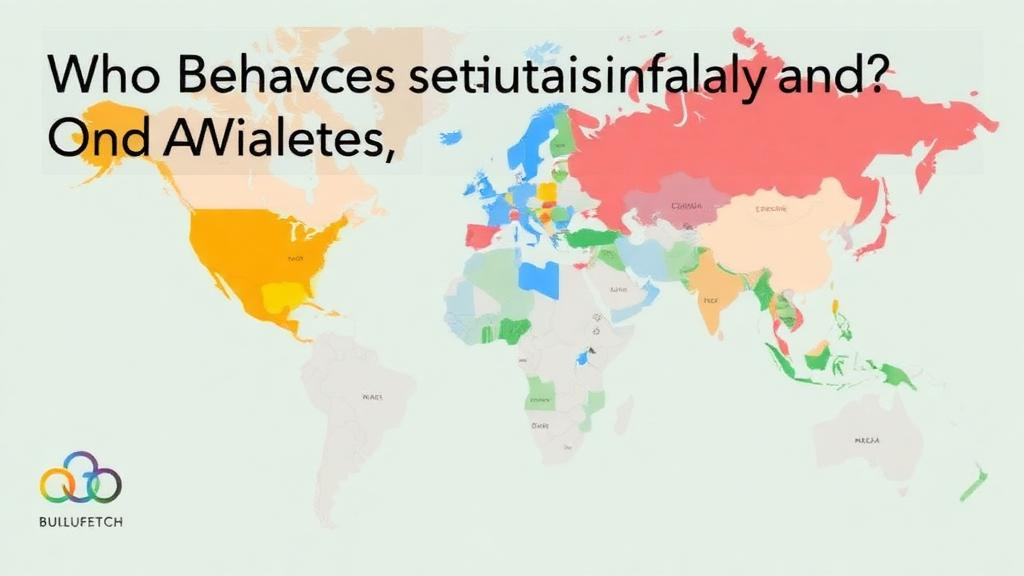
Geography turned out to matter enormously. When the researchers mapped the regional distribution of population segments, they found that regions typically grouped geographically by country, underscoring the influence of national context such as policy regimes, infrastructure, culture and climate on environmental behaviour. People in the same country tend to share a behavioural profile mix, which is exactly what makes national policy learning plausible. But the more surprising discovery lay beneath that national clustering: significant within-country variation. Some regions showed substantially different proportions of people in sustainable segments than their neighbours, despite operating under identical national policies. A region can be a behavioural outlier within its own country, hosting far more or far fewer sustainably behaving residents than the national policy environment alone would predict.
This within-country variation is where the study makes its most practical contribution. Traditional policy transfer is often ad hoc: a government observes that a scheme works in another country and imports it, hoping for similar results. Yang and colleagues propose instead a systematic framework for identifying evidence-based transfer opportunities. The framework answers three questions in sequence: who needs interventions, in the form of which population segments are prevalent and unsustainable in a given region; where successful patterns emerge, by locating regions with unusually high concentrations of sustainable segments; and which contexts may enable sustainable behaviours, by comparing the conditions of successful regions with those where unsustainable segments dominate. In effect, the method turns the map of behavioural segments into a targeting tool, directing policymakers to the places where a given intervention is most likely to find receptive conditions.
The technical machinery behind this framework deserves emphasis, because it is what elevates the study beyond a descriptive survey. Multilevel Latent Class Analysis avoids the arbitrariness of hand-drawn segments by letting the data define the behavioural classes, while its hierarchical structure prevents the ecological fallacy of treating national averages as if they described individuals. By estimating segment prevalence separately for each of the 61 regions, the method produces a granular behavioural geography that neither national surveys nor purely local studies can deliver. The cross-national design then allows genuine comparison: a region can be judged not only against its own country but against the full range of OECD contexts in the dataset, revealing whether its behavioural mix is typical, exceptional, or transferable.
The implications reach well beyond the nine countries studied. As governments race to meet climate targets, behaviour change in energy, transport and food is widely recognised as essential to achieving mitigation at the scale and speed required, yet it remains one of the least systematically measured dimensions of climate policy. This study demonstrates that the raw material for smarter policy already exists in large international surveys, and that sophisticated but well-established statistical methods can convert that data into actionable maps. The message for the international policy community is twofold: stop assuming that populations are homogeneous or that demographics predict behaviour, and start using evidence about who behaves unsustainably and where enabling contexts exist. If policy transfer is to deliver on its promise, it must begin not with a successful scheme in search of a home, but with a rigorous account of the people and places it is meant to serve.
Subject of Research: Population segmentation and regional patterns of environmental behaviour across nine OECD countries
Article Title: From segmentation to strategy: Identifying population segments and regional patterns of environmental behaviour
Article References: Yang, G., Rodger, A., Çoker, E. N., & Shipworth, D. (2026). From segmentation to strategy: Identifying population segments and regional patterns of environmental behaviour. PLOS Climate, 5(8), e0001039. https://doi.org/10.1371/journal.pclm.0001039
Image Credits: AI Generated
DOI: 10.1371/journal.pclm.0001039
Keywords: environmental behaviour, climate policy, policy transfer, latent class analysis, energy use, transport, food consumption, regional variation, OECD countries, behaviour change, sustainability, PLOS Climate
Cite Scienmag News
Sloane Callahan. (October 10, 2026). Who Behaves Sustainably, and Where? A Nine-Country Map of Environmental Behaviour. Scienmag. https://scienmag.com/who-behaves-sustainably-and-where-a-nine-country-map-of-environmental-behaviour/
Sloane Callahan. "Who Behaves Sustainably, and Where? A Nine-Country Map of Environmental Behaviour." Scienmag, 10 October 2026, https://scienmag.com/who-behaves-sustainably-and-where-a-nine-country-map-of-environmental-behaviour/. Accessed 10 October 2026.
Sloane Callahan. "Who Behaves Sustainably, and Where? A Nine-Country Map of Environmental Behaviour." Scienmag. October 10, 2026. https://scienmag.com/who-behaves-sustainably-and-where-a-nine-country-map-of-environmental-behaviour/


