


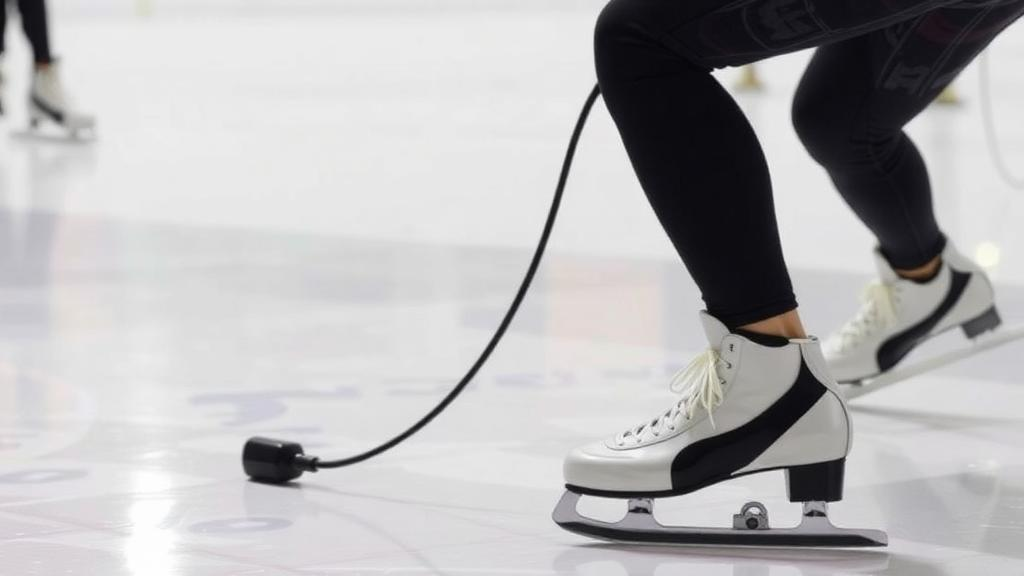
Speed skating is a sport of millimeters and milliseconds. The difference between a podium finish and an also-ran often comes down to how precisely an athlete can hold a low posture, push off the ice, and recover through each stride. Yet the way most skaters are trained has barely changed in decades: a coach watches, judges by eye, and adjusts based on years of subjective experience. A team of researchers from institutions in China, Thailand, and South Korea has now built a machine aimed at changing that, pairing a flexible cable-driven robot with a new control strategy that keeps its movements tracking an athlete’s body with remarkable accuracy. The work, published in the journal Mechanical Sciences, describes a full pipeline from mechanical design through kinematic modeling to control verification.
The core problem the team set out to solve is a familiar one in sports robotics. Exoskeleton robots, the most common type of wearable training aid, attach rigid links and motors directly to the athlete’s joints. That adds substantial inertia to the limbs, which is precisely what a speed skater does not need. A bulky frame strapped to the hips and legs can constrain the very fluid, high-speed movements the athlete is trying to refine. Cable-driven robots offer an elegant alternative: the motors sit on a stationary chassis, and lightweight, high-strength cables transmit forces to the athlete’s waist, legs, and ankles. The cables decouple the heavy drive hardware from the human body, and their inherent compliance softens the risk of rigid collisions. The trade-off is that controlling eight cables to move a platform in six degrees of freedom is a genuinely hard control problem, and existing control schemes were not precise enough for competitive skating.
The robot itself is built around a gantry of vertical columns and crossbeams, with pulleys guiding the cables along smooth force-transmission paths. Eight functional modules make up the machine: the load-bearing columns, the crossbeams that stabilize the gantry, the pulleys, ergonomically curved handrails that give the skater balance support, servo drivers housed in the chassis with high-precision encoders providing millisecond-level feedback, lightweight composite cover plates for protection and quick maintenance, a chassis integrating counterweights and shock absorption, and a polished mirror surface whose friction coefficient is tuned to resemble real ice. Cables connect to key points on the athlete’s waist, legs, and ankles, forming a closed-loop force control network. The design accommodates athletes from 1.65 to 1.98 meters tall, with a drive unit capable of 380 newtons of pulling force and a suspension rated for 500 kilograms, margins engineered to withstand the explosive peak loads of a skater’s push-off.
The drive unit combines an S7-1200 programmable logic controller, a 400-watt permanent magnet synchronous motor rated at 3000 revolutions per minute, and a type 1204 ball screw. When the motor spins, it turns the screw, which drives a slider that reels a cable in or out, adjusting both its length and tension in real time. This hybrid scheme lets the robot provide upward lifting assistance during the take-off phase and apply controllable damping at the moment of ice landing, cushioning joint impact. Because the motors live on the chassis rather than on the athlete, the components attached to the body stay light, preserving the flexibility that rigid exoskeletons sacrifice.
To make the machine useful, the researchers first had to solve its kinematics: the mathematical mapping between the pose of the moving platform, which carries the skater’s leg brace, and the lengths of the eight cables. They established a fixed coordinate system at the geometric center of the robot’s base frame and a moving coordinate system fixed to the platform at the center of the athlete’s thigh. Assuming the cables remain fully tensioned and can be treated as ideal massless straight segments, they derived the inverse kinematics, which computes cable lengths from a desired pose, using a closed vector quadrilateral approach combined with a rotation matrix built from roll, pitch, and yaw angles. Forward kinematics, the harder reverse problem of recovering the platform’s position and orientation from known cable lengths, was solved with the Newton-Raphson iterative method, chosen over analytical approaches for its rapid convergence and precision.
The Newton-Raphson method converges quadratically near the true root, but it is sensitive to the initial guess. The team exploited a practical trick: because the servo control system samples at millisecond intervals, the platform barely moves between consecutive control cycles, so the pose from the previous cycle serves as an excellent starting point for the next iteration. This guarantees robust, real-time convergence. To validate the model, the researchers ran simulations in MATLAB using five sets of pose points within the robot’s workspace, feeding them through inverse kinematics to get cable lengths and then through forward kinematics to recover the poses. The maximum deviation between the original and recovered poses was 0.95 percent, below the 1 percent threshold the team set as evidence that the kinematic model is sound.
With the mechanics settled, the heart of the paper is its control strategy. Conventional proportional-integral-derivative controllers, while simple and robust, struggle with the nonlinear coupling and sudden disturbances that characterize skating, such as abrupt changes in ice friction or the athlete’s own movements. Active disturbance rejection control offers a way forward: an extended state observer continuously estimates the combined internal and external disturbances acting on the system and compensates for them in real time. But traditional ADRC architectures include a tracking differentiator, a component that shapes the response to step inputs to avoid overshoot by ramping the control output up gradually. That conservatism introduces delays and sluggish response, a poor fit for the high-frequency movements of skating, like rapid ice pushes and sudden stops.
The researchers’ solution is a fractional-order active disturbance rejection controller, or FOADRC, with two key innovations. First, they removed the tracking differentiator entirely, allowing the large initial error to drive the system promptly and sharpen the dynamic response. Second, they replaced the conventional state feedback error law with a fractional-order PD control law and upgraded the observer to a fractional-order extended state observer. Fractional-order calculus, which uses non-integer differentiation and integration operators, gives the controller adjustable amplitude-frequency slopes and better high-frequency noise suppression than integer-order designs, along with superior robustness to complex disturbances. The fractional-order observer was tuned using a bandwidth parameterization borrowed from integer-order observer theory, so that only a single parameter needs adjustment, dramatically simplifying calibration. The fractional-order operators themselves were approximated in a practical frequency band using the Oustaloup method, a standard rational-fitting technique accurate enough at fifth order.
To generate realistic control targets, the team captured real skating motion using a NOKOV infrared motion capture system with eight cameras sampling at 100 hertz and a spatial positioning error under 0.1 millimeters. A 25-year-old male speed skater, 178 centimeters tall and weighing 70 kilograms, performed standard straight-line skating cycles while retroreflective markers on his hip, thigh, lower leg, and ankle tracked the movement. The researchers focused on the hip joint, the hub connecting trunk and legs that carries body weight and fine-tunes the center of gravity during skating. Raw marker data were smoothed with a fourth-order zero-phase Butterworth low-pass filter at a 6 hertz cutoff and gaps from marker occlusion were filled with cubic spline interpolation. The resulting hip joint angle time series, covering sagittal-plane flexion-extension and coronal-plane abduction-adduction, was fitted with an eighth-order Fourier series to produce a smooth, reproducible reference trajectory, and measured cable tensions grounded the simulation in realistic loads.
The payoff came in comparative simulations against a traditional PID controller, evaluated by motor angle tracking error on the drive units for the first two cables. The FOADRC strategy narrowed the error range substantially and improved motion control precision, and, crucially, the tracking error profiles of the two motors were highly consistent despite following different trajectories and load variations. That uniformity matters enormously in multi-cable systems, where all drives must stay synchronized to avoid unbalanced internal tensions or uncoordinated movements. The authors are candid about the study’s limits: everything so far rests on simulation and data from a single subject. The next step is building a physical prototype and running multi-subject trials in real training environments. If those succeed, the combination of flexible cable actuation and fractional-order disturbance rejection could become a template not just for skating, but for a broader generation of intelligent training equipment across competitive sports.
Subject of Research: Cable-driven skating training robot kinematics and fractional-order active disturbance rejection control
Article Title: Research on kinematics and fractional order active disturbance rejection control of skating training robot
Article References: Wang, B., Zhao, X., Gong, Y., Sun, L., & Yang, Z. (2026). Research on kinematics and fractional order active disturbance rejection control of skating training robot. Mechanical Sciences, 17(2), 731-746. https://doi.org/10.5194/ms-17-731-2026
Image Credits: AI Generated
Keywords: speed skating, cable-driven robot, fractional-order control, active disturbance rejection, kinematics, Newton-Raphson method, permanent magnet synchronous motor, motion capture, sports robotics, trajectory tracking, training technology, Mechanical Sciences
Cite Scienmag News
Denise Maddox. (October 10, 2026). Cable-Driven Robot With Fractional-Order Control Brings Precision to Speed Skating Training. Scienmag. https://scienmag.com/cable-driven-robot-with-fractional-order-control-brings-precision-to-speed-skating-training/
Denise Maddox. "Cable-Driven Robot With Fractional-Order Control Brings Precision to Speed Skating Training." Scienmag, 10 October 2026, https://scienmag.com/cable-driven-robot-with-fractional-order-control-brings-precision-to-speed-skating-training/. Accessed 10 October 2026.
Denise Maddox. "Cable-Driven Robot With Fractional-Order Control Brings Precision to Speed Skating Training." Scienmag. October 10, 2026. https://scienmag.com/cable-driven-robot-with-fractional-order-control-brings-precision-to-speed-skating-training/


