


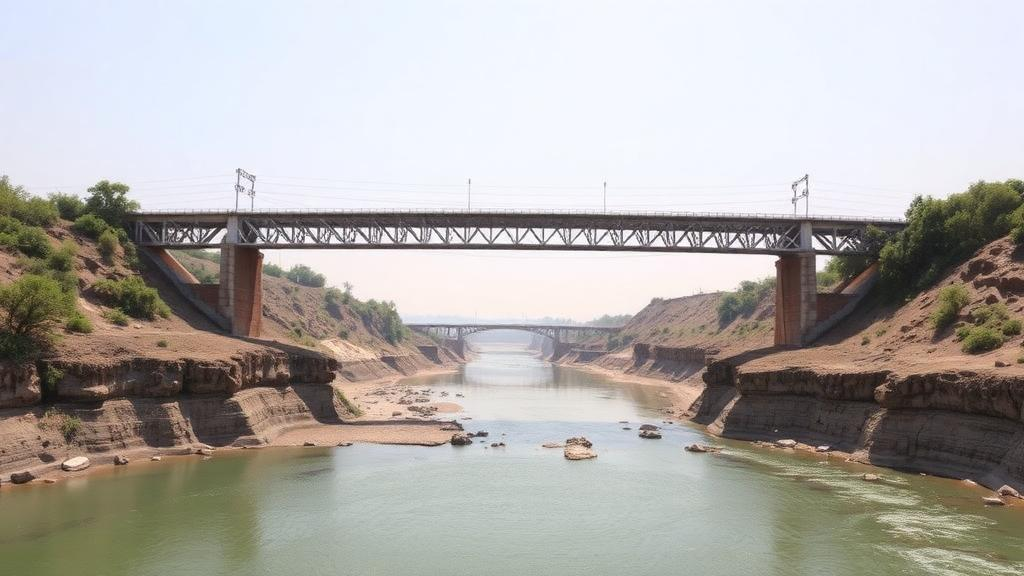
Beneath the piers of the Kolaghat Bridge, where the Rupnarayan River winds through the peri-urban heartland of eastern India, a slow and largely invisible threat is gathering force. New research published in Environmental Monitoring and Assessment suggests that by the end of this century, under a high-emissions future, the riverbed around the bridge’s foundations could be carved out by roughly 80 percent more than today’s scour depths, eroding the safety margin that keeps the structure standing. The study, led by Arnab Ghosh of Jadavpur University with Moumita Kundu of Vidyasagar University and Ellora Padhi of IIT Roorkee, is among the first to trace a complete, quantified chain from global climate projections down to the centimetre-scale physics of sediment motion around a bridge pier in a basin where measured data are notoriously scarce.
The problem the researchers set out to solve is one that haunts hydraulic engineers across the developing world. Bridge scour, the removal of sediment from around foundations by flowing water, is the leading cause of bridge collapse worldwide, and its severity depends on river discharge, sediment load, and channel geometry. Yet most design codes still assume that the statistics of future floods will resemble those of the past, an assumption famously challenged in 2008 when hydrologists declared that stationarity is dead. In data-scarce tropical basins like the Rupnarayan, where gauge records are short and sparse, quantifying how climate change will alter the forces acting on critical infrastructure has remained poorly constrained. The team’s answer was to build a modelling pipeline that squeezes usable engineering numbers out of limited observations.
At the top of the pipeline sits a high-resolution global climate model, the Max Planck Institute Earth System Model version 1.2 Higher Resolution, known as MPI-ESM1-2-HR. Raw global model output is too coarse and too biased to drive a local river model, so the researchers downscaled and bias-corrected the projections before feeding them into the Soil and Water Assessment Tool, a widely used watershed model that simulates how rainfall becomes runoff and sediment. The calibration was strong: the coupled model achieved a Nash-Sutcliffe efficiency of 0.90 and a coefficient of determination of 0.86 for discharge, figures that indicate the simulated river flows track the observed record closely. That performance matters, because every downstream estimate of scour depends on the credibility of the flow and sediment series entering the hydraulic model.
To bracket the range of possible futures, the team ran three Shared Socioeconomic Pathways: the moderate SSP245, the intermediate SSP370, and the fossil-fuel-intensive SSP585. The observed record from 1960 to 2020 shows no significant trend in the basin’s hydrology, but the projections diverge sharply from that historical baseline. Under SSP585, mean annual temperature rises by 1.31 degrees Celsius and mean annual rainfall increases by 22.1 percent by 2100. Those shifts translate into altered river flow regimes and sediment delivery, which the researchers propagated through a two-dimensional Hydrologic Engineering Center River Analysis System model, HEC-RAS 2D, to compute water-surface elevations, energy gradients, and bed shear stress for floods with return periods ranging from 2 to 100 years.
The hydraulic results reveal a consistent intensification of the forces that move sediment. Across the three-scenario comparison, critical shear stress and the energy gradient at the Kolaghat Bridge increase by 11 to 18 percent, with the MPI-ESM1-2-HR-driven projections clustering around 15 percent. Bed shear stress is the fundamental quantity in sediment transport: it describes the drag exerted by moving water on the channel bed, and when it exceeds the critical threshold for the bed material, grains begin to move. A higher energy gradient means steeper, more energetic flow, and a higher critical shear stress at the site means the river is pushing harder against its bed precisely where the bridge foundations are anchored.
The most striking number in the study comes from applying the HEC-18 procedure, the standard method of the U.S. Federal Highway Administration for evaluating scour at bridges. Total pier scour at the Kolaghat Bridge, projected under the high-emissions pathway, grows from approximately 6.07 metres to approximately 10.93 metres, an increase of about 80 percent. Pier scour develops when flowing water accelerates around a pier, forming horseshoe vortices at the bed that excavate a hole around the foundation. The deeper that hole becomes, the less of the pile remains embedded in competent material, and the smaller the reserve of safety against collapse. According to the study, the projected scour would diminish the foundation safety margin below the code threshold, a finding that converts an abstract climate statistic into a concrete engineering liability.
Paradoxically, the same simulations point to a second, opposite hazard. The projected water-surface elevations show reduced high-frequency variability, which the researchers interpret as a signal of increased sedimentation, channel narrowing, and a rise in overall channel sinuosity from 1.08 to 1.67. A sinuosity increase of that magnitude describes a river meandering more sharply through its floodplain, reshaping its course over decades. Sedimentation and narrowing can raise flood levels for a given discharge, while the shifting thalweg, the deepest line of the channel, can direct erosive flow toward piers that were designed for a different channel alignment. The bridge, in other words, faces threats from both directions: stronger scour during floods and a progressively less stable channel around it.
What makes the study methodologically significant is that it accomplishes this assessment in a basin with almost no dedicated monitoring infrastructure. The authors combined openly available bias-corrected CMIP6 climate projections, published by Mishra and colleagues on Zenodo, with satellite-derived terrain data and standard public modelling tools, creating a replicable template for other data-scarce rivers. The three-scenario, three-model comparison also gives engineers a sense of uncertainty: the 11 to 18 percent spread in shear stress intensification reflects how different scenario pathways and model configurations propagate through the chain. Similar physics-based approaches have been applied to regional bridge scour risk in the United States and to national scour assessments in Sweden, but applications to tropical, monsoon-dominated, peri-urban basins in South Asia have been rare, despite the region’s dense inventory of aging river crossings.
The practical implications extend well beyond a single bridge. The authors argue that their results make a clear case for climate-adjusted hydraulic design loads, meaning that new structures and retrofits should be sized not on historical flood statistics but on projected future flows and shear stresses. They also recommend regular bathymetric monitoring, repeated surveys of the riverbed depth around foundations, so that scour can be tracked as it develops rather than discovered after the fact, together with planned dredging to manage sediment accumulation. For the Kolaghat Bridge, which carries traffic across a working river in a densely populated corridor of West Bengal, such monitoring could mean the difference between a scheduled intervention and an emergency.
More broadly, the study is a reminder that climate change does not only arrive as floods and droughts; it arrives as altered physics in the beds of rivers, working silently on the foundations of the built world. A warming atmosphere loads more moisture into monsoon systems, reshaping discharge regimes and sediment budgets in ways that standard design manuals, written for a stationary climate, never anticipated. As extreme rainfall intensifies across South Asia, the modelling chain demonstrated here, from downscaled Earth system projections through watershed simulation to two-dimensional hydraulics and scour analysis, offers a way for engineers in data-poor regions to see that hidden stress coming, and to reinforce their infrastructure before the river quietly undermines it.
Subject of Research: Climate change impacts on bridge pier scour and river channel morphology in the data-scarce Rupnarayan basin, India
Article Title: Climate-induced hydraulic stress and geomorphological changes: an assessment of vulnerability of critical river infrastructure in the data-scarce basin, India
Article References: Ghosh, A., Kundu, M., & Padhi, E. (2026). Climate-induced hydraulic stress and geomorphological changes: an assessment of vulnerability of critical river infrastructure in the data-scarce basin, India. Environmental Monitoring and Assessment, 198(11), Article 1175. https://doi.org/10.1007/s10661-026-16013-6
Image Credits: AI Generated
DOI: 10.1007/s10661-026-16013-6
Keywords: bridge scour, climate change, HEC-RAS, SWAT, CMIP6, Rupnarayan River, bed shear stress, hydraulic modelling, infrastructure vulnerability, SSP585, India, geomorphology
Cite Scienmag News
Violet Maxwell. (October 10, 2026). Climate Change Could Scour Away 80 Percent More Riverbed Beneath a Vital Indian Bridge. Scienmag. https://scienmag.com/climate-change-could-scour-away-80-percent-more-riverbed-beneath-a-vital-indian-bridge/
Violet Maxwell. "Climate Change Could Scour Away 80 Percent More Riverbed Beneath a Vital Indian Bridge." Scienmag, 10 October 2026, https://scienmag.com/climate-change-could-scour-away-80-percent-more-riverbed-beneath-a-vital-indian-bridge/. Accessed 10 October 2026.
Violet Maxwell. "Climate Change Could Scour Away 80 Percent More Riverbed Beneath a Vital Indian Bridge." Scienmag. October 10, 2026. https://scienmag.com/climate-change-could-scour-away-80-percent-more-riverbed-beneath-a-vital-indian-bridge/


