


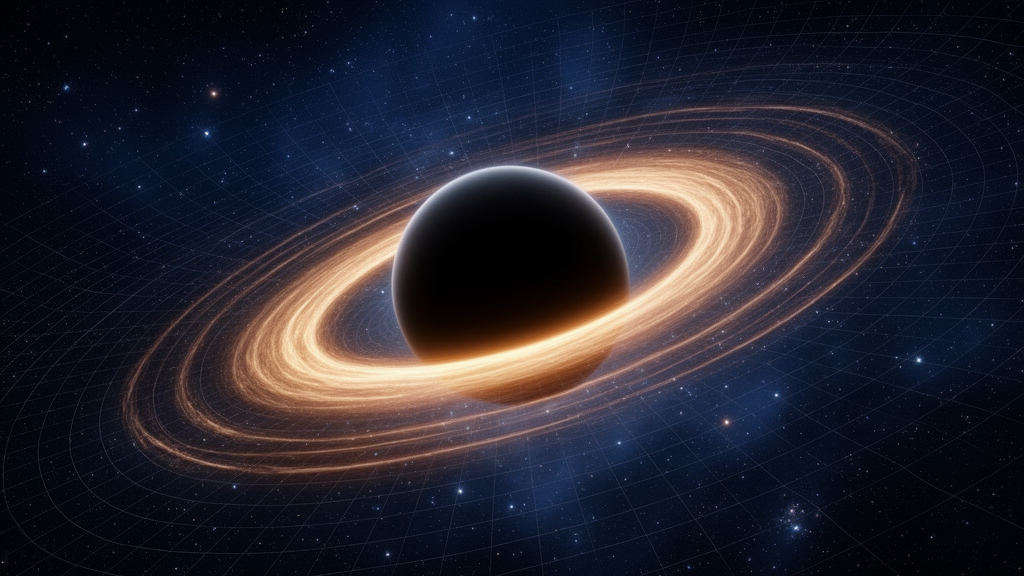
Black holes are the most extreme laboratories in the universe, and physicists are increasingly treating them as precision instruments for testing the foundations of gravity. In a new theoretical study published in The European Physical Journal C, Takamasa Kanai of the National Institute of Technology, Kochi College, has calculated exactly how hypothetical quantum-gravity-inspired corrections would alter the way charged black holes bend light and ring like bells. The work suggests that the faint, warped images produced by strongly lensing black holes could one day reveal physics operating beyond Einstein’s general relativity.
The framework at the heart of the study is effective field theory, or EFT, a systematic method physicists use to parametrize the low-energy fingerprints of unknown high-energy physics. Rather than replacing general relativity with a completely new theory, EFT adds a controlled series of higher-derivative correction terms to the familiar Einstein–Maxwell equations that describe gravity coupled to electromagnetism. Each correction carries a small coupling constant, and the whole expansion is controlled by a cutoff scale beyond which the theory breaks down. As long as the curvature of spacetime remains well below that cutoff, the corrections can be treated as small perturbations, even near a black hole’s photon sphere, the critical radius where light can orbit the hole before escaping or falling in.
A key technical achievement of the paper is the reduction of the bewildering zoo of possible four-derivative operators to just three independent interactions. Using integration by parts, Bianchi identities, and field redefinitions, Kanai shows that the four-dimensional Einstein–Maxwell EFT is fully parametrized by three couplings, denoted alpha, beta, and gamma, multiplying the operators built from the Maxwell field strength and the Riemann curvature tensor. The Gauss–Bonnet combination, which is topological in four dimensions, drops out entirely, as do operators proportional to the leading equations of motion. This minimal basis makes the analysis tractable and ensures that the predicted observables are genuinely independent quantities rather than artifacts of a redundant description.
Starting from the classical Reissner–Nordström solution, the unique static, electrically charged black hole of Einstein–Maxwell theory, Kanai solves the corrected field equations perturbatively to first order in the small EFT couplings. The result is a modified spacetime geometry in which the metric functions acquire small charge-dependent corrections. By carefully absorbing shifts in the total mass and charge into redefined physical parameters, the analysis isolates the genuine, nontrivial effects of the higher-derivative interactions. The corrected solution remains static and spherically symmetric, consistent with the uniqueness theorems for charged black holes, and agrees with earlier perturbative results in the literature.
With the corrected geometry in hand, the study turns to the photon surface, the timelike hypersurface on which every initially tangent light ray remains trapped in an unstable circular orbit. In static, spherically symmetric spacetimes this reduces to the familiar photon sphere, whose radius is found by setting the derivative of the ratio of the metric functions to zero. The EFT corrections shift this radius, and with it the critical impact parameter that separates light rays captured by the black hole from those that scatter back to infinity. Because the strong-lensing coefficients are determined locally by the geometry near the photon sphere, these shifts propagate directly into the observable bending of light.
The same unstable null orbits govern another celebrated black hole phenomenon: quasinormal modes, the characteristic damped oscillations that a perturbed black hole emits as gravitational waves. In the eikonal limit of large angular momentum, the real part of the quasinormal frequency is set by the angular velocity of the circular photon orbit, while the imaginary part is controlled by the Lyapunov exponent measuring the orbit’s instability. Kanai evaluates the corrected effective potential for a test scalar field at the shifted photon-sphere radius and derives explicit analytic corrections to both parts of the eikonal quasinormal spectrum. This tight correspondence means that gravitational-wave ringdowns and optical lensing probe the same underlying spacetime structure, offering two complementary windows onto the EFT couplings.
Gravitational lensing itself is analyzed in both the weak- and strong-field regimes. Far from the black hole, where light travels along nearly straight paths, the deflection angle receives corrections that scale as the inverse fourth and sixth powers of the distance of closest approach, entangled with subleading general-relativistic terms. These weak-field signatures are small and likely difficult to disentangle observationally. The situation changes dramatically near the photon sphere, where the deflection angle diverges logarithmically in the strong deflection limit formalism developed by Bozza. This logarithmic amplification can boost otherwise tiny EFT contributions, potentially bringing them within reach of high-precision observations of relativistic images and black hole shadows.
A particularly striking feature of the study is its unified treatment of two qualitatively different charge regimes. For near-extremal black holes, where the electric charge saturates the bound set by the mass, the enhanced symmetry of the near-horizon geometry amplifies the sensitivity to higher-derivative interactions, making extremal configurations ideal theoretical magnifying glasses for EFT effects. Weakly charged black holes, by contrast, behave more like their uncharged Schwarzschild cousins and admit a controlled expansion in the small charge, providing a direct comparison with well-understood results and a more astrophysically realistic scenario. Kanai derives the full analytic strong-deflection coefficients, including the logarithmic coefficient and the constant term, for both regimes, showing that the EFT corrections grow as the charge increases toward extremality.
The analysis is deliberately restricted to purely geometrical corrections, in which only the background spacetime metric is modified. In a complete EFT treatment, curvature–electromagnetic interactions also alter the propagation law of photons themselves, replacing the background null cones with an effective metric that depends on the photon’s polarization. This leads to phenomena such as gravitational birefringence, in which the two polarization modes effectively follow different trajectories and even different photon surfaces. Kanai outlines how such polarization-dependent corrections would shift the photon-sphere condition, the quasinormal frequencies, and the deflection angle, but a systematic treatment is left for future work, as is the extension to rotating black holes, which would greatly enhance the astrophysical relevance of the predictions.
The broader message is one of cautious optimism. The corrections computed here are perturbatively small, of the same order as the EFT couplings, and current observations cannot yet resolve them. But the Event Horizon Telescope’s images of M87* and Sagittarius A*, together with increasingly precise gravitational-wave detectors, are steadily sharpening humanity’s view of the strong-field regime. Because strong lensing observables, black hole shadows, and eikonal quasinormal modes all hinge on the geometry of unstable photon orbits, a coordinated observational program could eventually place real bounds on the higher-curvature couplings that encode quantum-gravity effects. If nature’s black holes carry even a whisper of charge, the light they bend may one day tell us what lies beyond Einstein.
Subject of Research: Effective field theory corrections to photon spheres, quasinormal modes, and gravitational lensing in Reissner–Nordström black holes
Article Title: Probing effective field theory corrections with quasinormal modes and gravitational lensing in Reissner–Nordström black holes
Article References: Kanai, T. (2026). Probing effective field theory corrections with quasinormal modes and gravitational lensing in Reissner–Nordström black holes. The European Physical Journal C, 86(9), Article 1075. https://doi.org/10.1140/epjc/s10052-026-16326-3
Image Credits: AI Generated
DOI: 10.1140/epjc/s10052-026-16326-3
Keywords: black holes, effective field theory, general relativity, gravitational lensing, quasinormal modes, photon sphere, Reissner–Nordström, higher-curvature corrections, Einstein–Maxwell theory, strong deflection limit, black hole shadows, theoretical physics
Cite Scienmag News
Grant Pearson. (October 10, 2026). How Charged Black Holes Could Reveal Hidden Corrections to Einstein’s Gravity. Scienmag. https://scienmag.com/how-charged-black-holes-could-reveal-hidden-corrections-to-einsteins-gravity/
Grant Pearson. "How Charged Black Holes Could Reveal Hidden Corrections to Einstein’s Gravity." Scienmag, 10 October 2026, https://scienmag.com/how-charged-black-holes-could-reveal-hidden-corrections-to-einsteins-gravity/. Accessed 10 October 2026.
Grant Pearson. "How Charged Black Holes Could Reveal Hidden Corrections to Einstein’s Gravity." Scienmag. October 10, 2026. https://scienmag.com/how-charged-black-holes-could-reveal-hidden-corrections-to-einsteins-gravity/


