


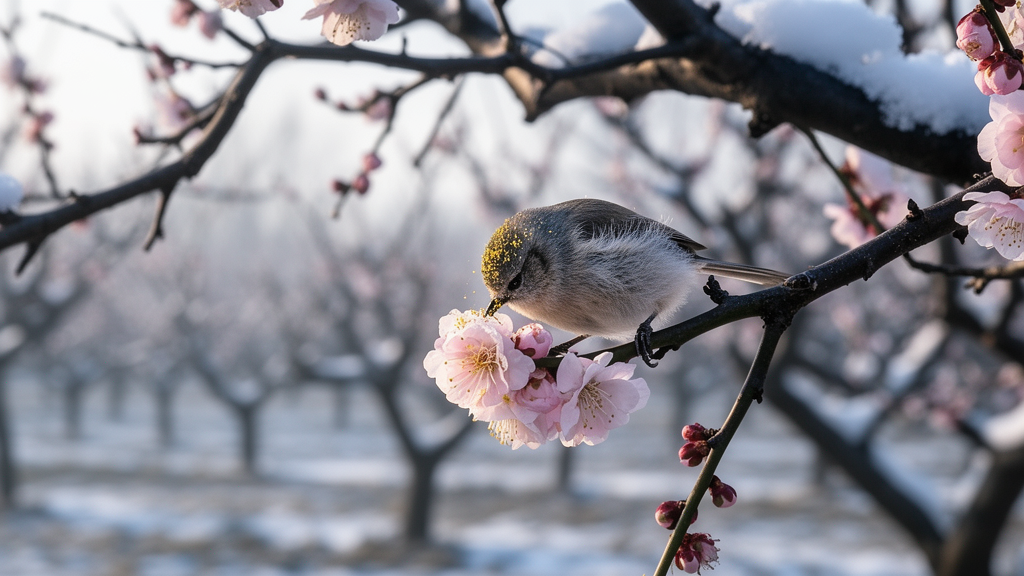
In the cold heart of winter, when most insects are dormant and the landscape lies in a state of suspended animation, the Chinese plum tree Prunus mume bursts into bloom. For more than three thousand years, this species has been cultivated in China for its delicate, fragrant flowers, celebrated in poetry and painting as a symbol of resilience. Yet the very trait that makes it culturally iconic—flowering in the depths of winter—has long posed a biological puzzle. If pollinating insects are scarce or inactive at low temperatures, how does the tree manage to reproduce at all? A new study published in BMC Plant Biology provides a striking answer: despite being visited frequently by honeybees, the plum tree owes roughly three-quarters of its fruit production to birds, making passerine pollinators the quantitative backbone of its reproductive success.
The research, led by Ying Wu, Yunjing Liu and colleagues at Guizhou Normal University, set out to resolve two intertwined questions that had remained open despite the species’ long history of cultivation. First, do the floral traits of P. mume show signs of adaptation to bird pollination, a syndrome known as ornithophily? Second, are birds merely occasional visitors, or do they provide pollination services that insects cannot replace? The answers carry significance well beyond a single ornamental species, because they extend the documented reach of bird pollination into temperate Asia and complement recent evidence that birds also pollinate Prunus species in temperate Europe—a region where bird pollination was long assumed to be essentially absent.
The study’s central finding is that P. mume operates a mixed bird–insect generalist pollination system, but one in which the two groups of visitors contribute very unequally to the bottom line of reproduction. Honeybees, the most frequent floral visitors, arrive far more often than any bird species. Yet when the researchers measured actual reproductive outcomes, birds—specifically sunbirds and bulbuls, representing both specialized and generalized flower-visiting avian guilds—turned out to be the quantitatively dominant pollinators. Together, the birds accounted for approximately 77 percent of fruit set. In other words, the insect that visits most often is not the pollinator that matters most, a discrepancy that illustrates why visitation frequency alone can be a misleading proxy for pollination effectiveness.
Why would birds outperform bees on a per-visit basis in this system? The answer lies in a suite of floral traits that the authors identify as collectively shaping the tree’s ecological dependence on endothermic, cold-tolerant pollinators. Winter flowering is the foundation: by blooming when ambient temperatures frequently fall below the activity thresholds of most insects, the tree enters a pollination market in which warm-blooded vertebrates hold a structural advantage. Birds maintain their body temperature internally and can forage in cold, damp, or windy conditions that ground insect pollinators entirely. When insect activity is thermally constrained, the only reliable vectors left in the ecosystem are the birds.
The floral morphology reinforces this winter strategy in several technically interesting ways. The flowers produce copious dilute nectar—a hallmark of bird-pollinated plants worldwide. Dilute nectar, with its relatively low sugar concentration, is characteristic of ornithophilous systems because birds, unlike many insects, need large volumes of water-rich nectar to meet their energetic and hydration demands; concentrated nectar typical of bee-pollinated flowers would be less attractive and less accessible to them. The sheer quantity of nectar available in P. mume flowers provides a reward substantial enough to justify a bird’s metabolic investment in visiting a tree that flowers during the leanest season of the year.
Anther architecture adds a further layer of adaptation. The study documents sequentially dehiscing, exserted anthers—stamens that extend beyond the floral envelope and release pollen in a staggered sequence rather than all at once. This arrangement has two consequences. Spatially, exserted anthers place pollen where a bird’s forehead and bill are likely to contact it as the animal probes for nectar, promoting pollen transfer between flowers. Temporally, sequential dehiscence spreads pollen release across the flowering period, ensuring that a single visit does not exhaust a flower’s pollen budget and that pollen remains available to successive visitors over many days, even in unpredictable winter weather. The researchers tracked this dynamic quantitatively, calculating the daily number of freshly dehisced anthers and the cumulative dehiscence across the flowering season to characterize how pollen availability unfolds through time.
The perigynous floral structure of P. mume—where the ovary sits within a floral cup with other floral parts arising around it—completes the functional picture, positioning reproductive structures in a geometry compatible with avian foraging. Taken together, winter flowering, abundant dilute nectar, sequentially dehiscing exserted anthers, and perigynous flowers constitute a coordinated trait package that the authors interpret as ecological adaptation to bird pollination, even though the tree does not exclude insects and honeybees do visit and transfer some pollen. The system is best described as generalist in its visitor assemblage but bird-dependent in its functional outcome.
Methodologically, the team combined observational visitor monitoring with pollinator-exclusion experiments, including cage exclusions that allowed the researchers to separate the contributions of birds and insects to fruit set. They analyzed nectar properties, documented anther dehiscence patterns, and employed chemical analytical techniques—high performance liquid chromatography and gas chromatography coupled with mass spectrometry—to characterize nectar composition and floral volatile organic compounds, the chemical signals that attract visitors. Breeding system assessments, including consideration of the gametophytic self-incompatibility system common in the Rosaceae, contextualized the importance of effective pollen transfer: a self-incompatible tree cannot fall back on self-fertilization, so the identity and efficiency of its pollinators directly determine how many seeds and fruits it produces. Statistical modeling with generalized linear models linked visitor categories to reproductive outcomes.
The biogeographical implications of the findings are considerable. Bird pollination has historically been regarded as a phenomenon of the tropics and subtropics, and of specialized habitats such as high-altitude ecosystems where cold and poor weather similarly favor endothermic pollinators. By demonstrating strong avian dependence in a winter-flowering tree of temperate Asia, this study widens the known ecological range of ornithophily and aligns with recent discoveries of bird pollination in European Prunus, suggesting that avian pollination in temperate-zone woody plants may be more widespread and underappreciated than the classical literature implies. The common thread is phenology: any temperate plant that flowers when insects are thermally constrained—whether in winter or at high elevation—may find in birds a pollination pathway that insects cannot supply.
The conservation message is equally pointed. Because sunbirds and bulbuls underwrite approximately 77 percent of fruit set, population declines in these passerine birds could directly threaten the reproductive success and long-term persistence of wild P. mume. Wild populations of this species are genetic resources for a crop lineage cultivated for millennia, and their regeneration depends on an animal partner that faces the same pressures afflicting birds globally: habitat loss, climate disruption, and seasonal food scarcity. The study thus reframes the conservation of a beloved flowering tree as inseparable from the conservation of its winter pollinators. It also offers a broader lesson for pollination science: in seasonal environments, the pollinators that matter most are not always the ones that visit most often, and protecting plant reproduction requires identifying the effective pollinators, not merely the frequent ones. For a tree that has bloomed through Chinese winters for three thousand years, the birds flitting among its branches turn out to be not incidental guests but essential partners in its survival.
Subject of Research: Bird pollination and reproductive ecology of the winter-flowering tree Prunus mume
Article Title: Avian pollination in a winter-flowering tree: Prunus mume depends on passerine birds for reproductive success
Article References: Avian pollination in a winter-flowering tree: Prunus mume depends on passerine birds for reproductive success. (n.d.). https://doi.org/10.1186/s12870-026-10106-7
Image Credits: AI Generated
DOI: 10.1186/s12870-026-10106-7
Keywords: Prunus mume, bird pollination, ornithophily, passerine birds, sunbirds, bulbuls, honeybees, winter flowering, floral traits, nectar, pollinator exclusion, reproductive success
Cite Scienmag News
Julie Wynn. (October 10, 2026). Winter-Blooming Plum Tree Relies on Birds, Not Bees, to Bear Fruit. Scienmag. https://scienmag.com/winter-blooming-plum-tree-relies-on-birds-not-bees-to-bear-fruit/
Julie Wynn. "Winter-Blooming Plum Tree Relies on Birds, Not Bees, to Bear Fruit." Scienmag, 10 October 2026, https://scienmag.com/winter-blooming-plum-tree-relies-on-birds-not-bees-to-bear-fruit/. Accessed 10 October 2026.
Julie Wynn. "Winter-Blooming Plum Tree Relies on Birds, Not Bees, to Bear Fruit." Scienmag. October 10, 2026. https://scienmag.com/winter-blooming-plum-tree-relies-on-birds-not-bees-to-bear-fruit/


