


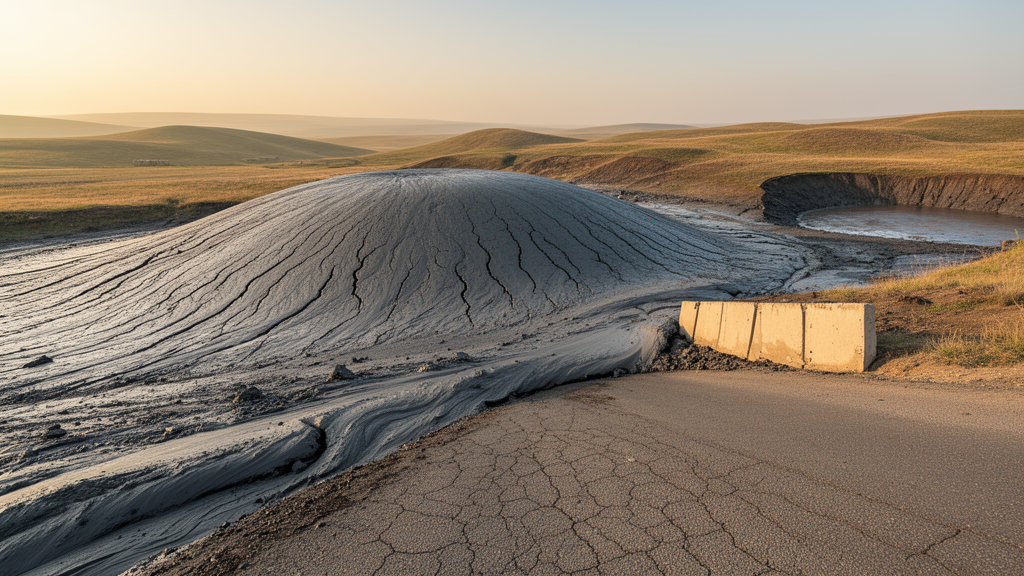
Azerbaijan’s Absheron Peninsula and the surrounding Caspian lowlands are home to the densest concentration of mud volcanoes on Earth, with more than 400 of these strange, bubbling edifices dotting the country, over 300 of them on land. For decades, geologists assumed that the kilometre-scale mud flows spilling from these volcanoes were the product of dramatic, short-lived eruptions, in which vast volumes of brecciated sediment were expelled in bursts analogous to copious lava flows from magmatic volcanoes. A new study published in Earth Surface Dynamics by Caroline Fenske, Petr Brož and Adriano Mazzini of the Institute of Geophysics of the Czech Academy of Sciences and partner institutions now upends that picture. By systematically combing through two decades of archived satellite imagery, the team found that nearly forty percent of the surveyed mud volcanoes are not merely erupting and then falling silent. Instead, their great mud flows are creeping slowly downslope, year after year, in a manner strikingly reminiscent of the motion of warm-based glaciers.
The investigation builds on a provocative reinterpretation of the Lokbatan mud volcano, one of Azerbaijan’s most active structures, where field observations, satellite data and radar interferometry had already suggested that the volcano’s kilometre-long flow did not form during single, high-volume eruptive events. Rather, the flow appears to advance gradually as newly erupted material accumulates around the crater, loading the older deposits and triggering slow gravitational sliding. In that model, two ingredients are essential: episodic mud effusion that increases the gravitational load on the flow, and a fluid-rich basal layer that lubricates the base of the moving mass. The mechanics are directly analogous to warm-based glaciers, where meltwater at the bed allows the ice to slide over its substrate. The question the new study set out to answer was whether this creeping behaviour is a local curiosity at Lokbatan or a widespread, previously overlooked process shaping mud volcanoes across the entire Caspian region.
To find out, the researchers compiled a database of 47 mud volcanoes in Azerbaijan from existing catalogues and then turned to the historical imagery function of Google Earth, which provides high-resolution satellite scenes stretching from 2004 to 2025. For each volcano, they compared the oldest clear image of the kilometre-sized flow with the most recent one, looking for detectable downslope displacement. Where movement was spotted, they downloaded every usable intermediate scene and constructed time-lapse animations that reveal the flows in motion. The team also extracted morphometric measurements, including edifice height, average slope and flow width, from elevation data derived from NASA’s Shuttle Radar Topography Mission, while tracking recognizable features within the flows to quantify total displacement. Field campaigns at Goturdag in 2022 and 2025 and at Durandag in 2025 then allowed them to walk the contact zones between moving flows and stable flanks, confirming with their own eyes what the satellites had shown.
The results were unambiguous. Nineteen of the 47 surveyed volcanoes, roughly forty percent, exhibit measurable creeping surface displacement of pre-existing mud flows, with rates ranging from a few metres to tens of metres per decade. The phenomenon is clearly not an isolated oddity. At Goturdag, the standout of the survey, deformation is continuous across the entire length of the flow, and the distal front advanced approximately 37 metres between 2004 and 2023, bulldozing the underlying substrate and forming a pronounced accretionary ridge at its terminus. Fieldwork there exposed a sharp boundary between the active flow and the stable flanks, with the sliding plane at their interface clearly visible. At Bozdaq Gobu, the flow shifted between 10 and 75 metres between 2009 and 2025 depending on position, while East Cheildag moved 7 to 24 metres between 2009 and 2023, West Shekikhan advanced 3 to 27 metres from 2008 to 2023, and Durandag crept 4 to 15 metres between 2014 and 2020.
Perhaps the most striking finding is how indiscriminate the process appears to be. Creeping motion was observed on slopes as gentle as two degrees and as steep as fifteen, and across every morphological class of mud volcano, from elongated and conical edifices to broad, plateau-like structures. That suggests creeping is not tied to a particular shape or gradient but is instead a general post-eruptive adjustment mechanism, one that can significantly influence the long-term evolution of kilometre-scale mud flows. For most of the volcanoes, the observed displacements could be linked to specific eruptive events, supporting the idea that eruptions act as the trigger: even minor releases of mud from the upper crater zones can reactivate old, apparently dormant flows, which then continue to move for months afterward as the added load drives slow basal sliding. A handful of structures, including Goturdag, Khamamdag and two of the West Cheildag complexes, deform continuously throughout the satellite record, hinting at ongoing extrusion and relentless basal motion.
The study also documents substantial variability in creeping velocities among individual volcanoes, which the authors attribute to a combination of factors: eruption frequency, slope inclination, mud viscosity and the volume of extruded breccia. The interplay of these variables likely explains why some flows respond vigorously to loading while others inch forward almost imperceptibly. In some cases, megablocks, large fragments of broken crater rims carried within the flows, obstruct and disrupt the otherwise homogeneous creeping motion. Intriguingly, the progressive downslope transport of these blocks, previously explained by massive eruption-driven rafting, can also be accounted for by the slower creeping mechanism the new study describes. And while pre-eruptive ground deformation had already been detected at mud volcanoes using satellite radar interferometry, this work demonstrates that significant post-eruptive deformation associated with flow creep is equally widespread around these structures.
Curiously, the phenomenon appears to be almost uniquely Azerbaijani. The researchers extended their survey to major mud volcano sites in Iran, Pakistan, Russia and beyond, and found no comparable behaviour, with a single exception: the Raznokol mud volcano in Russia, which exhibited creeping between 2017 and 2021. Why the Caspian region should be so special remains uncertain, but several factors may conspire in Azerbaijan’s favour. The country’s mud volcanoes are the largest on Earth, capable of generating long flows with enough mass to enhance gravitational propagation. Their positions and flow orientations are strongly controlled by underlying tectonic structures, particularly anticline axes, and many feature a single dominant crater rather than multiple aligned vents, which may concentrate how material is discharged. The Caspian mud breccia itself is typically heterogeneous, and the region’s weak meteoric erosion, compared with tropical settings, may preserve the flow morphologies that facilitate creeping. Dedicated studies will be needed to pin down the decisive factor.
Beyond its scientific novelty, the discovery carries a practical warning. Although most creeping flows occur far from inhabited areas, the team identified Bozdaq Gobu, located in a populated region near Baku, as a direct threat: renewed activity from smaller-scale eruptions over the past decade has produced house displacements observable in satellite imagery. At Lokbatan, ongoing flow movement is visibly deforming a pipeline built across what was assumed to be stable, dead terrain, a false assumption the authors say is common when engineering structures such as pipelines and power lines are routed across paleo-mud flows. Mud volcanoes in Azerbaijan can erupt without warning, as recent events at Lokbatan, Bozdag-Guzdek and Otman Bozdag in 2018 and 2025 have demonstrated, and the new findings show that significant ground movement does not require a major eruption at all. Even minor releases from upper crater zones can set old flows in motion, posing a risk to anything built in their path.
To lay the groundwork for future work, the team installed a simple in-situ monitoring setup in August 2025 at Durandag and Otman Bozdaq, two volcanoes with confirmed creeping activity, deploying wooden sticks in linear transects across the sliding planes of the flows. These markers will allow future research teams to independently refine surface displacement estimates over coming years. The authors emphasize that integrating satellite radar interferometry with in-situ measurements will be essential to quantify displacement rates with higher precision and to constrain the underlying mechanisms. The study also raises tantalizing questions beyond Earth: if creeping mud flows can shape kilometre-scale landforms on our own planet, similar processes might operate on other planetary bodies where mud volcanism has been proposed. For now, the message for Azerbaijan is clear. The country’s iconic mud volcanoes are not just explosive spectacles but slow, relentless movers of the landscape, and the terrain they blanket deserves far more respect, and far more monitoring, than it has received.
Subject of Research: Creeping mud flow dynamics at mud volcanoes in Azerbaijan
Article Title: Mud volcano dynamics in Azerbaijan: the overlooked role of creeping mud flows in landscape evolution
Article References: Mud volcano dynamics in Azerbaijan: the overlooked role of creeping mud flows in landscape evolution. (n.d.). https://doi.org/10.5194/esurf-14-433-2026
Image Credits: AI Generated
DOI: 10.5194/esurf-14-433-2026
Keywords: mud volcanoes, Azerbaijan, Caspian Basin, mud flows, creeping, glacier analog, satellite imagery, geohazard, landscape evolution, post-eruptive deformation, Lokbatan, infrastructure risk
Cite Scienmag News
Violet Maxwell. (October 9, 2026). Azerbaijan’s Mud Volcanoes Creep Like Glaciers, Reshaping Landscapes and Threatening Infrastructure. Scienmag. https://scienmag.com/azerbaijans-mud-volcanoes-creep-like-glaciers-reshaping-landscapes-and-threatening-infrastructure/
Violet Maxwell. "Azerbaijan’s Mud Volcanoes Creep Like Glaciers, Reshaping Landscapes and Threatening Infrastructure." Scienmag, 9 October 2026, https://scienmag.com/azerbaijans-mud-volcanoes-creep-like-glaciers-reshaping-landscapes-and-threatening-infrastructure/. Accessed 9 October 2026.
Violet Maxwell. "Azerbaijan’s Mud Volcanoes Creep Like Glaciers, Reshaping Landscapes and Threatening Infrastructure." Scienmag. October 9, 2026. https://scienmag.com/azerbaijans-mud-volcanoes-creep-like-glaciers-reshaping-landscapes-and-threatening-infrastructure/


