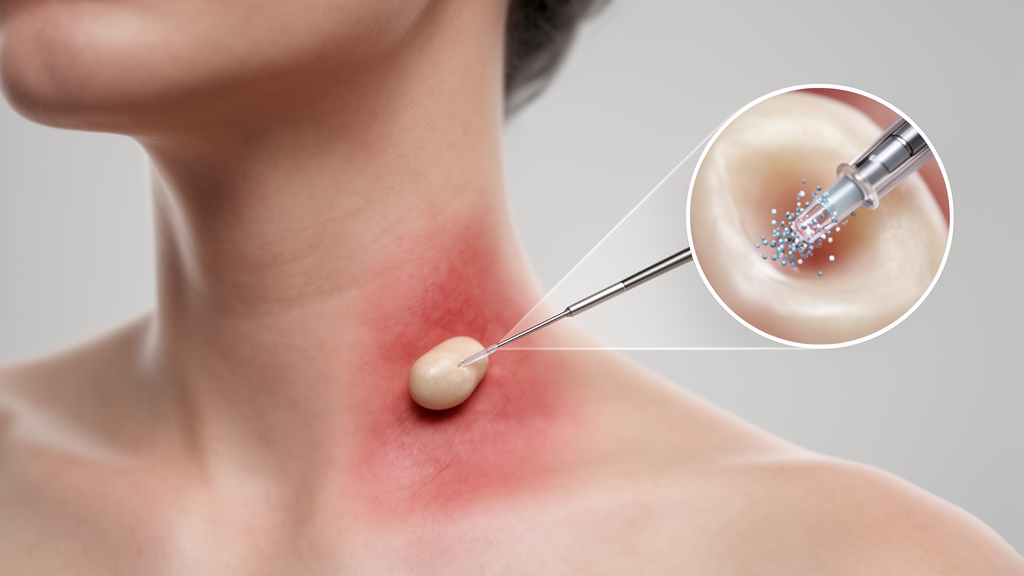
A device that began life as one of the oldest instruments in medicine, the acupuncture needle, has been re-engineered into a tool for one of its newest challenges: reading the molecular signatures of cancer spread without major surgery. In a study published online on July 25, 2026, in the journal iMetaMed, a research team led by Cui Baiping, Li Mingyu, Zhou Pingzhu, Cheow Lihfeng, Ma Hailong and Liu Dongdong described a modified acupuncture needle, dubbed His@PDA@Needle, that can sample DNA biomarkers directly from lymph nodes through a minimally invasive procedure. The work, published by the International Society for Health Data Science as a peer-reviewed release, positions the platform as a complement to conventional histopathology rather than a replacement for it, and it arrives at a moment when clinicians are increasingly hungry for molecular information that standard tissue examination cannot easily provide.
The scientific rationale behind the approach rests on a rethinking of where the most informative biomarkers in the body actually reside. Current clinical liquid biopsy approaches, in which fragments of tumor-derived DNA or other molecular signals are hunted in a patient’s bloodstream, have transformed oncology in recent years, but they face a persistent limitation: sensitivity. Tumor DNA shed into the blood can be heavily diluted across the roughly five liters of the circulating vascular compartment, and for many cancers, particularly at early stages or in regions of low tumor burden, the signal can fall below the detection threshold of even the most advanced sequencing and assay platforms. Blood, in other words, is a convenient but sometimes whisper-quiet medium for detecting the molecular echoes of a small metastatic deposit.
The research team argues that a far richer source of information lies in a compartment that liquid biopsy has largely ignored: the lymphatic system. Their reasoning draws on the Revised Starling Principle, the modern formulation of the physiological rules governing fluid exchange between blood vessels, tissues and the lymphatic circulation. Under this principle, lymphatic vessels, rather than venules and veins, absorb the majority of interstitial fluid in most tissues. That fluid, along with the proteins, cells and cell-free nucleic acids it carries, is funneled through lymphatic channels into regional lymph nodes, which act as biological filters and immunological processing stations. In practical terms, this means that molecules shed by tumor cells in a tissue are concentrated along a drainage route that terminates in a small, anatomically identifiable structure, the sentinel or regional lymph node, rather than dispersed throughout the entire bloodstream.
This anatomy makes lymphatic-derived biomarkers an attractive target for assessing metastatic risk. Lymph nodes are, after all, the first and most common destination for the spread of many solid tumors, including head and neck cancers, breast cancers and melanomas. A molecular readout obtained directly from a lymph node could, in principle, reveal the presence and character of metastatic cells far earlier and with far greater sensitivity than a blood test, because the analyte is collected at the point of concentration rather than after dilution. The catch has always been access. Lymph nodes are small, embedded in fatty and vascular tissue, and traditionally require surgical excision, or at minimum a core needle biopsy, to obtain material for analysis. Surgical sampling carries costs in operating time, anesthesia, scarring and, in the case of sentinel node procedures, the risk of lymphedema and other complications. The field has lacked a genuinely minimally invasive technique for reaching into a lymph node and retrieving molecular material without removing it.
His@PDA@Needle was designed to close that gap. The platform is built on a modified acupuncture needle, an instrument chosen for its extraordinary fineness, which allows it to be introduced into lymph node tissue with minimal disruption to surrounding structures. The modifications, indicated by the device’s name, involve surface functionalization of the needle with a histidine-based layer and polydopamine chemistry, an approach that equips the fine needle to capture and carry back DNA biomarkers from the lymph node microenvironment. Polydopamine coatings are widely used in biomedical engineering because they adhere robustly to diverse surfaces and can be further functionalized with ligands that bind specific molecular targets. By combining these materials on an acupuncture needle substrate, the team created a sampling device fine enough for minimally invasive insertion yet chemically tuned to harvest nucleic acid material suitable for downstream molecular profiling.
The performance of the platform was evaluated in two complementary settings. First, the researchers tested it in mouse footpad xenograft models, a well-established experimental system in which tumor cells are implanted in the footpad of a mouse and drain naturally to the popliteal lymph node, allowing lymphatic metastasis to be studied in a controlled setting. This model allowed the team to assess whether the modified needle could retrieve tumor-derived DNA from lymphatic tissue in a living organism. Second, and critically, the platform was applied to lymph node samples derived from patients with head and neck cancer, providing an initial window into how the technique might perform on human clinical material. The combination of an animal model and human tissue samples gave the study both a controlled proof of principle and a preliminary translational signal.
The most striking practical claim of the study concerns invasiveness. Compared with conventional lymph node biopsy, in which a node is surgically removed, the DNA sampling approach enabled by the modified needle is significantly less invasive. A fine needle insertion, closer in character to the fine-needle aspirations already familiar in oncology clinics than to an operating room procedure, could in principle be performed with far less tissue disruption, lower procedural burden and reduced risk of complications. For patients, that difference matters: less pain, faster recovery and a lower barrier to repeated sampling. For researchers and clinicians, it opens the possibility of serial molecular monitoring, sampling the same nodal basin at multiple time points during treatment to track how a tumor’s molecular profile evolves under therapy, something that is rarely feasible with excisional biopsy.
The authors are careful, and appropriately so, about the intended scope of the technology. His@PDA@Needle is presented as a molecular profiling tool designed to complement existing histopathological evaluations, not as a standalone instrument for direct clinical diagnosis. Histopathology, the microscopic examination of stained tissue sections by a pathologist, remains the gold standard for diagnosing lymph node metastasis, and it provides information, such as tissue architecture, cell morphology and the spatial relationships of tumor cells to lymphoid structures, that no molecular assay currently replicates. What a minimally invasive molecular sampling tool adds is a different layer of information: the genetic and epigenetic signatures of the material present in the node, which can reveal mutations, tumor lineage and other molecular features that inform prognosis and treatment selection. The two approaches are positioned as partners, with the needle offering a low-burden route to molecular data and pathology offering the definitive structural assessment.
The broader significance of the work lies in the paradigm it proposes. If lymphatic-derived biomarkers can be shown, in larger and more definitive studies, to outperform blood-based markers for detecting nodal metastasis, the entire architecture of liquid biopsy could shift. Instead of asking a blood draw to detect a signal that has been diluted across the whole circulation, clinicians could sample the lymphatic compartment directly, where tumor-derived molecules concentrate on their way through the nodes. The Revised Starling Principle provides the physiological foundation for this idea, and the modified acupuncture needle provides the first practical instrument for acting on it. The study was published under DOI 10.1002/imm3.70052, and the authors have disclosed that Dongdong Liu holds a patent related to the research, under application number 202510337544.5, with no other competing interests declared.
Much work remains before a modified acupuncture needle becomes a fixture in the cancer clinic. The validation reported to date is preliminary, and the technique will need to demonstrate its sensitivity, specificity and safety across larger patient cohorts, multiple cancer types and diverse clinical settings before it can influence diagnostic pathways. Questions about sampling adequacy, standardization of the coating chemistry, the molecular assays best paired with the harvested DNA, and the procedural training required will all need answers. But the conceptual advance is clear and consequential: the lymphatic system, long treated as a structural highway for cancer spread and a surgical target for staging, is now being reframed as a rich, accessible reservoir of molecular information. A needle fine enough to have served healers for millennia, re-engineered with modern materials chemistry, may be the instrument that finally opens that reservoir to molecular medicine.
Subject of Research: Minimally invasive lymph node sampling for cancer biomarker analysis using a surface-modified acupuncture needle
Article Title: New modified acupuncture needle enables minimally invasive lymph node sampling for molecular profiling
Article References: New modified acupuncture needle enables minimally invasive lymph node sampling for molecular profiling. (n.d.). Original publication
Image Credits: AI Generated
DOI: Not provided
Keywords: acupuncture needle, lymph node, liquid biopsy, molecular profiling, lymphatic system, Revised Starling Principle, DNA biomarkers, head and neck cancer, metastasis, minimally invasive, polydopamine coating, iMetaMed
Cite Scienmag News
Nathaniel Bowman. (October 9, 2026). Modified Acupuncture Needle Offers Minimally Invasive Route to Lymph Node Molecular Profiling. Scienmag. https://scienmag.com/modified-acupuncture-needle-offers-minimally-invasive-route-to-lymph-node-molecular-profiling/
Nathaniel Bowman. "Modified Acupuncture Needle Offers Minimally Invasive Route to Lymph Node Molecular Profiling." Scienmag, 9 October 2026, https://scienmag.com/modified-acupuncture-needle-offers-minimally-invasive-route-to-lymph-node-molecular-profiling/. Accessed 10 October 2026.
Nathaniel Bowman. "Modified Acupuncture Needle Offers Minimally Invasive Route to Lymph Node Molecular Profiling." Scienmag. October 9, 2026. https://scienmag.com/modified-acupuncture-needle-offers-minimally-invasive-route-to-lymph-node-molecular-profiling/