


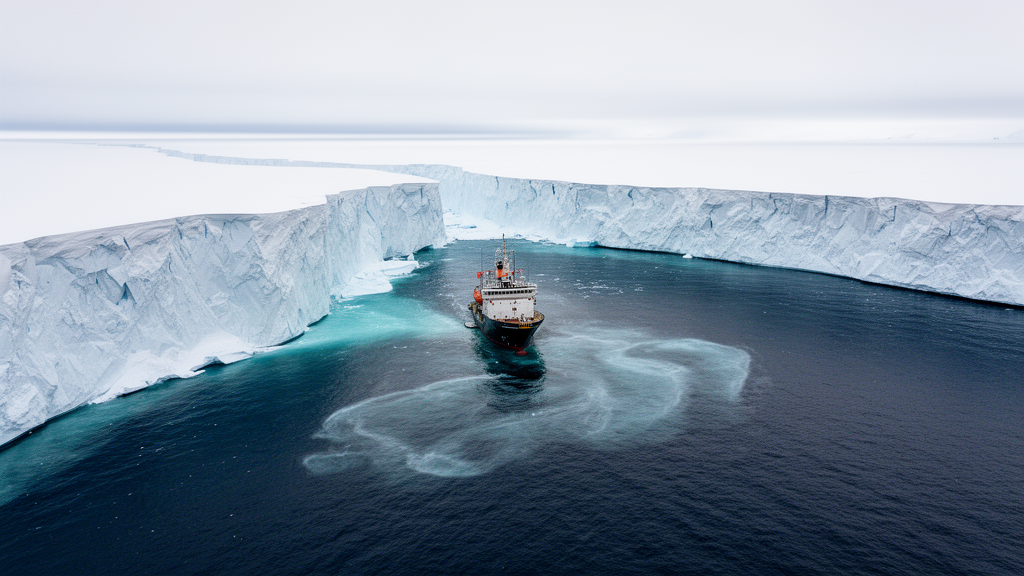
Two of the most feared tipping points in the climate system are the Atlantic Meridional Overturning Circulation, the great conveyor belt of ocean currents that carries heat northward across the equator, and the West Antarctic Ice Sheet, a marine-based ice mass whose collapse could raise global sea level by several meters. Scientists have long suspected that these two giants are connected: if the AMOC shuts down, the heat it no longer transports to the North Atlantic should pile up in the Southern Hemisphere, warming the waters that lap against Antarctic ice shelves and potentially triggering catastrophic melting. A new study published in Earth System Dynamics by Anna Höse of the Potsdam Institute for Climate Impact Research and colleagues now puts that assumption to a rigorous test, and the result is a genuine surprise. In a simulation spanning a full 1,500 years after an AMOC collapse, the Antarctic Ice Sheet did not destabilize at all.
The reason previous studies could not answer this question is technical as much as scientific. Most global climate models do not include an interactive Antarctic Ice Sheet; instead, they prescribe where and how much ice flows into the ocean, which means they cannot capture the slow, centennial-to-millennial feedbacks between ocean temperatures and ice dynamics. Höse and her team broke new ground by coupling the CM2Mc Earth system model, developed at the Geophysical Fluid Dynamics Laboratory and modified at Potsdam, to the Parallel Ice Sheet Model, or PISM, which simulates the entire Antarctic Ice Sheet at a horizontal resolution of 16 kilometers. The two models exchange information through the Potsdam Ice-shelf Cavity model, known as PICO, which calculates how fast ice melts from below based on the temperature and salinity of water entering 19 Antarctic drainage basins. Crucially, the meltwater and heat released by the ice sheet are fed back into the ocean model, closing the loop between the two components.
To force an AMOC collapse, the team followed the protocol of the North Atlantic Hosing Model Intercomparison Project, adding artificial freshwater at a rate of 0.3 Sverdrups, roughly 300,000 cubic meters per second, to the surface of the North Atlantic and Arctic Oceans. This deluge of freshwater stratifies the subpolar North Atlantic, suppressing the deep convection that drives the overturning circulation. Within 100 years, the simulated AMOC weakened from about 21.5 Sverdrups to just 5 Sverdrups, a state the researchers treat as a collapse. They then let the coupled model run for another 1,400 years, long enough for the deep ocean and the ice sheet to respond on their own sluggish timescales, while a parallel control run without freshwater forcing provided a baseline against which every anomaly could be measured.
The immediate consequences of the collapse matched what earlier modeling work had established. Northern Hemisphere surface temperatures dropped sharply, by up to 9 degrees Celsius over the North Atlantic, while the Southern Hemisphere warmed as the oceanic heat transport reversed its imbalance. The Intertropical Convergence Zone shifted southward, the mid-latitude westerly winds over the Southern Ocean strengthened, and the Antarctic Circumpolar Current intensified by roughly 20 Sverdrups. Heat accumulated in the subsurface South Atlantic north of 40 degrees south, exactly as the bipolar seesaw theory, developed to explain the antiphased temperature oscillations recorded in Greenland and Antarctic ice cores, would predict. On the surface, then, everything pointed toward trouble for Antarctica.
But the surface is not where the ice sheet lives. What matters for basal melting, the erosion of ice shelves from below, is the temperature of water at depths of 500 to 1,000 meters, near the cavities beneath floating ice. And here the simulation delivered its first counterintuitive finding: for the first eight centuries after the AMOC collapse, subsurface temperatures along most of the Antarctic margin did not warm at all. In fact, they cooled slightly, by around 0.15 degrees Celsius on average, because residual North Atlantic Deep Water, chilled by the collapsed overturning, was carried southward and upwelled near the continent before being swept around the coast by the Circumpolar Current. As a result, basal melt rates actually declined, by up to 100 gigatonnes per year in some periods, and the total Antarctic ice volume barely changed, remaining within the range of natural variability seen in the control run.
The story took another turn around model year 830, when the Southern Ocean underwent a dramatic regime shift. Deep convection, the vertical mixing of the water column, intensified in the Ross Sea and later spread to coastal regions east of the Weddell Sea, releasing centuries of accumulated heat from the deep ocean to the surface. Antarctic Bottom Water formation surged by more than 10 Sverdrups, maximum sea ice extent abruptly shrank by about 40 percent, and sea surface temperatures around the continent rose roughly four times more than they had in the immediate aftermath of the AMOC collapse. Yet paradoxically, this convective heat release cooled the subsurface waters at ice-shelf cavity depths, producing average negative temperature anomalies of 1.4 degrees Celsius along the continental slope. Basal melting dropped further, with a mean decline of 160 gigatonnes per year, and ice shelves grew thicker.
Herein lies the elegant compensating mechanism that kept the ice sheet stable. As reduced basal melting allowed the ice shelves to expand, their calving fronts extended into deeper water and became more prone to fracturing, so the calving flux increased by an average of 170 gigatonnes per year, almost exactly offsetting the reduction in melt. The net change in sea-level-rise potential after 1,500 years was a decrease of only about 2.5 centimeters, a trivial amount compared with the several meters locked in the West Antarctic Ice Sheet. The authors conclude that the widely assumed positive feedback, in which an AMOC shutdown destabilizes Antarctica through surface warming, is not supported when the full ocean-ice interaction is simulated: it is the subsurface temperature at cavity depths, not the sea surface temperature, that governs the ice sheet’s fate.
The researchers are careful to spell out the limitations of their approach. The coupling between the climate and ice-sheet models is restricted to the ocean-ice interface, so atmospheric changes over Antarctica, including warming of 0.5 to 5 degrees Celsius and increased coastal precipitation, were not transmitted to the ice sheet surface. The artificial freshwater hosing, maintained continuously for 1,500 years, freshened the global ocean without compensation, an amount of water roughly seven times the current freshwater flux from Greenland, and the coarse ocean model does not resolve the Antarctic continental shelf, so bottom water forms through open-ocean convection rather than shelf processes, a known bias shared by about 80 percent of CMIP6 models. The timing of the convective regime shift, and therefore of the subsurface cooling, may also be model-specific, and the authors emphasize that repeating the experiment with other coupled models is essential before general conclusions can be drawn.
Nevertheless, the study marks a milestone: the first freshwater hosing experiment ever conducted with an interactively coupled climate-ice sheet model capable of resolving the millennial response of Antarctica. Its message cuts both ways for the climate conversation. On one hand, it suggests that a collapsing AMOC would not, at least through the ocean pathway alone, immediately push the West Antarctic Ice Sheet over its tipping point, which previous work places at an oceanic warming of about 1.5 degrees Celsius above preindustrial levels. On the other hand, it warns that simple assumptions about tipping cascades, in which one tipping element triggers another through a single variable such as sea surface temperature, may be dangerously oversimplified in a system where deep convection can invert the sign of a temperature anomaly within a few centuries. As freshwater pours from Greenland and Antarctic ice shelves melt at accelerating rates, understanding these cross-hemispheric connections has never mattered more, and this first coupled glimpse suggests the true dynamics are far stranger than the seesaw metaphor implies.
Subject of Research: The impact of an AMOC collapse on the stability of the Antarctic Ice Sheet simulated with a coupled climate-ice sheet model
Article Title: Simulating the impact of an AMOC weakening on the Antarctic Ice Sheet using a coupled climate and ice-sheet model
Article References: Höse, A., Kreuzer, M., Huiskamp, W., Petri, S., & Feulner, G. (2026). Simulating the impact of an AMOC weakening on the Antarctic Ice Sheet using a coupled climate and ice-sheet model. Earth System Dynamics, 17(4), 1025-1059. https://doi.org/10.5194/esd-17-1025-2026
Image Credits: AI Generated
Keywords: AMOC, Antarctic Ice Sheet, climate tipping points, bipolar seesaw, Southern Ocean, ice sheet modeling, basal melt, Antarctic Bottom Water, deep convection, sea level rise, PISM, freshwater hosing
Cite Scienmag News
Violet Maxwell. (October 9, 2026). Ocean Current Collapse Surprisingly Fails to Destabilize Antarctic Ice Sheet in 1,500-Year Simulation. Scienmag. https://scienmag.com/ocean-current-collapse-surprisingly-fails-to-destabilize-antarctic-ice-sheet-in-1500-year-simulation/
Violet Maxwell. "Ocean Current Collapse Surprisingly Fails to Destabilize Antarctic Ice Sheet in 1,500-Year Simulation." Scienmag, 9 October 2026, https://scienmag.com/ocean-current-collapse-surprisingly-fails-to-destabilize-antarctic-ice-sheet-in-1500-year-simulation/. Accessed 9 October 2026.
Violet Maxwell. "Ocean Current Collapse Surprisingly Fails to Destabilize Antarctic Ice Sheet in 1,500-Year Simulation." Scienmag. October 9, 2026. https://scienmag.com/ocean-current-collapse-surprisingly-fails-to-destabilize-antarctic-ice-sheet-in-1500-year-simulation/


