


A quiet but consequential argument is unfolding in the pages of Nature Communications, and it concerns one of the most basic assumptions in the chemistry of solid-water interfaces: that a single, fixed number can stand in for the reactivity of an entire surface. In a Matters Arising reply published on 28 September 2026, a team of geochemists, chemists, and modelers led by Anastasia G. Ilgen of Sandia National Laboratories has defended a provocative proposal first laid out in their 2024 Perspective article. Their claim is that the equilibrium constants and rate constants at the heart of continuum-scale models should not be treated as fixed values at all, but as probability distributions that capture the true spatial and temporal variability of real surfaces. The reply responds directly to a comment by L. Criscenti and colleagues, and it doubles down on the idea that the field needs a paradigm shift in how it represents interfacial reactivity.
To understand why this matters, it helps to look at how surface chemistry is currently modeled. In surface complexation modeling, or SCM, the standard workhorse for describing ion adsorption at mineral-water interfaces, heterogeneity is handled by dividing a surface into distinct classes of reactive sites. Each site class is assigned its own fixed equilibrium constant or rate constant, and the probabilities attached to those classes reflect how common each type of site is on the surface. Classic formulations such as the constant capacitance model, the diffuse layer model, and the triple layer model all assume that the total free energy of ion adsorption is simply the sum of a chemical adsorption term and a Coulombic electrostatic term. More sophisticated frameworks, including the Double Diffuse Layer Model and the charge distribution CD-MUSIC model, can incorporate multiple site types, including high-affinity binding sites attributed to defects or impurities. But in all of these approaches, the chemical descriptors themselves remain single fixed numbers.
The Ilgen team argues that this is precisely where the conventional approach falls short. Their proposed probabilistic framework differs fundamentally by suggesting that the chemical descriptors, such as equilibrium constants and rate constants, should themselves be modeled as probability distribution functions rather than constants. The probabilities in existing multi-site models describe the likelihood of encountering each site type, not variability in the chemical properties of those sites. The distinction sounds subtle, but it changes what the model is capable of expressing. By retaining the full probability distribution at the continuum scale, rather than condensing it into a single averaged value, the framework aims to capture the complexity of heterogeneous and dynamic interfacial systems that a point value inevitably erases. The authors acknowledge that this concept has not yet been incorporated into existing modeling codes and remains largely unexplored in the literature, which is part of why the exchange with their critics has been so spirited.
The deeper issue, according to the reply, is a thermodynamic one. Standard reactive transport models describe equilibrium and kinetic processes using equations that assume well-mixed, homogeneous systems, where the chemical potential of a species can equalize across the domain. Equilibrium constants enter mass action equations to calculate species concentrations, and rate constants enter the rate laws that govern mineral dissolution. These constants are typically derived from laboratory measurements or thermodynamic relationships that presuppose uniformity. Real solid surfaces violate that assumption. Unlike gases or aqueous solutions, where equilibration of chemical potential can plausibly occur, mineral surfaces can vary compositionally and structurally at the atomic scale. Local environments and energetic contributions fluctuate from one location to another, producing variations in chemical potentials and reaction parameters even among sites that are nominally identical.
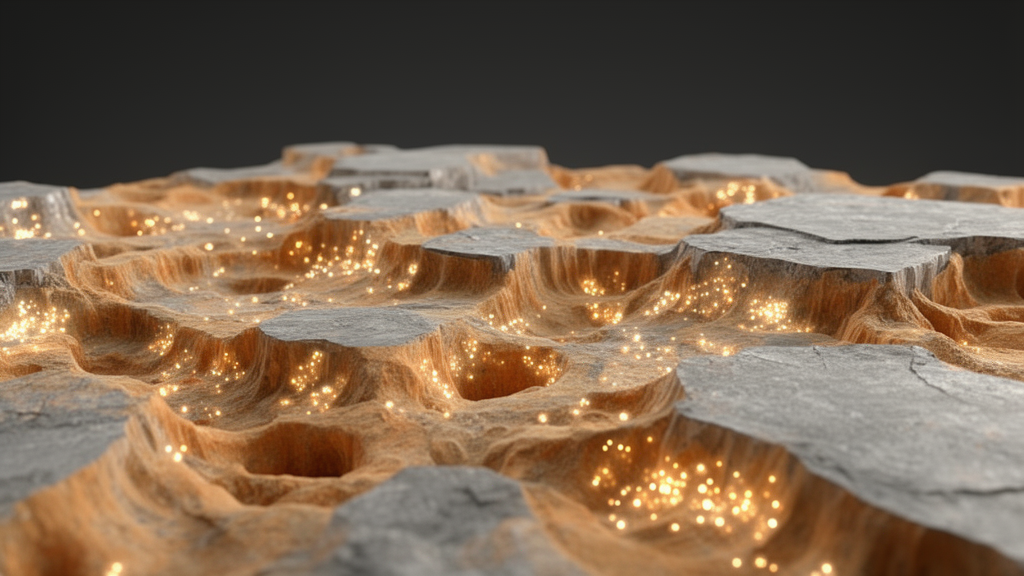
The evidence for this variability is concrete. Surface charge distributions on oxides have been shown to be heterogeneous, with individual sites dynamically flickering between neutral and protonated or deprotonated states. Spatially resolved measurements of calcite dissolution rates reveal Gaussian-like distributions of rates across a single crystal surface, with variability that persists over time and across different surface locations even when chemical conditions are held constant. If the well-mixed assumption held, those distributions would remain consistent in space and time. Instead, the observed spread indicates that the assumption breaks down. The authors frame the logic in terms of activation energies: when the distribution of activation energies across a surface is narrow, a single rate constant derived from it closely approximates the system’s behavior. But when the distribution is broad or multi-modal, or when spatial heterogeneity creates distinct domains with different local distributions, no single rate constant can capture the complexity. Atomic-scale defects, strain, impurities, and differences in the local molecular environment all conspire to produce a distribution of rate constants rather than a single value.
The team’s proposed remedy is to represent equilibrium constants and rate constants as time-dependent probability distribution functions that capture both spatial and temporal variability. A promising mathematical tool for this task, they argue, is the Fokker-Planck equation, a mainstay of statistical physics that describes how the probability density of a variable evolves under the combined influence of deterministic drift and stochastic fluctuations. Applied to interfacial chemistry, the equation could track the evolution of a chemical descriptor such as a surface site acidity constant, accounting for both systematic changes and random noise affecting surface properties. The approach has precedent elsewhere. In heterogeneous catalysis, probabilistic treatments based on Fokker-Planck theory have already been proposed to describe variations in binding energies between catalysts and reactants, and statistical treatments of distributed binding energies have been used to analyze the activity and durability of electrocatalysts.
Support for the probabilistic view also comes from reactive transport modeling itself. Recent work has shown that models incorporating surface morphology descriptors, such as surface slope as a proxy for kink site density, improve the accuracy of reactive transport simulations by linking local structural variability to distributions of activation energy. These developments suggest that the information needed to populate probabilistic descriptions already exists in experimental and computational datasets; what is missing is a modeling infrastructure designed to carry distributions through continuum-scale calculations rather than collapsing them at the parameterization stage. The authors are explicit that probability distributions may not be necessary for surfaces known to possess a single chemically active site, but they contend that such distributions provide a valuable framework for representing uncertainty and heterogeneity in the far more common case of complex, defective surfaces.
In responding to the specific critiques raised in the comment, the authors report that they find no major contradictions or inaccuracies between the comment and their own writing. They concede that chemical adsorption energies and Coulombic energies are often treated as constants in SCMs, but they point out that these values in reality vary with surface site type, coverage, solution composition, and pH. Their argument is that these variations should be represented as distributions rather than fixed constants, even for identical site types, because of local energetic fluctuations. On the question of ion pairing at surfaces, they acknowledge that current SCMs can consider adsorption products involving ion pairs, but they maintain that accurately predicting changes in ion pairing due to surface effects remains challenging. Surface-induced shifts in solvation properties alter the equilibrium constants for ion pairs, and these effects are not yet fully captured by existing models, a limitation that the authors say reinforces the need for probabilistic frameworks.
What emerges from the exchange is a vision of interdisciplinary collaboration as the enabling condition for this shift. The authors emphasize that progress will require expertise spanning chemistry, statistics, applied mathematics, computer science, artificial intelligence-enhanced data analysis, and engineering, all aimed at developing innovative tools that accurately capture the chemistry of solid-water interfaces in continuum models. That breadth is not accidental. Representing time-dependent distributions of chemical descriptors within reactive transport codes poses substantial numerical and statistical challenges, from sampling high-dimensional parameter spaces to propagating uncertainty through coupled reaction and transport equations. The payoff, however, could be transformative for a range of fields that depend on predictive models of fluid-solid interactions, including geochemistry, catalysis, chemical separations, corrosion science, and energy storage.
Whether the broader community embraces the probabilistic paradigm remains to be seen, but the stakes of the debate are easy to state. Continuum-scale models built on fixed constants inherit the limitations of the near-ideal, chemically homogeneous surfaces for which those assumptions were developed. As experimental techniques resolve ever finer details of surface structure and dynamics, the gap between what can be measured at the molecular scale and what can be represented at the continuum scale has widened. The reply by Ilgen and colleagues is an argument that closing this gap requires more than better parameters; it requires a different mathematical language, one in which variability is not an error term to be minimized but a fundamental property to be preserved. For anyone who cares about predicting how minerals dissolve, how contaminants bind, or how catalysts age, the outcome of this debate will shape the models they use for years to come.
Subject of Research: Probabilistic representation of interfacial reactivity in continuum-scale models of solid-water interfaces
Article Title: Reply to: Should we return to probability distributions to represent interfacial reactivity?
Article References: Ilgen, A. G., Borguet, E., Geiger, F. M., Gibbs, J. M., Grassian, V. H., Jun, Y.-S., Kabengi, N., & Kubicki, J. D. (2026). Reply to: Should we return to probability distributions to represent interfacial reactivity?. Nature Communications, 17(1), Article 10217. https://doi.org/10.1038/s41467-026-78021-x
Image Credits: AI Generated
DOI: 10.1038/s41467-026-78021-x
Keywords: interfacial reactivity, surface complexation modeling, reactive transport, probability distributions, mineral dissolution, calcite, Fokker-Planck equation, surface heterogeneity, geochemistry, chemical kinetics, heterogeneous catalysis, Nature Communications
Cite Scienmag News
Violet Maxwell. (October 9, 2026). Scientists Say a Single Number Cannot Describe How Reactivity Varies Across Mineral Surfaces. Scienmag. https://scienmag.com/scientists-say-a-single-number-cannot-describe-how-reactivity-varies-across-mineral-surfaces/
Violet Maxwell. "Scientists Say a Single Number Cannot Describe How Reactivity Varies Across Mineral Surfaces." Scienmag, 9 October 2026, https://scienmag.com/scientists-say-a-single-number-cannot-describe-how-reactivity-varies-across-mineral-surfaces/. Accessed 9 October 2026.
Violet Maxwell. "Scientists Say a Single Number Cannot Describe How Reactivity Varies Across Mineral Surfaces." Scienmag. October 9, 2026. https://scienmag.com/scientists-say-a-single-number-cannot-describe-how-reactivity-varies-across-mineral-surfaces/


