


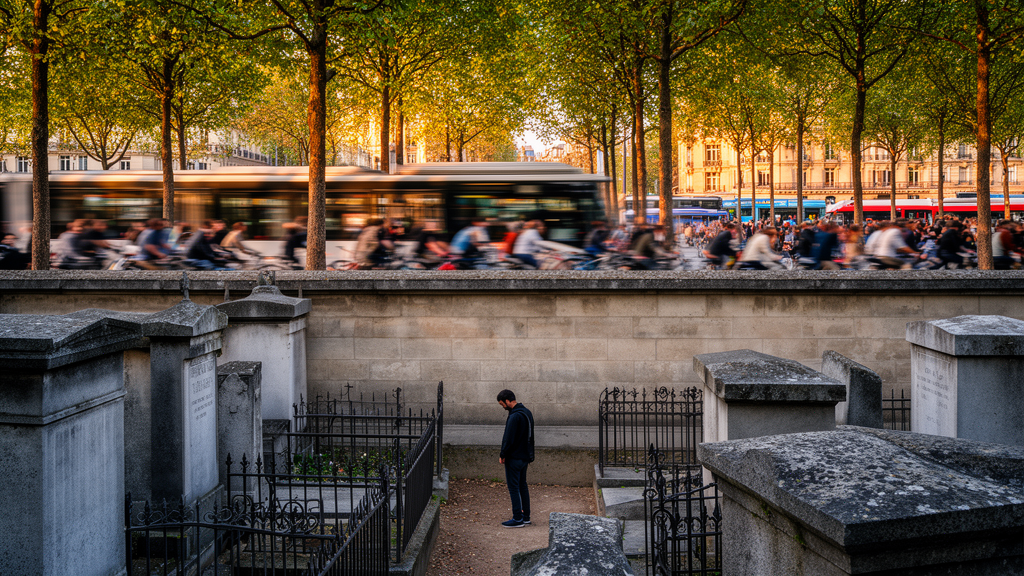
Urban cemeteries occupy a strange position in the modern city. They are legally expected to be places of silence, where mourners can grieve in peace and where the dead are guaranteed the dignity of quiet rest. Yet a new study of the Lyon metropolitan area in France reveals a striking contradiction: while local regulations go to remarkable lengths to forbid noise within cemetery walls, the cemeteries themselves have become surprisingly loud places, saturated with the traffic noise of the growing metropolis that surrounds them. The research, published in the journal Geographica Helvetica by geographer Louis Dall’Aglio of the ENS de Lyon, uses this tension between law and sound to ask a provocative question: does the contemporary city actually respect its dead?
The study approaches silence not merely as a measurement in decibels but as a social and legal construct. Since the composer and sound theorist R. Murray Schafer introduced the concept of the soundscape in 1977, geographers have recognized that what counts as silence varies enormously across space and time. A park can feel silent even with children playing, so long as those sounds are considered legitimate. Producing silence, in other words, is a selective activity: it requires deciding which sounds to erase and, by extension, controlling the people or things responsible for them. Cemeteries, as highly regulated spaces designed to connect the living with the absent dead, represent perhaps the purest example of this engineered quiet.
To understand how French law imagines the cemetery soundscape, Dall’Aglio collected 34 sets of local cemetery rules and regulations from municipalities across the Lyon metropolitan area, a territory of 58 municipalities and roughly 1.4 million inhabitants that contains 91 cemeteries. The documents, ranging from a single page to more than 60 pages, were analyzed both qualitatively and quantitatively. The findings were unambiguous. Twenty-five of the 34 documents explicitly forbid making noise, typically with formulaic language prohibiting visitors from screaming, shouting, singing, arguing, or holding loud conversations. Making noise turned out to be among the most heavily regulated behaviors in the entire corpus, outranking even eating and smoking, and second only to the ban on bringing dogs into the cemetery.
The regulation extends well beyond explicit sound bans. Twelve documents forbid meetings within the cemetery that have no connection to funerary matters, effectively silencing friendly or professional gatherings before they can become audible. One document optimistically prohibits disputes outright, while two produce singularly curious rules: one banning telephone alarms and another forbidding laughing. Professional workers face their own acoustic discipline. Stonecutting is forbidden in 17 documents, meaning monument companies must deliver finished gravestones rather than carve them on site. Machinery-heavy work is banned on weekends in 25 documents and on holidays in 27, particularly around All Saints Day. Twenty-five documents forbid driving within cemetery grounds except for funeral processions, removing the mechanical drone of vehicles from the sacred space.
Perhaps most revealing is what the rules permit. Twenty-two of the noise-prohibiting documents carve out an exception for funerary ceremonies, and several specifically allow music. But the framing of that music betrays an implicit religious heritage: one municipality permits no music except religious music, two allow only the recital of psalms, and another restricts singing to liturgic chants, wording strongly associated with Catholic practice. The study argues that this produces a lawscape populated by ghostly, implicitly Christian visitors engaged in solitary silent meditation, while excluding funerary traditions common elsewhere in the world, such as eating at gravesides or ritual dancing, practices that do occur in France on Buddhist graves. The overall principle, the author concludes, is the evacuation of the organic, the bodily, and the mundane from the cemetery soundscape.
But do these ambitious regulations actually produce silence? To answer this, Dall’Aglio turned to publicly available noise data collected by the local association Acoucités, which measured automobile and train noise across the metropolis using fixed and mobile sonometers in 2022. Averaging these measurements within cemetery polygons using GIS software yielded a sobering picture. The average traffic noise level inside Lyon’s cemeteries was 54 decibels, ranging from 41 to 71 decibels. For comparison, those levels correspond to soft music, a lively conversation, or a busy street. Far from being silent, many cemeteries are acoustically indistinguishable from ordinary urban space, and during rush hours the sound of traffic is essentially impossible to escape.
The geography of this noise is no accident, and it tells a two-century-old story. In the early 19th century, French municipalities were pushed by national authorities to relocate cemeteries out of city centers onto secluded, elevated terrain, driven by sanitary fears of miasmas emanating from the dead. This expulsion pushed cemeteries toward the urban margins, where they found themselves neighbors to other space-consuming infrastructure that was likewise relegated to the periphery: landfills, railway lines, and later highways. The pattern persists. The Guillotière cemetery opened a decade after the Lyon-Marseille railway lines beside it were completed. The Bron metropolitan cemetery, built in 1988, was conceived as a way to fill empty land near major roads. A beltway ramp in Villeurbanne was constructed on land originally intended as a cemetery extension. Meanwhile, the quietest cemeteries in the study are either in northern municipalities without major highways or on 19th-century hilltop sites chosen for their fresh air.
This gap between legal promise and acoustic reality leads the study to its most provocative argument. Under French law, the dead occupy a peculiar intermediate status: they are not persons, yet profaning a body is classified in the criminal code as harm to a person rather than harm to property. Since a 2008 law, the respect due to a human body does not cease with death, and violating a deceased person’s funeral instructions is a criminal offense. Yet despite this legal dignity, the dead cannot invoke it. They cannot file complaints, organize, or protest the highways built beside their graves. Drawing on Henri Lefebvre’s concept of the right to the city, the author argues that the dead, as a socially produced category, are deprived of that right in practice: they hold a right not to the city with its silent heterotopias, but merely to the urban, with its continuous flow of noise.
The comparison extends to other groups excluded from urban consideration. Following Christelle Chivallon’s notion of the in-human, beings excluded from humanity in ways that grant humans power over them, the study suggests that noise pollution, like any other form of waste produced by the metropolitan metabolism, is poured into spaces inhabited by those considered lesser citizens or lesser beings. The dead are presumed insensitive, unable to hear or suffer, a sentiment the researcher encountered half-jokingly in conversations with visitors. And because the dead cannot speak, they become prime targets for political instrumentalization: advocates and cemetery managers routinely claim to speak on their behalf, making it difficult to distinguish genuine defense of the dead’s right to rest from political leverage. As Achille Mbembe’s concept of necropolitics implies, the problem is not that the dead are treated like a marginalized group, but that some marginalized groups are treated as if they were already dead.
The study’s conclusion is deliberately exploratory but methodologically suggestive. The failure of cemetery regulations to produce silence says less about the inefficiency of local law than about its virtual nature: rules always require spatial actualization, and the dead cannot perform that work themselves. The changing soundscape is driven primarily by the growing entanglement of cemeteries with the urban fabric, not by any deliberate policy of noise. How to resolve the contradiction between an inherited legal and spiritual order and a contemporary urban and technical order is, the author insists, fundamentally a political question. More broadly, the work proposes that mapping noise pollution, like mapping any urban flow, can reveal geographies of power and relegation, offering geographers a new way to listen to inequality in the city.
Subject of Research: Noise pollution and the legal production of silence in French urban cemeteries
Article Title: When the city wakes the dead – silence, noise pollution, and politics within the contemporary French cemetery
Article References: Dall'Aglio, L. (2026). When the city wakes the dead – silence, noise pollution, and politics within the contemporary French cemetery. Geographica Helvetica, 81(3), 361-373. https://doi.org/10.5194/gh-81-361-2026
Image Credits: AI Generated
Keywords: cemeteries, noise pollution, soundscape, legal geography, urban planning, silence, Lyon, right to the city, necropolitics, traffic noise, death studies, France
Cite Scienmag News
Violet Maxwell. (October 9, 2026). French Cemeteries Promise Silence but the City Refuses to Keep Quiet. Scienmag. https://scienmag.com/french-cemeteries-promise-silence-but-the-city-refuses-to-keep-quiet/
Violet Maxwell. "French Cemeteries Promise Silence but the City Refuses to Keep Quiet." Scienmag, 9 October 2026, https://scienmag.com/french-cemeteries-promise-silence-but-the-city-refuses-to-keep-quiet/. Accessed 9 October 2026.
Violet Maxwell. "French Cemeteries Promise Silence but the City Refuses to Keep Quiet." Scienmag. October 9, 2026. https://scienmag.com/french-cemeteries-promise-silence-but-the-city-refuses-to-keep-quiet/


