


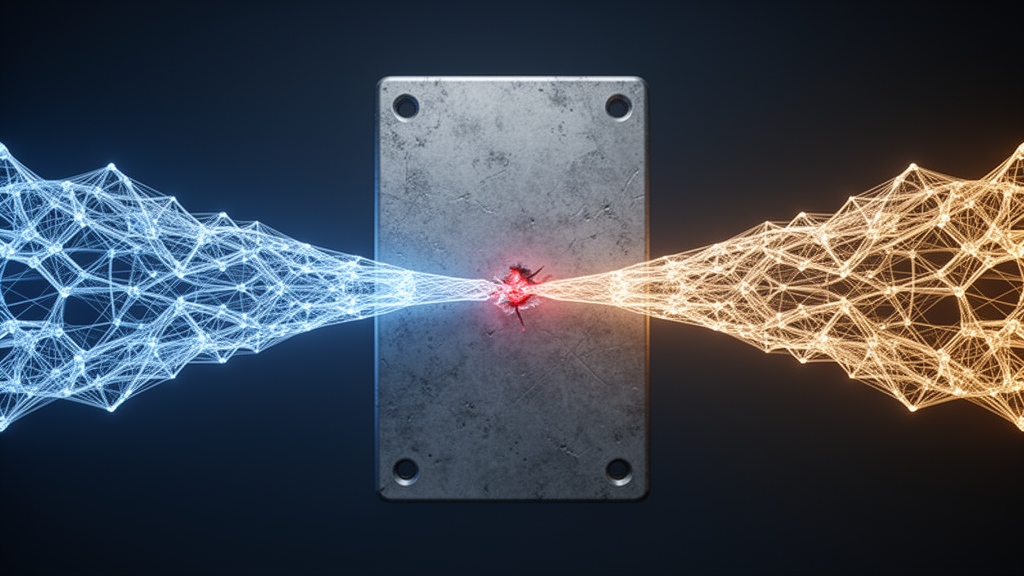
Factories, hospitals, and self-driving cars all share a stubborn problem: they need to recognize when something looks wrong, even though nobody has ever shown the system exactly what wrong looks like. Labeled examples of defects are scarce, expensive, and sometimes impossible to collect, which is why unsupervised visual anomaly detection has become one of the most actively pursued goals in applied computer vision. A new study published in Applied Intelligence by researchers at the Intelligent Perception Lab of Shiv Nadar University in Chennai, India, tackles this challenge with a dual-path neural architecture that reconstructs images in two fundamentally different ways and compares the results. The approach, called RGAE+PNNR, combines a Residual Gated AutoEncoder with a Patchwise Nearest Neighbor Reconstruction module, and it delivers improved detection and localization accuracy on two of the field’s most demanding benchmarks.
The core insight behind the work is that existing reconstruction-based anomaly detectors tend to sacrifice one kind of fidelity for another. When a model is trained to reproduce normal images, it must capture both the global semantic structure of a scene and the fine local texture of its surfaces. Networks that excel at global consistency often produce blurred reconstructions in which subtle defects are smoothed away, while networks tuned for local detail can lose track of the overall arrangement of objects and misinterpret normal variation as abnormal. This trade-off between semantic coherence and texture fidelity has been a persistent bottleneck, and it directly limits how precisely a system can localize an anomaly down to individual pixels.
The Residual Gated AutoEncoder addresses the global side of this problem. Built on top of features extracted by DINOv2, a powerful self-supervised vision transformer pretrained on massive image collections, the autoencoder learns to reconstruct the semantic essence of normal images. Its distinguishing feature is a gating mechanism that controls how information flows through residual connections inside the network. Rather than letting every feature propagate indiscriminately, the gates suppress redundant signals while preserving fine details, which keeps the reconstruction sharp where it matters. The result is a global reconstruction pathway that maintains the identity and layout of objects without washing out the small cues that often betray a defect.
In parallel, the Patchwise Nearest Neighbor Reconstruction module takes a deliberately different route. Instead of learning to generate an image, it retrieves. The researchers first build a memory bank of local feature patches extracted exclusively from normal training samples. When a new image arrives, PNNR reconstructs each local patch by finding its nearest neighbors in this memory bank and assembling a reconstruction from the retrieved pieces. Because the memory bank contains only normal material, any patch that cannot be matched well, for instance a scratch on a metal surface or a crack in a circuit board, will be reconstructed poorly. This retrieval-based strategy preserves fine-grained local structure with a fidelity that learned generators struggle to match.
The final anomaly map emerges from the disagreement between the two pathways. The system computes pixel-wise discrepancies between the output of the Residual Gated AutoEncoder and the output of the PNNR module, producing a spatial map of where the two reconstructions diverge. Because the two modules fail in complementary ways, their disagreement is informative: regions that look anomalous to one pathway but not the other, or to both, can be flagged with high confidence. The authors emphasize that this comparison yields interpretable localization, meaning a human inspector can see exactly which pixels drove the decision rather than receiving an opaque score for the whole image.
The entire framework rests on DINOv2 features, and that choice matters. DINOv2 was trained without labels using self-supervised objectives, and it produces visual representations that transfer remarkably well across domains. By anchoring both reconstruction pathways to these pretrained features, RGAE+PNNR avoids training a full vision backbone from scratch, which reduces data requirements and helps the system generalize. The authors report that the architecture generalizes effectively across diverse domains, from the complex real-world industrial scenes of the VisA dataset to the controlled object surfaces of MVTec AD, two benchmarks that stress very different aspects of visual appearance.
Extensive experiments on both benchmarks showed that the proposed architecture achieves improved image-level and pixel-level AUROC scores compared to state-of-the-art methods. The area under the receiver operating characteristic curve is the standard yardstick in this field: the image-level metric measures whether a whole picture is correctly judged normal or defective, while the pixel-level metric measures whether the defect is localized accurately within it. Achieving gains on both simultaneously is notable, because methods that boost whole-image classification often do so at the expense of precise segmentation, and vice versa. The dual-path design appears to sidestep that compromise by letting each pathway specialize in the regime where it is strongest.
The study situates itself within a rapidly evolving landscape. Earlier approaches such as PaDiM modeled the statistical distribution of patch features, while PatchCore pushed memory-bank nearest-neighbor ideas toward total recall on industrial data. More recent systems have explored normalizing flows with FastFlow, efficient millisecond-level inference with EfficientAD, and transformer-based designs such as Dinomaly, which applies a less-is-more philosophy to multi-class detection. Other lines of work have incorporated vision-language models like CLIP for zero-shot detection, and dual memory banks for real-world conditions. RGAE+PNNR draws on the memory-bank tradition through its PNNR module but pairs it with a learned global reconstructor, a combination the authors argue resolves the semantic-versus-texture tension more cleanly than either strategy alone.
The practical implications extend well beyond leaderboard numbers. In industrial inspection, unsupervised detectors allow manufacturers to spot defects on production lines without curating large defect libraries for every product, a requirement that has historically made automated quality control brittle and costly. In medical imaging, where pathological examples are rare and privacy constraints limit data sharing, a system that learns only from normal anatomy could flag tumors, lesions, or tissue irregularities without ever being told what they look like. In autonomous perception, vehicles encounter novel hazards constantly, and a detector that notices when the world deviates from its learned notion of normal could serve as an early-warning layer. The interpretable anomaly maps produced by this framework are especially valuable in these settings, because operators need to trust and verify machine judgments before acting on them.
The researchers have released their code publicly on GitHub, and both evaluation datasets, MVTec AD and VisA, are freely available, which lowers the barrier for other teams to reproduce, scrutinize, and extend the results. The work, authored by Nighil Natarajan, Nithilan M, Raghav Sridharan, and Chandrakala S, who contributed equally, reflects a broader trend in machine intelligence: rather than building ever-larger monolithic models, researchers are increasingly composing specialized modules whose complementary strengths can be exploited systematically. By teaching one network to remember what normal looks like globally and another to retrieve what normal looks like locally, and then listening to where the two disagree, the Chennai team offers a template that could shape anomaly detection systems well beyond the factory floor. As machines are asked to watch over more of the physical world, methods that make their judgments both accurate and explainable will only grow in importance.
Subject of Research: Unsupervised visual anomaly detection using a dual-path reconstruction architecture built on DINOv2 features
Article Title: Residual gated AutoEncoder with patchwise nearest neighbor reconstruction for visual anomaly detection
Article References: Natarajan, N., M, N., Sridharan, R., & S, C. (2026). Residual gated AutoEncoder with patchwise nearest neighbor reconstruction for visual anomaly detection. Applied Intelligence, 56(15), Article 484. https://doi.org/10.1007/s10489-026-07530-5
Image Credits: AI Generated
DOI: 10.1007/s10489-026-07530-5
Keywords: visual anomaly detection, unsupervised learning, autoencoder, DINOv2, nearest-neighbor reconstruction, computer vision, industrial inspection, MVTec AD, VisA, AUROC, anomaly localization, self-supervised learning
Cite Scienmag News
Denise Maddox. (October 9, 2026). Dual-Path AI Spots Defects by Reconstructing Images Two Ways at Once. Scienmag. https://scienmag.com/dual-path-ai-spots-defects-by-reconstructing-images-two-ways-at-once/
Denise Maddox. "Dual-Path AI Spots Defects by Reconstructing Images Two Ways at Once." Scienmag, 9 October 2026, https://scienmag.com/dual-path-ai-spots-defects-by-reconstructing-images-two-ways-at-once/. Accessed 9 October 2026.
Denise Maddox. "Dual-Path AI Spots Defects by Reconstructing Images Two Ways at Once." Scienmag. October 9, 2026. https://scienmag.com/dual-path-ai-spots-defects-by-reconstructing-images-two-ways-at-once/


