


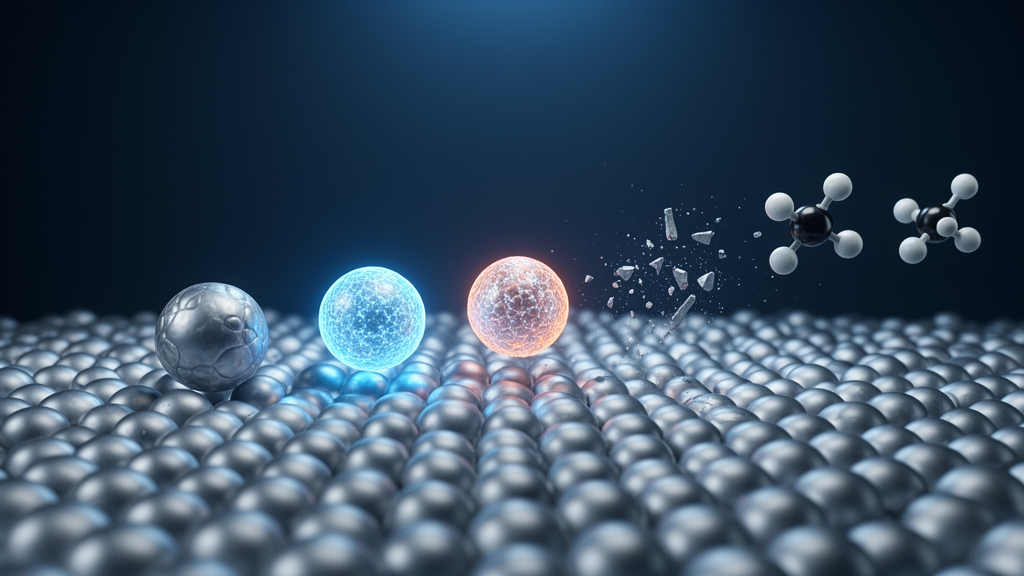
Methane, the principal component of natural gas, is one of the most abundant carbon resources on the planet, yet chemists have struggled for decades to transform it efficiently into more useful products. A research team in Japan now reports a catalyst design that may finally shift the balance. Scientists at Institute of Science Tokyo, working with a colleague at The University of Tokyo, have created a high-entropy lanthanoid oxide that converts methane into ethane and ethylene at temperatures far below those demanded by conventional systems, while maintaining its performance over days of continuous operation. The study, published online in the Journal of the American Chemical Society on October 8, 2026, offers a rare combination of low-temperature activity, product selectivity, and long-term durability in a reaction that has long resisted all three at once.
The reaction in question, oxidative coupling of methane, or OCM, directly converts methane and oxygen into higher-value C2 hydrocarbons, namely ethane and ethylene. These molecules are foundational feedstocks for the chemical industry, serving as precursors to plastics, solvents, and countless other materials. In principle, OCM could allow producers to bypass the energy-intensive indirect route, in which natural gas is first converted to synthesis gas and then rebuilt into longer hydrocarbons. In practice, however, the reaction has proven notoriously difficult to control, and no industrial process based on direct oxidative coupling has achieved widespread commercial adoption.
The difficulty stems from two intertwined problems. First, the carbon–hydrogen bonds in methane are exceptionally stable, making the molecule reluctant to react at moderate temperatures; substantial energy input is needed to activate it. Second, and more troubling, the desired products are more reactive than methane itself. Once ethane and ethylene form, they are readily attacked further by oxygen, over-oxidizing to carbon oxides and destroying the selectivity that any viable process requires. Conventional OCM catalysts therefore operate near 800 degrees Celsius to achieve acceptable conversion, and even then they tend to deactivate substantially during prolonged operation, as their active surface sites degrade or their crystal structures transform under the harsh reaction conditions.
The Science Tokyo team, led by Professor Keigo Kamata of the Materials and Structures Laboratory in the Institute of Integrated Research, together with Assistant Professor Keiju Wachi of the Department of Applied Chemistry at the Graduate School of Engineering, The University of Tokyo, approached the problem through the emerging field of high-entropy oxides. These are materials in which five or more metallic elements are incorporated into a single common crystal structure, producing a chemically disordered but structurally stable lattice. The entropic stabilization inherent to such compositions can lock in crystal phases that would otherwise collapse, and the mixing of elements creates a dense landscape of tunable surface sites whose properties can be adjusted by changing the elemental recipe.
To find the right recipe, the researchers undertook a broad compositional screen, testing 55 high-entropy oxide compositions that spanned five different crystal structures and 24 elements. According to Kamata, the screening showed that lanthanoid-containing systems emerged as promising candidates, with C-type rare-earth high-entropy oxides combining relatively high C2 yields with structural stability. The lanthanoids, a family of chemically similar rare-earth elements, are attractive for this purpose because they share crystal chemistry that allows them to substitute for one another freely, while their ionic radii vary systematically across the series, providing a built-in dial for tuning surface properties.
Seven of the screened compositions were synthesized as nanoparticle catalysts using a sol–gel method developed in-house. Amorphous precursors prepared from metal acetates and aspartic acid were calcined at 750 to 800 degrees Celsius, yielding oxides in which five elements were homogeneously integrated into a single phase. Further screening singled out one composition, designated HEO-2, as a representative catalyst for detailed study. HEO-2 combines lanthanum, samarium, europium, gadolinium, and dysprosium in the formula (LaSmEuGdDy)0.4O3, adopting the C-type rare-earth oxide structure that had proven most resilient in the initial tests.
The catalytic results were striking. HEO-2 initiated the formation of C2 hydrocarbons at just 525 degrees Celsius, a significantly lower onset temperature than previously investigated OCM catalysts, and at 600 degrees Celsius it reached a C2 yield of 12.3 percent. The team traced this low-temperature activity to the catalyst’s surface basicity. Their analysis revealed a subtle but crucial point: moderately basic sites, rather than the strongest basic sites, are the most favorable for oxidative coupling. Excessively strong basicity promotes over-oxidation of the desired C2 products or binds carbon dioxide too tightly, both of which erode performance. The sweet spot lies in the middle of the basicity range.
What makes the finding especially valuable is that the researchers discovered surface basicity can be systematically tuned through the average ionic radius of the constituent lanthanoid elements, giving chemists a rational design parameter rather than a trial-and-error search. HEO-2, with an average ionic radius of 0.957 angstroms, exhibited carbon dioxide desorption predominantly in the 300 to 400 degrees Celsius range, a signature of the moderately basic sites that proved most effective for C2 production. The high-entropy configuration itself also appears to stabilize these active surface functionalities, anchoring them against the degradation that plagues simpler materials.
That stabilization was most evident in long-term testing. At 600 degrees Celsius, HEO-2 maintained its C2 yield after 240 hours of continuous operation, essentially unchanged from its initial performance. Its calculated deactivation rate of 1.0 millimole of carbon per gram of catalyst per hour squared was more than 25 times lower than those of the corresponding single oxides. Surface analysis showed that the moderately basic sites were substantially preserved after the reaction, and the catalyst retained its C-type polycrystalline framework throughout. In contrast, the single oxides either underwent structural transformation or progressively lost their active basic sites, illustrating precisely the failure modes that high-entropy mixing appears to suppress.
Beyond the immediate performance gains, the study establishes a design principle that could extend well beyond methane conversion. By identifying the average ionic radius as a descriptor for surface basicity, the researchers provide a framework for engineering selective oxidation catalysts that operate at lower temperatures with sustained activity, a goal relevant to many industrial processes that currently demand extreme conditions. As Kamata concluded, the work offers a rational foundation for designing such catalysts. If the approach can be scaled from laboratory nanoparticles to industrial reactors, the direct conversion of abundant natural gas into ethylene and ethane could move closer to commercial reality, with significant implications for energy efficiency and the carbon footprint of the chemical industry.
Subject of Research: High-entropy lanthanoid oxide catalysts for low-temperature oxidative coupling of methane
Article Title: High-entropy lanthanoid oxide catalyst enables low-temperature oxidative coupling of methane
Article References: High-entropy lanthanoid oxide catalyst enables low-temperature oxidative coupling of methane. (n.d.). Original publication
Image Credits: AI Generated
DOI: Not provided
Keywords: oxidative coupling of methane, high-entropy oxide, lanthanoid, catalysis, C2 hydrocarbons, ethylene, ethane, surface basicity, sol-gel method, methane conversion, heterogeneous catalysis, selective oxidation
Cite Scienmag News
Bethany Barker. (October 9, 2026). Five-Element Lanthanoid Catalyst Cracks Methane Conversion at Record-Low Temperatures. Scienmag. https://scienmag.com/five-element-lanthanoid-catalyst-cracks-methane-conversion-at-record-low-temperatures/
Bethany Barker. "Five-Element Lanthanoid Catalyst Cracks Methane Conversion at Record-Low Temperatures." Scienmag, 9 October 2026, https://scienmag.com/five-element-lanthanoid-catalyst-cracks-methane-conversion-at-record-low-temperatures/. Accessed 9 October 2026.
Bethany Barker. "Five-Element Lanthanoid Catalyst Cracks Methane Conversion at Record-Low Temperatures." Scienmag. October 9, 2026. https://scienmag.com/five-element-lanthanoid-catalyst-cracks-methane-conversion-at-record-low-temperatures/


