


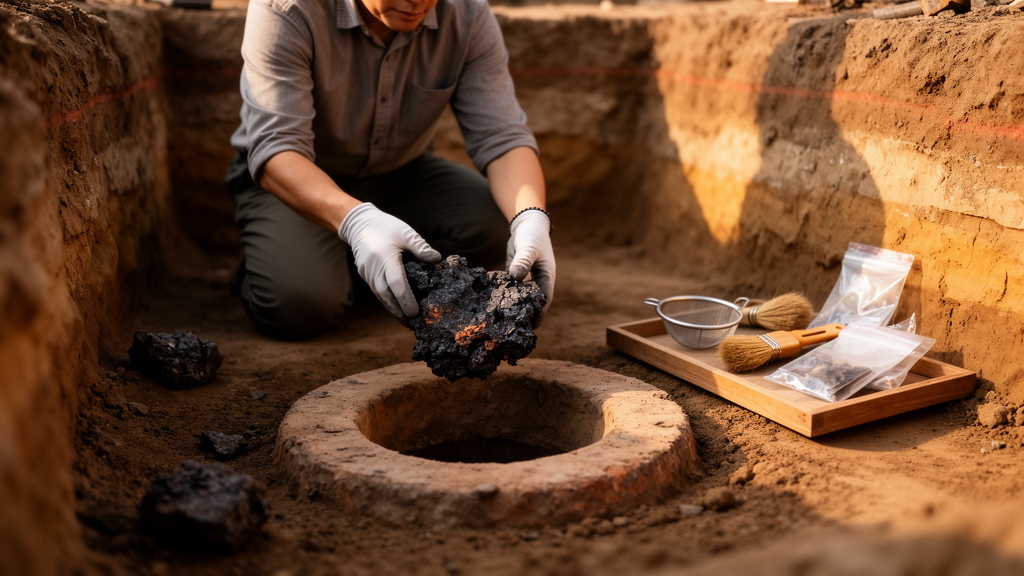
Beneath the modern city of Ezhou in China’s Hubei Province, archaeologists have been piecing together the story of an industrial operation that ran more than a thousand years ago. A new study of the Zhujiazui site, published in npj Heritage Science, examines iron production during the late Tang dynasty, roughly from the late eighth to the early tenth century AD. By combining traditional archaeological observation with laboratory-based materials science, a team led by Mengyi Zhang and Boyao Ma of Northwest University, together with Xiaoyang Li of the Hubei Provincial Institute of Cultural Relics and Archaeology, has determined what kind of iron technology operated at the site and, just as importantly, what kind did not.
The research focused on one of the most diagnostic classes of material that an ancient metalworking site can yield: slag, the stony waste product left behind when iron is produced or worked. Slag is far more than debris. Its mineralogy and chemical composition encode the temperature of the furnace, the type of ore and fuel used, and the fundamental nature of the smelting or melting process. Because different ironmaking traditions leave chemically distinct residues, slag can act as a fingerprint for reconstructing ancient technology even when the furnaces themselves have not survived.
The team applied three complementary techniques to the Zhujiazui assemblage. Macroscopic classification allowed researchers to sort slag fragments and iron artifacts into groups based on shape, texture, color, and other visible features, providing a first-pass typology of the material. Metallographic analysis, in which samples are polished, etched, and examined under a microscope, reveals the internal microstructure of the metal and slag, including phases that form only under specific thermal and chemical conditions. Finally, scanning electron microscopy coupled with energy-dispersive X-ray spectroscopy, known as SEM-EDS, delivered precise elemental compositions at the microscopic scale, identifying the distribution of elements such as iron, silicon, calcium, and magnesium within individual slag phases.
The results pointed decisively in one direction. The analytical signature of the slags indicated operations within a cast iron technological system, rather than bloomery smelting or a fining process. This distinction is fundamental to the history of metallurgy. In bloomery smelting, the dominant early technology in much of the ancient world, iron ore is reduced in a solid state below the melting point of iron, producing a spongy mass of metallic iron mixed with slag that must be repeatedly hammered to expel impurities. Cast iron, by contrast, contains enough carbon to melt at a much lower temperature, allowing liquid iron to be tapped from a furnace and poured directly into molds. Ancient China was remarkable for developing and widely deploying cast iron technology centuries before it became common elsewhere, and the Zhujiazui evidence adds a late Tang data point to that long trajectory.
Equally telling was what the excavated area lacked. The researchers found no iron ore and no ore-processing debris, the materials that would be expected if smelting, the initial reduction of ore to metal, had taken place on site. Instead, the excavation yielded ceramic molds and cast iron artifacts. Taken together, the absence of ore and the presence of molds indicate that the excavated area was primarily used for the melting and casting of cast iron. In other words, Zhujiazui was not a place where rock was turned into metal for the first time, but a foundry where already-produced cast iron was reheated, liquefied, and shaped into finished objects. This division of labor, with smelting at ore sources and casting at separate workshops, reflects an organized industrial chain rather than a single self-contained production site.
The chemistry of the slags offered further clues about workshop practice. Some of the analyzed samples showed elevated levels of calcium oxide and magnesium oxide, which the authors suggest may indicate the use of dolomitic flux. Fluxes are added to furnaces to lower the melting point of gangue, the unwanted mineral components of the charge, and to promote the formation of fluid slag that can be easily separated from the metal. Dolomite, a calcium magnesium carbonate mineral, would have served this purpose effectively. Identifying a possible dolomitic flux through slag chemistry provides a rare glimpse into the deliberate choices made by Tang dynasty metallurgists, who understood through accumulated craft knowledge which additives improved furnace performance, even without a modern theory of silicate chemistry to guide them.
Fuel evidence came in a more direct and visually striking form. The slags preserved charcoal impressions, providing direct evidence that charcoal was the fuel used in the ironworking operations. Charcoal, produced by burning wood in low-oxygen conditions, was the standard metallurgical fuel of the premodern world because it burns hot and introduces relatively few contaminants into the charge. Impressions of charcoal fragments frozen into slag record the fuel in situ, anchoring the reconstruction of furnace conditions in physical evidence rather than inference alone. For a site of this period, the confirmation of charcoal fuel also connects the foundry to the broader environmental and logistical demands of large-scale iron production, which consumed substantial quantities of wood resources.
The chronological placement of the site is significant in its own right. The late eighth to early tenth century corresponds to the late Tang dynasty and its turbulent aftermath, a period when China’s economic center of gravity was shifting southward and when iron production supported agriculture, weaponry, coinage, and daily implements on an enormous scale. Ezhou’s location on the Yangtze River places it within a region long associated with metalworking, and the authors note that the site’s location and regional context raise the possibility that it participated in wider systems of metal supply and product circulation. A casting workshop positioned within such networks would have depended on pig iron delivered from smelting sites and would have distributed its cast products through riverine trade routes, embedding Zhujiazui in an economy of raw materials and finished goods that stretched beyond the immediate locality.
Methodologically, the study demonstrates the value of reassessing archaeological contexts alongside laboratory analysis. Macroscopic classification, metallography, and SEM-EDS each answer different questions, and only by integrating them with a careful re-reading of the excavation record could the team distinguish a casting workshop from a smelting site, a difference that surface finds alone might not reveal. The work was supported by the National Social Science Fund of China and the Shaanxi Provincial Natural Science foundation, and it was carried out with the assistance of the Hubei Provincial Institute of Cultural Relics and Archaeology, whose excavation made the assemblage available for study.
For the archaeology of Chinese metallurgy, Zhujiazui contributes a clearly characterized example of late Tang cast iron melting and casting, complete with evidence for flux use and charcoal fuel, and a persuasive argument that the site operated as one node in a larger industrial landscape. As analytical techniques continue to be applied to slag assemblages across China, studies of this kind are transforming fragmentary industrial debris into readable records of ancient technology, revealing not only how iron was made but how production was organized, supplied, and connected across the Tang world.
Subject of Research: Late Tang dynasty cast iron melting and casting technology at the Zhujiazui site in Ezhou, China
Article Title: Iron production at the Zhujiazui site of the late Tang dynasty in Ezhou, South China
Article References: Zhang, M., Gao, Y., Su, J., Ma, B., & Li, X. (2026). Iron production at the Zhujiazui site of the late Tang dynasty in Ezhou, South China. npj Heritage Science. https://doi.org/10.1038/s40494-026-03010-8
Image Credits: AI Generated
DOI: 10.1038/s40494-026-03010-8
Keywords: iron production, cast iron, Zhujiazui site, Tang dynasty, archaeometallurgy, slag analysis, SEM-EDS, metallography, dolomitic flux, charcoal fuel, Ezhou, ancient foundry
Cite Scienmag News
Courtney Benton. (October 9, 2026). Ancient Chinese Foundry Revealed: Slag Analysis Shows Late Tang Iron Casting at Zhujiazui. Scienmag. https://scienmag.com/ancient-chinese-foundry-revealed-slag-analysis-shows-late-tang-iron-casting-at-zhujiazui/
Courtney Benton. "Ancient Chinese Foundry Revealed: Slag Analysis Shows Late Tang Iron Casting at Zhujiazui." Scienmag, 9 October 2026, https://scienmag.com/ancient-chinese-foundry-revealed-slag-analysis-shows-late-tang-iron-casting-at-zhujiazui/. Accessed 9 October 2026.
Courtney Benton. "Ancient Chinese Foundry Revealed: Slag Analysis Shows Late Tang Iron Casting at Zhujiazui." Scienmag. October 9, 2026. https://scienmag.com/ancient-chinese-foundry-revealed-slag-analysis-shows-late-tang-iron-casting-at-zhujiazui/


