


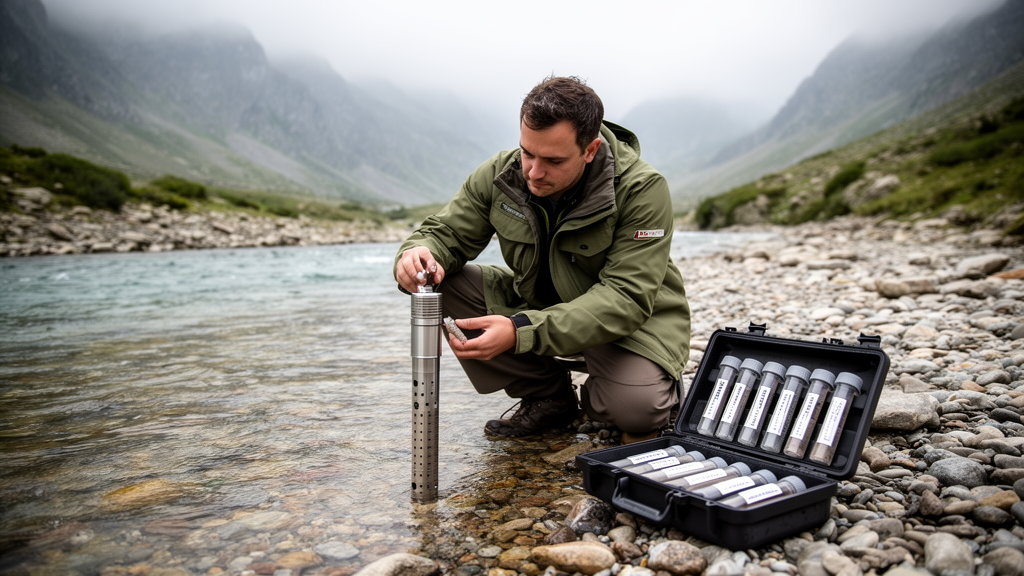
Deep in the mountains of northern Spain, a river is quietly rewriting what scientists thought they knew about how sediments travel from mountaintop to ocean. The Rio Sella, which rises in the dramatic limestone peaks of the Picos de Europa and flows about 66 kilometres to the Cantabrian coast, has become the focus of an unusually detailed investigation into the microscopic grains it carries. Andreas Gärtner and Anja Sagawe of the Senckenberg Naturhistorische Sammlungen Dresden analysed 37 samples of bedrock and modern river and beach sediments, identifying more than 363,000 individual heavy mineral grains. Their findings, published in the E&G Quaternary Science Journal, carry two surprises: first, that most of the catchment’s rocks contribute almost nothing to the river’s mineral fingerprint, and second, that the sediments are saturated with particles of human origin at concentrations no one expected.
Heavy minerals are the workhorses of provenance studies. Defined as grains denser than about 2.80 grams per cubic centimetre, they include familiar names such as zircon, rutile, tourmaline, garnet, epidote and amphibole. Because different rock types yield characteristic heavy mineral assemblages, geologists can read the composition of a river sand like a barcode and infer which rocks upstream supplied the sediment. This technique underpins everything from reconstructing ancient mountain belts to tracing the sources of beach sand. But the method rests on an assumption that is rarely tested at high resolution: that the rocks in a catchment contribute to the river’s signal roughly in proportion to the area they cover. The Rio Sella study shows just how badly that assumption can fail.
The Sella drains roughly 1,284 square kilometres of eastern Asturias and northernmost Castilla y León, one of the steepest small catchments in the region. Its geology is dominated by Palaeozoic rocks: Cambrian and Ordovician sandstones and quartzites, vast expanses of Carboniferous limestone, and younger Permian, Mesozoic and Cenozoic strata. Igneous rocks are almost entirely absent, covering only about 0.1 percent of the area. On paper, siliciclastic rocks occupy about 26.7 percent of the catchment, carbonates about 46.7 percent, and mixed lithologies about 24.7 percent. If sediment supply simply mirrored geology, carbonate-derived minerals should dominate the river’s heavy mineral load. They do not.
The key evidence comes from apatite, a phosphate mineral that is abundant in many of the catchment’s carbonate rocks yet virtually absent from the modern river sands. The researchers considered and rejected the obvious explanations. Chemical dissolution seemed unlikely because the carbonate terrain buffers stream water at a pH of around 8, conditions in which apatite is relatively stable, and the mineral is known to survive long river journeys elsewhere. Hydrodynamic sorting by density also seemed implausible, since apatite’s density of roughly 3.1 to 3.2 grams per cubic centimetre is similar to that of tourmaline and many amphiboles, which do persist downstream. Instead, scanning electron microscope images of apatite grains revealed intense surface pitting consistent with collisions during transport, suggesting the grains may shatter rapidly and effectively vanish from the coarser fractions. Whatever the precise mechanism, the conclusion is stark: heavy minerals from carbonate rocks appear to remain trapped in local subcatchments and are not transferred to the main river channel in the 6.3 to 630 micrometre grain sizes studied.
The practical consequence is that only about one third of the outcropping rocks, the siliciclastic units and the siliciclastic portions of mixed strata, actually supply the heavy minerals that reach the river’s mouth. Cambro-Ordovician sandstones contribute the ultra-stable trio of zircon, rutile and tourmaline, while post-Middle Carboniferous siliciclastics supply garnet and mica. Any scientist sampling river sediment to reconstruct the geology of a hinterland would therefore receive a heavily biased picture, one that systematically underrepresents nearly two thirds of the landscape. The authors stress that their results, based on a limited sample set, are preliminary, but the scale of the analysis, with hundreds of thousands of grains individually characterised, is unparalleled for a catchment of this size and provides a benchmark for future work.
The study also documented systematic grain size effects that complicate comparisons between samples. Mica becomes progressively more abundant in finer fractions, garnet shows a similar trend, and epidote peaks sharply in the 63 to 20 micrometre range. Rutile behaves differently in modern sediments than in the source rocks, hinting that grain size distributions are inherited from crystal growth in the parent lithology rather than imposed purely by river hydraulics. The researchers recommend reporting heavy mineral data as area percentages rather than simple grain counts, arguing that this better reflects true mineral proportions, and they caution that samples yielding fewer than 300 analysed grains should be interpreted carefully.
When the river reaches the sea, its mineralogical message is essentially erased. Beach sands collected near the river mouth at Ribadesella bear little resemblance to sediments from the lower Sella, indicating that longshore currents moving sediment eastward overwhelm the river’s input. More striking still, the beach samples differ from one another more than the river samples do, and their composition tracks the rocks that crop out along the shoreline itself. A beach northeast of Bebes is dominated by fluorite and barite, minerals linked to well-known fluorite deposits mined in the immediate vicinity. Beaches east of Ribadesella are rich in the zircon, rutile and tourmaline signature of Ordovician rocks exposed nearby. There appear to be no large littoral sediment cells along this coast; instead, the mineral signal changes almost continuously with local geology. The implication is sobering for provenance studies: sampling a small river mouth tells you little about the catchment behind it, and possibly even less about the coast in front of it.
The second surprise is the anthropogenic one. In the course of their analyses, the researchers identified large numbers of heavy anthropogenic particles, or HAPs, defined as human-made particles dense enough to fall within the heavy mineral fraction. These include metal alloys such as bronze, brass and various steels, native metals like aluminium, lead, tin, zinc and copper, heavy glasses such as barium titanate, and particles with unnatural concentrations of rare earth elements. The most abundant group consists of particles more than 75 percent iron, likely remnants of steel alloys at various stages of oxidation, along with distinctive spherules that may lend themselves to automated identification in future studies.
The concentrations are remarkable. Modern fluvial sediments contained between 58 and 4,170 HAPs per gram of sample, averaging around 1,220 per gram, with the iron-rich group dominating. Even excluding that group, counts reached up to 92 particles per gram, including up to 10 glassy spherules per gram. The highest values came from samples collected near main roads, and one headwater site on a quiet single-lane road yielded abundant particles that the authors attribute to inputs elsewhere, possibly from a busy mountain pass with numerous hairpin bends where increased braking would elevate emissions of metallic wear particles. Intriguingly, HAP counts decrease downstream and do not spike in towns such as Ribadesella, and beach sediments are markedly depleted, averaging only about 63 particles per gram, almost all of them iron-rich. Whether this coastal decline reflects physical destruction during transport, chemical reactions or some other process remains an open question.
The broader message of the study is twofold. For geoscientists, it is a warning that heavy mineral signals in small mountainous rivers are strongly filtered by source rock fertility, grain size inheritance and transport processes, so that catchment-wide reconstructions demand detailed characterisation of both the bedrock and the sediments before any provenance story can be trusted. For environmental scientists, it is a wake-up call: heavy anthropogenic particles are present in every modern sediment sample examined, sometimes by the thousands per gram, yet their behaviour, transport and ecological effects remain almost entirely unstudied compared with the attention devoted to microplastics. As the authors note, even the least inhabited corners of the Sella catchment, visited by up to two million tourists a year heading for the Picos de Europa, are far from pristine. The river sand, it turns out, remembers both the mountains and us.
Subject of Research: Heavy mineral provenance and anthropogenic particle transport in the Rio Sella catchment and adjacent coast of northern Spain
Article Title: Transport of heavy minerals and heavy anthropogenic particles in the Rio Sella catchment and along the adjacent coast, northern Spain
Article References: Gärtner, A., & Sagawe, A. (2025). Transport of heavy minerals and heavy anthropogenic particles in the Rio Sella catchment and along the adjacent coast, northern Spain. E&G Quaternary Science Journal, 74(2), 281-299. https://doi.org/10.5194/egqsj-74-281-2025
Image Credits: AI Generated
DOI: 10.5194/egqsj-74-281-2025
Keywords: heavy minerals, Rio Sella, sediment transport, provenance analysis, anthropogenic particles, Picos de Europa, northern Spain, beach sediments, carbonate rocks, siliciclastic rocks, scanning electron microscopy, environmental contamination
Cite Scienmag News
Violet Maxwell. (October 9, 2026). Spanish River Study Reveals Hidden Human Particles in Mountain Sediments. Scienmag. https://scienmag.com/spanish-river-study-reveals-hidden-human-particles-in-mountain-sediments/
Violet Maxwell. "Spanish River Study Reveals Hidden Human Particles in Mountain Sediments." Scienmag, 9 October 2026, https://scienmag.com/spanish-river-study-reveals-hidden-human-particles-in-mountain-sediments/. Accessed 9 October 2026.
Violet Maxwell. "Spanish River Study Reveals Hidden Human Particles in Mountain Sediments." Scienmag. October 9, 2026. https://scienmag.com/spanish-river-study-reveals-hidden-human-particles-in-mountain-sediments/


