


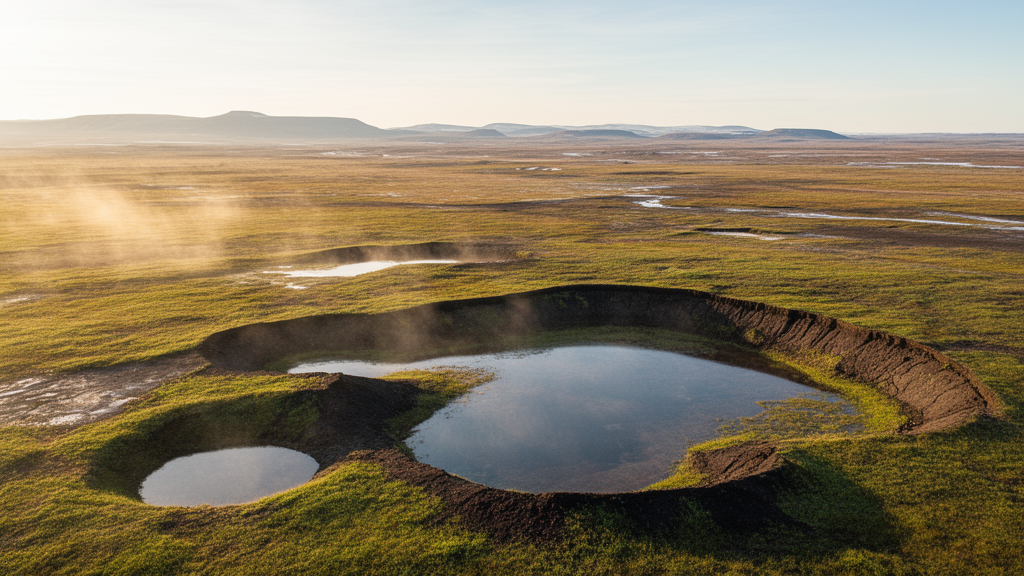
Beneath the frozen ground of the Northern Hemisphere’s high latitudes lies a carbon bomb that climate scientists have long warned about: permafrost soils hold more than twice as much carbon as the entire atmosphere. Now a team of Japanese researchers has shown, in unprecedented physical detail, that even if humanity overshoots its climate targets and then pulls carbon dioxide back out of the air, the permafrost will not simply freeze again and undo the damage. Instead, the frozen ground follows a delayed, one-way trajectory that keeps releasing greenhouse gases long after temperatures begin to fall.
The study, published in the journal Earth System Dynamics by Natsuki Watanabe of the University of Tokyo’s Atmosphere and Ocean Research Institute and colleagues, used the MIROC-ES2L Earth system model, a participant in the Coupled Model Intercomparison Project Phase 6. The team ran a series of idealized overshoot experiments in which carbon dioxide emissions of 10 petagrams of carbon per year, roughly matching recent observed emissions of 9.6 plus or minus 0.5 petagrams annually, were prescribed until global-mean surface air temperature rose by 2, 4, 6, or 8 degrees Celsius. At each threshold, the sign of the emissions was flipped to negative, meaning the model world began absorbing carbon at the same rate it had been emitting it, until cumulative net emissions returned to zero.
The central finding is a striking asymmetry between what the permafrost looks like and what it is made of. The total area of permafrost, defined as ground remaining below 0 degrees Celsius for two or more consecutive years, turned out to be largely reversible: in most experiments, the frozen extent at the end of the cooling phase closely resembled the starting area. But the physical character of that ground had changed permanently, at least on human timescales. In the deepest soil layer, spanning 4 to 14 meters below the surface, regions that began as solidly frozen ice-rich ground ended the experiments as mixed zones where liquid water and ice coexist, a state the researchers call sherbet, at temperatures hovering just at the freezing point.
This distinction matters enormously for the carbon cycle. Fully frozen ice layers do not emit greenhouse gases, but sherbet layers, where phase change is actively underway, do. When the researchers compared the initial state of their warming experiment with the final state of the cooling experiment, they found the ice area in the bottom soil layer had shrunk while the sherbet area had expanded, even though ground temperatures had returned almost exactly to their initial values. In other words, the permafrost recovered its area but not its identity, a partial irreversibility that had not previously been demonstrated with a full Earth system model.
The mechanism behind this behavior lies in the sluggish physics of soil. Heat moves downward through the ground by conduction, and the phase change of water between ice and liquid absorbs or releases enormous amounts of energy as latent heat. During warming, excess heat penetrates the soil column layer by layer, first converting ice to sherbet without much visible loss of permafrost area, then, once a critical threshold of roughly 3 degrees Celsius of global warming is crossed, melting the sherbet entirely and driving rapid thaw. During cooling, the process reverses from the top down, but the deep layers lag far behind. In the representative 6-degree experiment, surface air temperatures began falling immediately after emissions flipped negative, yet permafrost thaw continued for another 150 years.
Sensitivity experiments confirmed which physical parameters control this lag. When the team doubled the soil’s heat conductivity, the hysteresis loop narrowed; when they multiplied it tenfold, the hysteresis nearly vanished. But the more powerful lever was the latent heat of the water phase change itself. Halving that parameter enlarged the hysteresis, while reducing it to one-tenth made both the area response and the ice-to-sherbet redistribution almost completely reversible. The conclusion is that the apparent thermal inertia of soil, dominated by the energy cost of melting and freezing water, is the primary driver of the permafrost’s delayed and asymmetric response, consistent with earlier work using simpler intermediate-complexity models.
The consequences for the carbon budget are far from trivial. Using an offline model called PDGEM, the Permafrost Degradation and Greenhouse gasses Emission Model, the team estimated how much carbon dioxide and methane would escape from thawing ground. Carbon release during the first 4 degrees of warming came to roughly 14 petagrams of carbon per degree, within the uncertainty range of 3 to 41 petagrams per degree reported by earlier assessments. Crucially, the hysteresis means emissions continue during the cooling phase: in the experiment capped at 2 degrees, the additional carbon released after emissions turned negative reached about 10.9 petagrams, accounting for a remarkable 41.3 percent of total cumulative permafrost emissions over the whole experiment. At the 8-degree threshold, by contrast, nearly all permafrost had already thawed, so the post-peak contribution was only 0.6 percent.
Paradoxically, this means that modest warming scenarios, often considered the safe ones, are where permafrost hysteresis bites hardest in relative terms. The additional emissions from thawed permafrost amplified modeled warming by 10 to 15 percent, contributing 0.19 degrees Celsius at the 2-degree level and up to 0.96 degrees at 8 degrees. Offsetting these committed emissions would require extending the period of negative emissions by roughly 12 to 17 percent, a substantial burden for any future carbon-removal infrastructure. The authors note that limiting warming to 2 degrees is critical to avoid triggering the pronounced deep-soil hysteresis, yet even then the committed permafrost emissions of around 11 petagrams of carbon during the recovery phase would significantly shrink the remaining carbon budget.
The study is careful about its uncertainties. The offline carbon model assumes that once soil thaws it keeps emitting for 15 to 40 years even if it refreezes, which likely overestimates emissions in regions that refreeze quickly, particularly in the 2-degree scenario where up to about 4.34 petagrams of the post-peak carbon dioxide could be overestimated. The model also assumes a uniform vertical distribution of soil organic carbon, whereas in reality most carbon sits in the upper 3 meters, and it neglects emissions from sherbet regions, which would push estimates in the opposite direction. The researchers also found that the Atlantic Meridional Overturning Circulation exhibits its own hysteresis, emerging stronger than its initial state during recovery and cooling the Northern Hemisphere surface, a non-local effect that actually worked against, rather than explained, the permafrost lag.
What emerges from this work is a sobering picture of the climate system’s memory. Global-mean temperature, atmospheric carbon dioxide concentration, and even total permafrost area can appear reversible on paper, yet the ground beneath the Arctic retains a hidden record of the overshoot in the ratio of ice to liquid water locked deep in the soil. A 2000-year extension of the control run after the cooling experiment showed the ice and sherbet areas slowly drifting back toward their initial states, but the frozen-to-liquid ratio in the deepest layer may never fully recover even at equilibrium. For policymakers weighing overshoot pathways, the message is clear: carbon that escapes the permafrost during the warming years is only part of the bill, and the thaw, once set in motion, keeps invoicing for decades after the planet begins to cool.
Subject of Research: Hysteresis and irreversibility in the physical response of Northern Hemisphere permafrost to rising and falling CO2 emissions
Article Title: Hysteresis and irreversibility in permafrost physical response to increase and decrease of CO2 emissions
Article References: Watanabe, N., Watanabe, M., Hajima, T., Yokohata, T., & Melnikova, I. (2026). Hysteresis and irreversibility in permafrost physical response to increase and decrease of CO 2 emissions. Earth System Dynamics, 17(4), 1135-1150. https://doi.org/10.5194/esd-17-1135-2026
Image Credits: AI Generated
Keywords: permafrost, hysteresis, irreversibility, carbon cycle feedback, Earth system model, MIROC-ES2L, overshoot scenarios, negative emissions, soil thermal physics, latent heat, greenhouse gas emissions, tipping elements
Cite Scienmag News
Sloane Callahan. (October 9, 2026). Permafrost Thaw Lags Behind Cooling, Locking In Carbon Emissions Even After CO2 Falls. Scienmag. https://scienmag.com/permafrost-thaw-lags-behind-cooling-locking-in-carbon-emissions-even-after-co2-falls/
Sloane Callahan. "Permafrost Thaw Lags Behind Cooling, Locking In Carbon Emissions Even After CO2 Falls." Scienmag, 9 October 2026, https://scienmag.com/permafrost-thaw-lags-behind-cooling-locking-in-carbon-emissions-even-after-co2-falls/. Accessed 9 October 2026.
Sloane Callahan. "Permafrost Thaw Lags Behind Cooling, Locking In Carbon Emissions Even After CO2 Falls." Scienmag. October 9, 2026. https://scienmag.com/permafrost-thaw-lags-behind-cooling-locking-in-carbon-emissions-even-after-co2-falls/


