


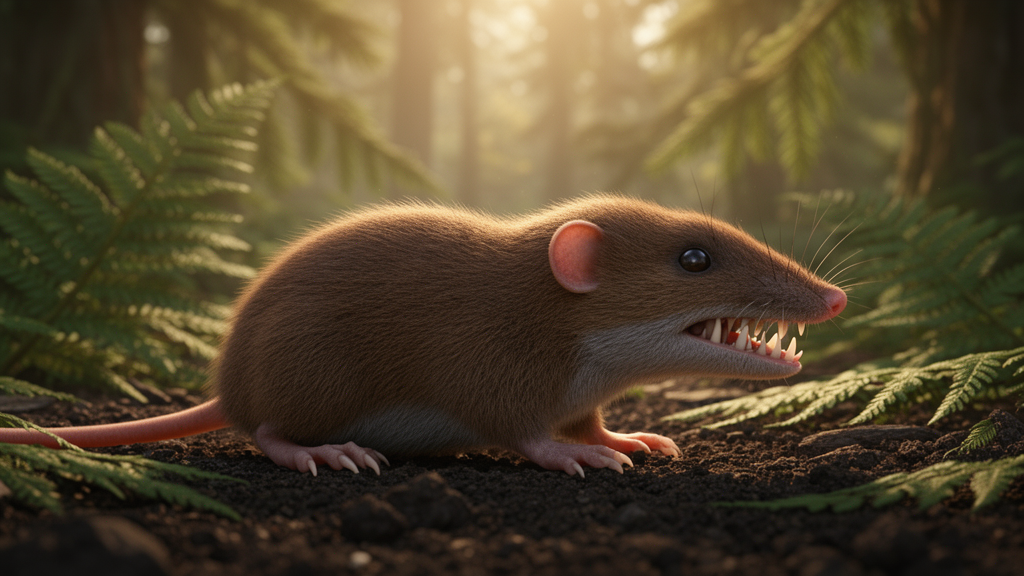
A nearly complete 120-million-year-old skeleton unearthed from the Jiufotang Formation of Liaoning Province, China, is forcing paleontologists to rethink one of the most fundamental assumptions about what makes a mammal a mammal. The fossil, a new species named Dongoconodon platycauda, belongs to the extinct order Eutriconodonta and preserves an extraordinary combination of traits: multiple generations of teeth at several tooth positions, a partially detached middle ear, and a suite of adaptations for swimming. Described in Nature Communications by a team led by Shundong Bi of Yunnan University, Howard University, and the Carnegie Museum of Natural History, the specimen challenges the long-held view that the two-generation tooth system of modern mammals was a one-way evolutionary commitment made early in mammalian history.
Living mammals are diphyodont, meaning they grow only two generations of teeth: a deciduous, or milk, set followed by a permanent set. Reptiles, by contrast, are polyphyodont, continuously replacing their teeth throughout life. Diphyodonty has long been considered pivotal to the evolution of other hallmark mammalian traits, including precise occlusion, in which upper and lower teeth fit together with exacting accuracy, and determinate growth, in which the skeleton stops growing once adult size is reached. Because teeth cannot keep being replaced if the precise fit of opposing crowns is to be maintained, the transition from polyphyodonty to diphyodonty has been viewed as a critical gatekeeper in mammalian evolution. Yet reconstructing dental replacement in fossils is notoriously difficult, because growth series that capture animals at different life stages are rarely preserved, and interpretations of Mesozoic mammal dentitions have relied largely on indirect evidence from tooth wear, crown morphology, and phylogeny.
Dongoconodon changes that picture with direct evidence. The holotype skeleton, catalogued as IMMNH-PV01700 and housed at the Inner Mongolia Museum of Natural History, preserves a well-ossified cranium, robust mandibles, and an articulated postcranial skeleton missing only the right forelimb elements. Computed tomography scanning at a voxel size of 21.95 micrometers allowed the team to peer inside the jawbones and map every tooth in three dimensions. The dental formula counts three incisors, one canine, three premolariforms, and four molariforms on each side of the upper jaw, with a slightly different arrangement below. The crucial observation lies in the right lower jaw, where unerupted replacement teeth sit inside the bone at positions that complicate any diphyodont reading.
The logic is subtle but decisive. In the right lower mandible, the second and third molariforms are fully erupted, while anterior to the erupted canine sit three unerupted teeth, including a first incisor that itself has a replacement tooth behind it. If this were a standard diphyodont dentition, those molariforms would have had to erupt fully before what would be two deciduous incisors, a pattern unknown in any living or extinct mammal. The team instead interprets the delayed unerupted incisors as second-generation teeth, which makes the replacement behind the first incisor a third generation. In other words, at some loci across all four tooth types, Dongoconodon was replacing teeth more than twice. The lower first molariform had already been shed, its complex replacement still embedded in the jaw, with a small enamel cap below it that appears to represent yet another generation.
Only one other mammal is known to have achieved anything similar: Gobiconodon borissiaki, a relative from the Early Cretaceous of Mongolia, which multiple specimens suggest had three generations of some of its molariform teeth. Together with Dongoconodon, these animals belong to a clade in which molariform replacement appears repeatedly. The prevailing view has held that ante-molar diphyodonty arose once at the base of Mammaliaformes, the broad group encompassing Late Triassic forms such as Morganucodon and all living mammals. That consensus was already strained by reports of diphyodonty in the Norian eucynodont Brasilodon, some 20 million years earlier than expected, and now by the clear polyphyodonty of these eutriconodontans. The authors suggest that the reappearance of tooth replacement in this lineage was likely tied to their carnivorous specializations, with large caniniform incisors and powerful jaws used for catching and ripping prey, a lifestyle in which continual tooth renewal would carry a clear advantage.
The skeleton also preserves a remarkable snapshot of one of the most contested transitions in mammalian evolution: the detachment of the middle ear from the lower jaw. In mammalian embryos, Meckel’s cartilage forms a rod connecting the future ear ossicles to the developing mandible; its proximal end gives rise to the malleus and incus, while the rest is progressively resorbed or incorporated into the jaw. Many Mesozoic mammals retain a groove on the inner surface of the mandible that housed an ossified version of this cartilage, implying that the ear ossicles still did double duty in both chewing and hearing. Dongoconodon preserves the ossified Meckel’s cartilage itself, along with the full bony middle ear apparatus of malleus, incus, stapes, and ectotympanic.
The shape of that cartilage is what makes the specimen so informative. Among eutriconodontans, two types of ossified Meckel’s cartilage were previously known: one with a mandibular attachment spanning nearly 60 percent of its length, as in Repenomamus, Liaoconodon, and Yanoconodon, and a second with an attachment of only about 25 percent. Dongoconodon’s cartilage is a straight, flattened spindle with a twist in the middle, its mandibular end compressed and touching the jaw only through a small facet. Combined with a third morphology seen in Corviconodon, where the Meckelian groove is entirely absent and the ossicles were fully detached, these three states form a transformation series. The team argues that this series mirrors the developmental sequence in living mammals, in which the connection breaks down from front to back, with separation occurring first between the cartilage and the mandible before the cartilage separates from the ear ossicles. Because similar long, short, and absent states appear across other mammalian lineages, including the one leading to placental mammals, the authors conclude that fully detached, hearing-dedicated ear ossicles evolved multiple times independently.
Beyond its evolutionary significance, Dongoconodon was plainly an animal of the water’s edge. Estimated at 115 to 190 grams, roughly the size of a water vole, it shows a femur with a flattened shaft and broadened distal end, and hands and feet strikingly similar to those of the platypus, broad and elongated with metacarpals and metatarsals that lengthen from the medial to the lateral side. Several finger bones bear dorsal flanges resembling those in the platypus where interdigital webbing attaches, suggesting Dongoconodon too had webbed extremities that could spread to maximize propulsive surface during the swimming stroke. A canonical variate analysis of 13 limb-bone functional indices across 124 extant mammal species placed the fossil squarely within the morphospace of semiaquatic species, with a 100 percent posterior probability for that classification.
Its tail adds a final flourish. Nineteen caudal vertebrae are preserved, with the proximal ones bearing flattened, plate-like centra and box-like transitional vertebrae that closely resemble those of the nutria, the semiaquatic South American rodent. This points to a tapered tail, dorsoventrally flattened but narrowing to a point, used mainly for steering and stabilization rather than propulsion. That combination, platypus-like webbed forefeet providing the main thrust and a nutria-like tail for maneuvering, distinguishes Dongoconodon from other semiaquatic Mesozoic mammaliforms such as Castorocauda, which paddled with a broad beaver-like tail, and Liaoconodon and Yanoconodon, whose caudal vertebrae lack flattened transverse processes.
Taken together, the fossil dismantles the tidy linear narrative in which key mammalian characters accumulated in lockstep along a single path toward the modern condition. Eutriconodontans now display a mosaic of states: Triconodon was diphyodont with precise occlusion, while Dongoconodon reverted to polyphyodonty; the Meckelian sulcus ranges from elongated forms resembling Morganucodon to fully detached ossicles like those of living mammals. Dental, occlusal, and auditory features, the evidence suggests, could evolve independently and even reverse course, producing complex combinations of ancestral and derived traits. For a lineage that branched off more than 120 million years ago, Dongoconodon platycauda offers a vivid reminder that early mammalian evolution was less a staircase than a branching experiment, with some lineages finding their own solutions to the demands of predation, hearing, and life in the water.
Subject of Research: Dental replacement, middle ear evolution, and semiaquatic adaptation in an Early Cretaceous eutriconodontan mammal
Article Title: A polyphyodont, semiaquatic eutriconodontan mammal from the Early Cretaceous of China
Article References: Bi, S., Shi, Y., Li, Z., Rahmat, S. J., Wang, J., & Wible, J. R. (2026). A polyphyodont, semiaquatic eutriconodontan mammal from the Early Cretaceous of China. Nature Communications, 17(1), Article 10032. https://doi.org/10.1038/s41467-026-77339-w
Image Credits: AI Generated
DOI: 10.1038/s41467-026-77339-w
Keywords: Dongoconodon platycauda, Eutriconodonta, polyphyodonty, diphyodonty, Meckel's cartilage, middle ear evolution, Early Cretaceous, Jiufotang Formation, semiaquatic mammals, tooth replacement, Mesozoic mammals, paleontology
Cite Scienmag News
Violet Maxwell. (October 9, 2026). Cretaceous Mammal With Replacing Teeth Rewrites the Story of Mammalian Dentition. Scienmag. https://scienmag.com/cretaceous-mammal-with-replacing-teeth-rewrites-the-story-of-mammalian-dentition/
Violet Maxwell. "Cretaceous Mammal With Replacing Teeth Rewrites the Story of Mammalian Dentition." Scienmag, 9 October 2026, https://scienmag.com/cretaceous-mammal-with-replacing-teeth-rewrites-the-story-of-mammalian-dentition/. Accessed 9 October 2026.
Violet Maxwell. "Cretaceous Mammal With Replacing Teeth Rewrites the Story of Mammalian Dentition." Scienmag. October 9, 2026. https://scienmag.com/cretaceous-mammal-with-replacing-teeth-rewrites-the-story-of-mammalian-dentition/


