


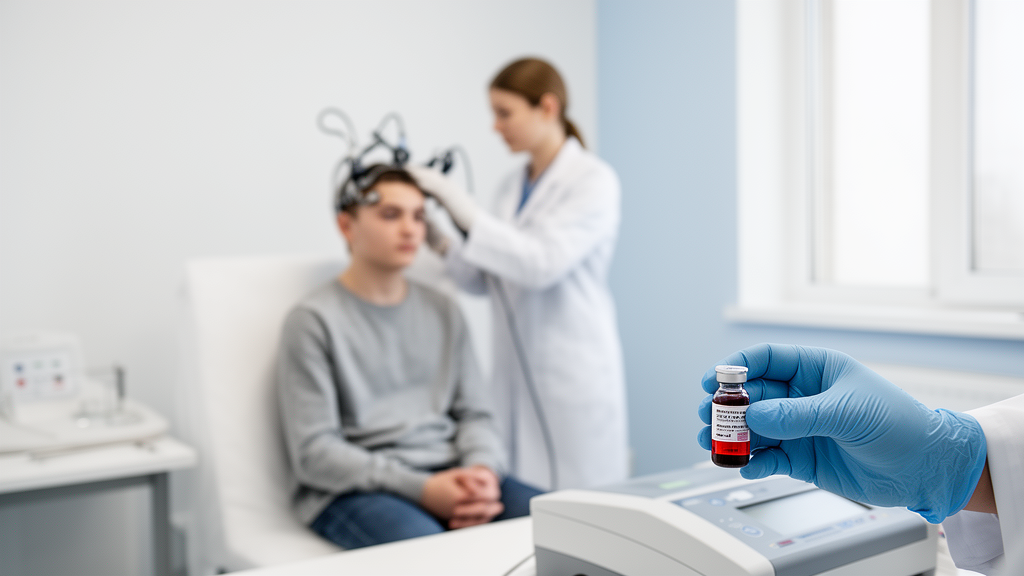
A simple blood test measuring a chronic inflammation marker may soon help clinicians decide which adolescents with depression are most likely to benefit from repetitive transcranial magnetic stimulation, a non-invasive brain stimulation technique increasingly used when standard antidepressant medications fall short. In a randomized controlled trial published in BMC Psychiatry, researchers in China report that a protein called soluble urokinase-type plasminogen activator receptor, or suPAR, played two distinct roles in predicting treatment outcomes: the level present before treatment began forecast whether a patient would respond at all, while the change in that level after two weeks of therapy tracked how much their depressive symptoms were improving. The finding, if confirmed in larger studies, could give psychiatrists an early, biologically grounded signal for tailoring treatment in a population where options are limited and delays in finding the right therapy can be especially damaging.
Adolescent depression is a widespread and clinically challenging condition. While selective serotonin reuptake inhibitors such as sertraline remain a first-line pharmacological option, a substantial fraction of young patients do not achieve adequate relief from medication alone, and clinicians have few tools to predict in advance who will respond to any given intervention. Repetitive transcranial magnetic stimulation, or rTMS, has emerged as a promising add-on treatment. The technique uses magnetic pulses, typically applied over the dorsolateral prefrontal cortex, to modulate neural circuit activity in regions implicated in mood regulation. Yet even with rTMS, response varies considerably from patient to patient, and the search for biomarkers that could guide patient selection has become a priority in biological psychiatry.
The new study is rooted in the inflammatory hypothesis of depression, which holds that low-grade immune activation contributes to depressive symptoms in at least a subset of patients. Numerous studies in adults have documented dysregulation of inflammatory markers in major depressive disorder, but evidence in adolescents has remained scarce. SuPAR is the soluble form of a receptor found on immune cells, and it has attracted attention as a marker of chronic, low-grade systemic inflammation. Unlike more transient inflammatory signals, suPAR levels tend to be relatively stable over time, making it an appealing candidate for tracking a chronic condition. Elevated suPAR has been linked to depression severity and poorer outcomes in adult cohorts, but its relationship to brain stimulation outcomes in teenagers had not been established.
To address this gap, the research team, led by investigators at Xuzhou Medical University and its affiliated Oriental Hospital, enrolled 120 adolescents diagnosed with depression. Participants were randomly assigned in a 7:3 ratio to receive either active rTMS combined with sertraline (84 patients) or sham stimulation combined with sertraline (36 patients). The trial was registered with the Chinese Clinical Trial Registry, received ethics approval from the Institutional Review Board of Xuzhou Oriental Hospital, and was conducted in accordance with the Declaration of Helsinki, with written informed consent obtained from all participants and their legal guardians. At baseline, the researchers collected demographic information and assessed childhood trauma using the Childhood Trauma Questionnaire, a variable known to influence both inflammation and depression trajectories.
Clinical assessments were carried out at three time points: before treatment, at two weeks, and at four weeks. Depressive symptom severity was measured with the 24-item Hamilton Depression Rating Scale, a clinician-administered instrument widely regarded as a standard endpoint in depression trials. Because the study also probed pain-related cognition, participants completed the Pain Catastrophizing Scale and the Pain Vigilance and Awareness Questionnaire. Blood samples were drawn at each visit, and serum levels of suPAR, C-reactive protein, and interleukin-6 were quantified using enzyme-linked immunosorbent assay, a laboratory technique that detects and measures specific proteins with high sensitivity. This three-marker panel allowed the team to compare a stable chronic inflammation marker against more classical acute-phase indicators.
The clinical results showed a modest but meaningful advantage for active stimulation. After four weeks, the rTMS group demonstrated significantly greater improvement in pain catastrophizing scores than the sham group, although pain vigilance scores did not differ between the arms. On the primary depression measure, the between-group difference on the HAMD-24 reached statistical significance at week four, with a P value of 0.02, though the overall time-by-group interaction across the full study period did not reach significance (P = 0.160), suggesting the divergence emerged late in the treatment course. Importantly, the proportion of responders was significantly higher in the active group: 64.29 percent of rTMS patients responded to treatment, compared with 44.44 percent of sham patients, a difference the authors reported as statistically significant (P = 0.04).
The biomarker findings were the study’s most striking contribution. The researchers found that the change in suPAR levels between baseline and week two correlated significantly with the improvement in depressive symptoms among patients receiving active rTMS, with a correlation coefficient of -0.290 and a P value of 0.008. In practical terms, patients whose suPAR levels fell during the first two weeks of stimulation tended to show greater reductions in depression scores, positioning the early suPAR trajectory as a potential on-treatment indicator of response. This is clinically valuable because it offers a biological readout at a point when treatment could still be adjusted, rather than forcing patients and families to wait the full four weeks or longer to learn whether therapy is working.
Equally important was the role of baseline suPAR. When the researchers examined pretreatment levels as a predictor of eventual response, they found that higher starting suPAR significantly predicted a lower likelihood of responding, with an odds ratio of 0.609 and a P value of 0.03. In other words, adolescents with greater baseline chronic inflammatory burden were less likely to benefit from the combined rTMS and sertraline regimen. Building on this, the team constructed a prediction model that combined suPAR with clinical variables, and the model showed moderate ability to discriminate responders from non-responders, achieving an area under the curve of 0.786 on receiver operating characteristic analysis. An AUC of that magnitude, while short of clinical-grade certainty, indicates discriminative performance well above chance and comparable to early-stage biomarker models in other areas of psychiatry.
The dual role of suPAR, predictive before treatment and reactive during it, carries conceptual weight for the field. It suggests that chronic inflammatory state may shape the neurobiology that determines whether prefrontal stimulation can produce clinical gains, while the dynamics of that same marker may reflect the biological response unfolding as treatment proceeds. Notably, the study found no such relationships reported for C-reactive protein or interleukin-6 in its headline results, which may reflect the fact that these acute-phase markers fluctuate more readily with minor infections and stress, whereas suPAR’s stability makes it a cleaner window into chronic immune activation. The authors describe their conclusions as preliminary, and the study’s modest sample size, particularly the smaller sham arm, means the estimates carry uncertainty that larger replication cohorts will need to resolve.
Still, the implications for adolescent psychiatry are considerable. If suPAR measurement can be validated as a pretreatment selection tool, clinicians could reserve rTMS, which requires repeated clinic visits over multiple weeks, for patients most likely to benefit, while steering those with high inflammatory signatures toward alternative or combination strategies. The two-week suPAR check could serve as an early decision point, sparing non-responders months of ineffective therapy. The work also strengthens the broader case that depression in young people is not a single homogeneous disorder but a set of biologically distinct states, some of them inflammation-driven, that may demand different treatments. As the authors and the field emphasize, biomarker-guided psychiatry for adolescents remains in its infancy, but this trial offers a concrete, testable step toward blood-based personalization of brain stimulation therapy at a moment when the need for better tools has never been clearer.
Subject of Research: suPAR inflammatory biomarkers for predicting and monitoring rTMS treatment response in adolescent depression
Article Title: Baseline versus 2-week change in suPAR: distinct predictive and early-response roles in rTMS for adolescent depression
Article References: Xie, Z., Li, S., Qi, Y., Liu, Y., Tang, F., Gao, Z., Xin, N., & Zhang, C. (2026). Baseline versus 2-week change in suPAR: distinct predictive and early-response roles in rTMS for adolescent depression. BMC Psychiatry. https://doi.org/10.1186/s12888-026-08738-y
Image Credits: AI Generated
DOI: 10.1186/s12888-026-08738-y
Keywords: suPAR, rTMS, adolescent depression, biomarker, inflammation, major depressive disorder, sertraline, transcranial magnetic stimulation, psychiatry, treatment response, IL-6, C-reactive protein
Cite Scienmag News
Glenn Wilkins. (October 9, 2026). Blood Protein Could Predict Which Depressed Teens Respond to Brain Stimulation. Scienmag. https://scienmag.com/blood-protein-could-predict-which-depressed-teens-respond-to-brain-stimulation/
Glenn Wilkins. "Blood Protein Could Predict Which Depressed Teens Respond to Brain Stimulation." Scienmag, 9 October 2026, https://scienmag.com/blood-protein-could-predict-which-depressed-teens-respond-to-brain-stimulation/. Accessed 9 October 2026.
Glenn Wilkins. "Blood Protein Could Predict Which Depressed Teens Respond to Brain Stimulation." Scienmag. October 9, 2026. https://scienmag.com/blood-protein-could-predict-which-depressed-teens-respond-to-brain-stimulation/


