


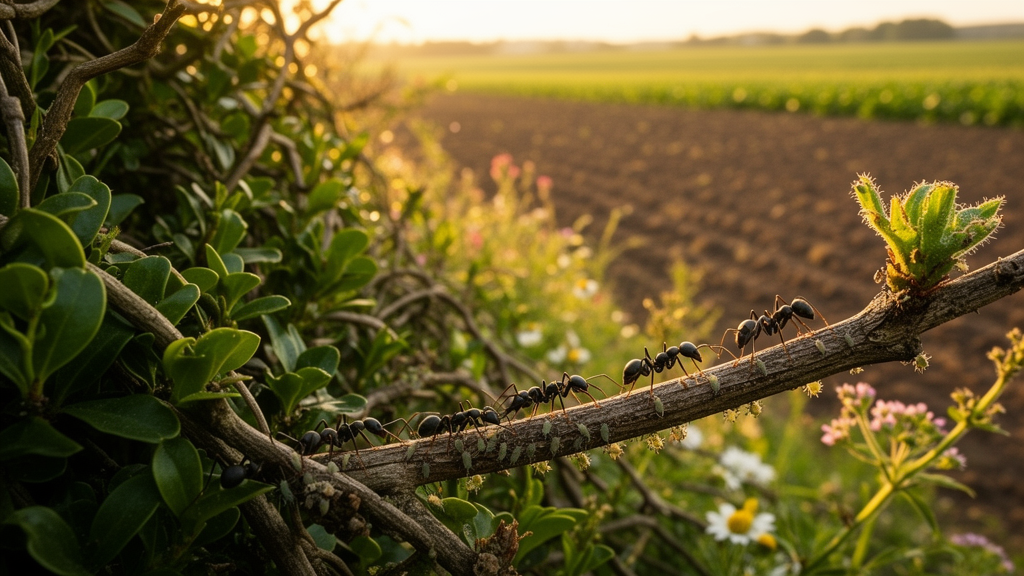
Across the rolling farmland of central France, the humble hedgerow is doing far more work than most people realize. A new study published in the journal Web Ecology has revealed that these linear strips of trees and shrubs, long celebrated as refuges for birds and wildflowers, also act as powerful architects of ant communities in neighboring fields — and through those ants, they may be quietly shaping the very productivity of the farms they border. The research, conducted by Cyril Marty, Tom Jamonneau, and Gabriel Johnson of the University of Montpellier, offers some of the first functional evidence that hedgerows influence not just which ants live where, but what those ants actually do for the agricultural landscape.
The stakes are considerable. Agricultural land covers nearly six billion hectares worldwide, roughly forty percent of the planet’s emerged land surface, and in metropolitan France it stretches across twenty-seven million hectares — about half the national territory. This dominance makes farming one of the most impactful human activities on biodiversity. France’s wooded countryside, known as bocage, once formed an intricate patchwork of hedgerows totaling around two million linear kilometers in the early nineteenth century. By 2006, approximately seventy percent of that network had been erased, as mechanized, industrial agriculture redrew parcel boundaries and replaced wooded fields with open ones. The consequences for biodiversity, including species beneficial to crops, have been profound and are still unfolding.
Hedgerows occupy a special ecological position. They create ecotones — transitional zones between distinct ecosystems — that often harbor more biodiversity than the uniform habitats on either side. Previous work has shown that hedgerows can support more ground beetle species than adjacent meadows, and that ant species abundance distributions can display a distinctive ecotonal effect. Yet despite decades of research on hedgerow ecology, no study appears to have focused specifically on how these structures shape ant communities, let alone on the functional traits those ants carry. Ants are ideal candidates for such scrutiny: they are considered keystone species, they are sensitive to soil disturbance and quality, and their species richness correlates with the diversity of numerous other groups, from springtails to beetles to microbes.
To fill this gap, the team deployed three hundred pitfall traps in the Allier department of central France during August 2020. The traps were arranged along transects running from the edge of twenty different hedgerows into the centers of adjacent agricultural plots, at distances of zero, six, twelve, twenty-four, and forty-eight meters. That outermost distance was chosen deliberately: earlier research suggests it approximates the threshold at which hedgerows influence crop yields. The twenty hedgerows were split into two categories — eleven arboreal hedges exceeding five meters in height along most of their length and containing at least five substantial trees, and nine shrubby hedges that fell below those thresholds. Each trap operated for seven days, and every ant collected was identified to species level.
The haul amounted to 2,556 individual ants representing twenty-one species from ten genera and three subfamilies. The most abundant species, Tetramorium grp. caespitum-impurum, accounted for 969 individuals, while two species — Lasius brunneus and Colobopsis truncata — were each represented by a single specimen. When the researchers analyzed species richness using accumulation curves, two patterns emerged: richness tended to increase with proximity to hedgerows, and arboreal hedgerows supported significantly more species than shrubby ones. The latter finding is particularly notable, as the authors know of no previous study that has compared different hedgerow types in terms of insect richness. They suggest that shrubby hedges may be structurally closer to herbaceous infrastructure than to their taller, more complex arboreal counterparts.
Community composition told an equally compelling story. A redundancy analysis revealed that distance from the hedgerow significantly shaped ant communities, explaining nearly twenty-eight percent of the variance, while a factorial correspondence analysis exposed a clear gradient: communities close to hedges differed more sharply from one another than those farther away. Species such as Myrmecina graminicola and Temnothorax nylanderi were largely restricted to within six meters of hedgerows, whereas Tetramorium moravicum and Tapinoma erraticum dominated the forty-eight-meter mark. The researchers interpret this as evidence that agricultural disturbances act as environmental filters, selecting for hardy generalists in the open field while allowing more specialized species to persist in the sheltered hedge margin. Rare species, including the arboreal-nesting C. truncata and the shining black Lasius fuliginosus, appeared almost exclusively at the base of arboreal hedges — consistent with the habitat heterogeneity hypothesis, which holds that more structurally complex vegetation offers more ecological niches.
The functional analysis went a step further, asking not just which ants were present but what traits they carried. Using a database of eighteen functional traits per species, the team computed eight functional diversity indices. Three proved sensitive to hedgerow effects: functional evenness and functional mean nearest neighbor distance declined with distance from hedges, indicating that functions are distributed more evenly and with greater differentiation near the woody corridors, while functional dispersion was higher around arboreal hedges than shrubby ones. Ten of the fourteen response traits correlated with distance. Near hedges, ants tended to be larger, individually foraging, and equipped with more queens and nests; farther out, communities shifted toward smaller, behaviorally dominant, seed-eating species with larger colonies and independent colony foundation — a classic profile of pioneer generalists suited to frequently disturbed environments.
The most agriculturally charged results came from the effect traits, which the researchers linked to presumed ecosystem services and disservices. Soil tilling — the bioturbation ants perform as they excavate nests — decreased with distance from hedgerows, suggesting that hedgerows promote a service known to enhance water infiltration, boost nitrogen and phosphorus availability, and accelerate decomposition. Insect predation, which encompasses the consumption of crop pests, also declined with distance, aligning with earlier findings that natural enemies accumulate near hedgerows. Most strikingly, the aphid breeding and nectar-theft disservice was lowest close to hedgerows and in shrubby hedges. The authors propose that elevated predation near hedges suppresses the ant-aphid mutualism, and they note that their results echo previous reports of reduced aphid abundance in fields adjacent to hedgerows. Seed dispersal showed only a weak, non-significant declining trend.
These findings carry a nuanced message about biodiversity on farmland. The authors caution against framing biodiversity purely in terms of ecosystem services, arguing that such an oversimplified portrayal can backfire when farmers, whose concerns include genuine disservices, feel misled. Soil tilling, for instance, is generally beneficial but can occasionally clash with the needs of particular crops through altered microbial activity or pH. The classification of any biological process as a service or disservice depends on context — a reality the study embraces rather than obscures. Intriguingly, while arboreal hedges hosted greater ant diversity, shrubby hedges appeared to deliver (dis)services more closely aligned with the needs of the adjacent field, hinting that predators spilling out of shrubby corridors are functionally more compatible with farmland conditions.
Ultimately, the study positions hedgerows as strategic infrastructure for the agroecological transition — a more resilient alternative to the intensive practices that have stripped them from the landscape. By supporting taxonomically and functionally distinct ant communities, and by tilting the balance toward beneficial processes like pest predation and soil engineering while suppressing aphid-related problems, hedgerows demonstrate that conservation and productivity need not be adversaries. The authors call for future research extending to other taxa, greater distances, and degraded bocage landscapes, along with standardized pitfall trap designs that prevent vertebrate bycatch. For now, the message is clear: every meter of hedge removed from a French field takes with it an invisible workforce of six-legged laborers whose services agriculture has barely begun to account for.
Subject of Research: The effects of hedgerow type and distance on ant community taxonomy, functional diversity, and agroecosystem services in French farmland
Article Title: The role of hedgerows in shaping ant (Formicidae) communities in agricultural ecosystems: for a better understanding of agroecosystems functioning, including presumed ecosystem services and disservices
Article References: Marty, C., Jamonneau, T., & Johnson, G. (2026). The role of hedgerows in shaping ant (Formicidae) communities in agricultural ecosystems: for a better understanding of agroecosystems functioning, including presumed ecosystem services and disservices. Web Ecology, 26(1), 1-25. https://doi.org/10.5194/we-26-1-2026
Image Credits: AI Generated
DOI: 10.5194/we-26-1-2026
Keywords: hedgerows, ants, Formicidae, agroecology, biodiversity, ecosystem services, functional diversity, bocage, France, agricultural landscapes, soil bioturbation, pest control
Cite Scienmag News
Gavin Prescott. (October 9, 2026). Hedgerows quietly orchestrate ant armies that farm the land for us. Scienmag. https://scienmag.com/hedgerows-quietly-orchestrate-ant-armies-that-farm-the-land-for-us/
Gavin Prescott. "Hedgerows quietly orchestrate ant armies that farm the land for us." Scienmag, 9 October 2026, https://scienmag.com/hedgerows-quietly-orchestrate-ant-armies-that-farm-the-land-for-us/. Accessed 9 October 2026.
Gavin Prescott. "Hedgerows quietly orchestrate ant armies that farm the land for us." Scienmag. October 9, 2026. https://scienmag.com/hedgerows-quietly-orchestrate-ant-armies-that-farm-the-land-for-us/


