


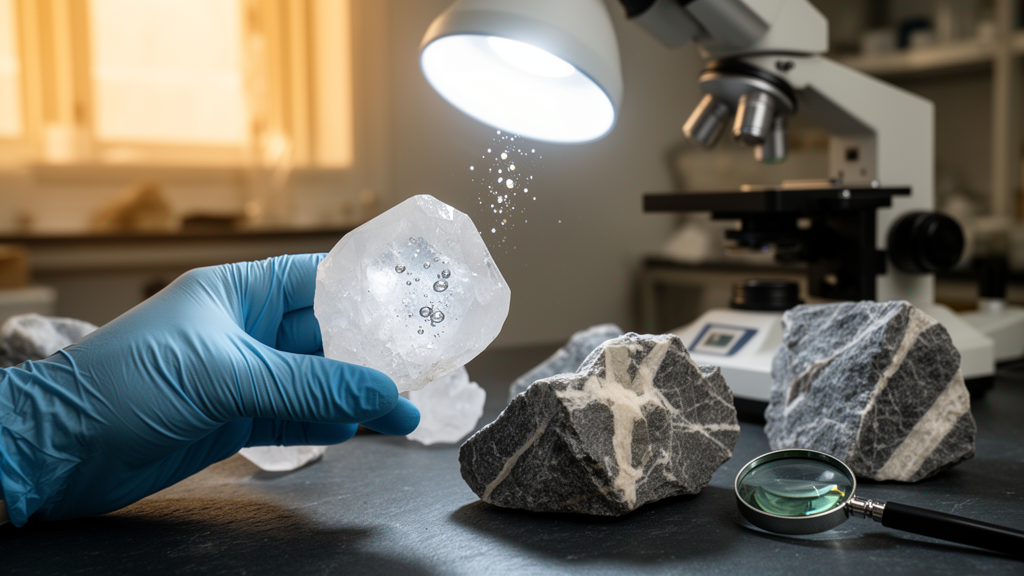
Quartz looks like the plainest mineral on Earth, yet a new study shows it is also one of the most talkative. A team of researchers led by Marko Bermanec of the University of Bern, working with Nils B. Gies, Thomas Pettke, and Jörg Hermann, has demonstrated that the trace amounts of lithium, boron, aluminium, titanium, and water locked inside hydrothermal quartz crystals can be read like a chemical diary of the fluids that built some of the world’s most important ore deposits. By combining three complementary imaging and analytical techniques, the team reconstructed the complete cooling history of pegmatite systems in Italy and Switzerland, from magmatic temperatures above 590 degrees Celsius down to hydrothermal conditions near 300 degrees Celsius. The work, published in the European Journal of Mineralogy, turns a humble mineral into a high-resolution recorder of the magmatic–hydrothermal transition, the critical moment when a cooling granite melt exsolves water-rich fluids that can concentrate economically valuable metals.
The stakes are considerable. Granitic pegmatites are increasingly important sources of lithium, caesium, tantalum, beryllium, boron, and a long list of other elements classified as critical raw materials for the green-energy transition. Lithium in particular has become a strategic commodity because of its role in rechargeable batteries for electric vehicles and portable electronics, and this demand has revived interest in pegmatite deposits once considered too low-grade to mine. The difficulty for geologists is that the geochemical processes operating at the magmatic–hydrothermal transition are hard to observe directly. Fluids escape, minerals react, and the record is often incomplete. Quartz, however, grows throughout the entire crystallization sequence of a pegmatite and is stable from the first hydrous granitic melts to the last drops of hydrothermal fluid, making it an ideal witness if its chemistry can be decoded.
Decoding that chemistry is precisely the challenge the Bern team set out to solve. Quartz incorporates only tiny amounts of foreign elements, often below the detection limits of conventional analytical methods, which is why its potential as a tracer of ore-forming fluids has remained underexploited. The researchers focused on free-grown quartz crystals, some longer than ten centimetres, collected from miarolitic cavities, the gas-filled pockets in pegmatites where crystals grow unimpeded into spectacular euhedral forms. Their samples came from two contrasting settings: the Rosina pegmatite on the island of Elba, Italy, a lithium–caesium–tantalum-type pegmatite emplaced into the Miocene Monte Capanne monzogranite, and the Misox pegmatite in the Ticino region of the Swiss Alps, which formed around 23 to 21.5 million years ago during high-temperature metamorphism of the Lepontine dome.
The first step of the multi-method approach was scanning electron microscopy charge contrast imaging, a technique that reveals chemical growth zonation in quartz at a resolution comparable to cathodoluminescence. Uncoated, doubly polished thick sections were imaged with a gaseous scintillation detection system, producing maps in which brighter contrast generally corresponds to higher trace element contents. In the Rosina quartz, the images revealed classic core–rim zonation with brighter cores, suggesting that trace elements were most abundant early in crystal growth. The Misox crystals told a more complicated story: they displayed extensive Dauphiné-law twinning, in which two crystal domains with different crystallographic orientations grew side by side and incorporated different amounts of trace elements, producing contrasting brightness within what is nominally the same growth zone.
Next came Fourier transform infrared spectroscopy, which detects the hydroxyl point defects that tie hydrogen into the nominally anhydrous quartz structure. Each defect species produces a characteristic absorption band: the AlOH defect yields a sharp triplet near 3378, 3310, and 3440 wavenumbers per centimetre, the LiOH defect absorbs near 3480 and 3510, and the BOH defect appears at 3595. By mapping these bands across polished sections in polarized light and applying defect-specific absorption coefficients confirmed by density functional theory calculations, the team converted spectral images into quantitative maps of water coupled to lithium, boron, and aluminium. The results were striking. In Rosina quartz, OH-coupled lithium, boron, and aluminium reached maximum concentrations of 1.9, 3.3, and 8.9 micrograms per gram respectively, dropping by up to an order of magnitude toward the crystal rims. In Misox quartz the pattern reversed, with aluminium defects reaching up to 68 micrograms per gram in the crystal tips.
With the growth architecture mapped, the researchers then navigated laser ablation inductively coupled plasma mass spectrometry spot measurements to specific zones identified in the charge contrast and FTIR images. The LA-ICP-MS data quantified total trace element contents, including titanium, which serves as the basis of the titanium-in-quartz geothermometer. Rosina quartz contained 11 to 450 micrograms per gram of lithium, 43 to 1780 micrograms per gram of aluminium, and up to 12 micrograms per gram of titanium, all highest in the crystal cores. Misox quartz showed the opposite trend, with all measured elements increasing from core to rim. Crucially, lithium and aluminium were linearly correlated in every sample, following an almost perfect one-to-one molar ratio in Rosina quartz, consistent with a coupled substitution in which trivalent aluminium replaces tetravalent silicon and monovalent lithium occupies structural channels to balance the charge.
Titanium-in-quartz thermometry then anchored the chemical zonation to temperature. Assuming a pressure of 2.3 kilobars for Rosina and 5 to 6 kilobars for Misox, and a titanium activity of 0.5 based on the presence of ilmenite in the mineral assemblages, the calculated temperatures decreased smoothly from core to rim in both localities: from about 590 to 330 degrees Celsius in Rosina and from roughly 520 to 300 degrees Celsius in Misox. But the study also exposed a cautionary tale for anyone using this popular thermometer. Because Dauphiné twin domains incorporate different amounts of titanium, identical growth zones in adjacent twin domains yielded apparent temperatures differing by more than 20 degrees Celsius, and in extreme cases up to about 30 degrees. The authors conclude that titanium-in-quartz temperatures cannot realistically be more precise than roughly ten percent, or about 25 degrees Celsius, unless the textural complexity of the crystal is fully characterized first.
The comparison between the two localities produced perhaps the most practically exciting result. When lithium content is plotted against total water content, the Rosina and Misox quartz occupy two distinct compositional fields: for a given water concentration, Rosina quartz carries up to an order of magnitude more lithium. The difference makes geological sense, because the Rosina pegmatite contains lithium micas and lithium tourmalines whereas the Misox pegmatite does not, meaning the Rosina fluids were far more lithium-rich before lithium minerals saturated. This relationship suggests that lithium and water measurements in quartz could serve as a prospecting tool, allowing geologists to identify lithium-rich pegmatite systems even from detrital quartz grains in stream sediments or soils, long before any pegmatite outcrop is found. In an era of surging lithium demand, a cheap mineralogical fingerprint for buried lithium deposits is a prospect with obvious commercial appeal.
Beyond exploration, the study delivers a fundamental insight into how trace elements actually enter the quartz structure. Only a small fraction of total lithium and aluminium, between 5 and 30 percent depending on the element and locality, is incorporated through hydroxyl-coupled defects, yet these defects faithfully record fluid composition because diffusion is too slow at hydrothermal temperatures to erase the sharp zoning. Boron stands out: roughly half of all boron in the studied quartz is associated with hydroxyl defects, and at low concentrations essentially all of it may be. The dominance of the LiOH defect in the Rosina spectra is itself rare, apparently restricted to highly evolved pegmatitic environments. The sharp decrease in lithium, aluminium, and water at the Rosina core–rim transition occurred without any corresponding temperature drop, hinting that factors such as the magmatic–hydrothermal transition itself, or the crystallization of new lithium minerals like lepidolite, controlled the switch in incorporation mechanisms. Each miarolitic cavity, moreover, evolved in isolation at local equilibrium, with different lithium contents but parallel cooling trends. Taken together, the results show that a quartz crystal, interrogated with the right combination of instruments, is not just a pretty specimen but a complete pressure–temperature–composition recorder of the fluids that make ore deposits, and a roadmap for finding the next generation of critical metal resources.
Subject of Research: Trace element and hydroxyl defect zonation in hydrothermal quartz from granitic pegmatites as a recorder of magmatic–hydrothermal fluid evolution and ore formation
Article Title: Hydrothermal quartz genesis revealed by the combination of SEM charge contrast maps, FTIR mapping, and LA-ICP-MS trace element geochemistry
Article References: Bermanec, M., Gies, N. B., Pettke, T., & Hermann, J. (2026). Hydrothermal quartz genesis revealed by the combination of SEM charge contrast maps, FTIR mapping, and LA-ICP-MS trace element geochemistry. European Journal of Mineralogy, 38(4), 397-417. https://doi.org/10.5194/ejm-38-397-2026
Image Credits: AI Generated
Keywords: quartz, pegmatites, hydrothermal fluids, lithium, FTIR spectroscopy, LA-ICP-MS, trace elements, Ti-in-quartz thermometry, ore deposits, critical metals, SEM charge contrast, Elba
Cite Scienmag News
Bethany Barker. (October 9, 2026). Hidden Water and Lithium Clues Inside Quartz Reveal How Pegmatite Ores Form. Scienmag. https://scienmag.com/hidden-water-and-lithium-clues-inside-quartz-reveal-how-pegmatite-ores-form/
Bethany Barker. "Hidden Water and Lithium Clues Inside Quartz Reveal How Pegmatite Ores Form." Scienmag, 9 October 2026, https://scienmag.com/hidden-water-and-lithium-clues-inside-quartz-reveal-how-pegmatite-ores-form/. Accessed 9 October 2026.
Bethany Barker. "Hidden Water and Lithium Clues Inside Quartz Reveal How Pegmatite Ores Form." Scienmag. October 9, 2026. https://scienmag.com/hidden-water-and-lithium-clues-inside-quartz-reveal-how-pegmatite-ores-form/


