


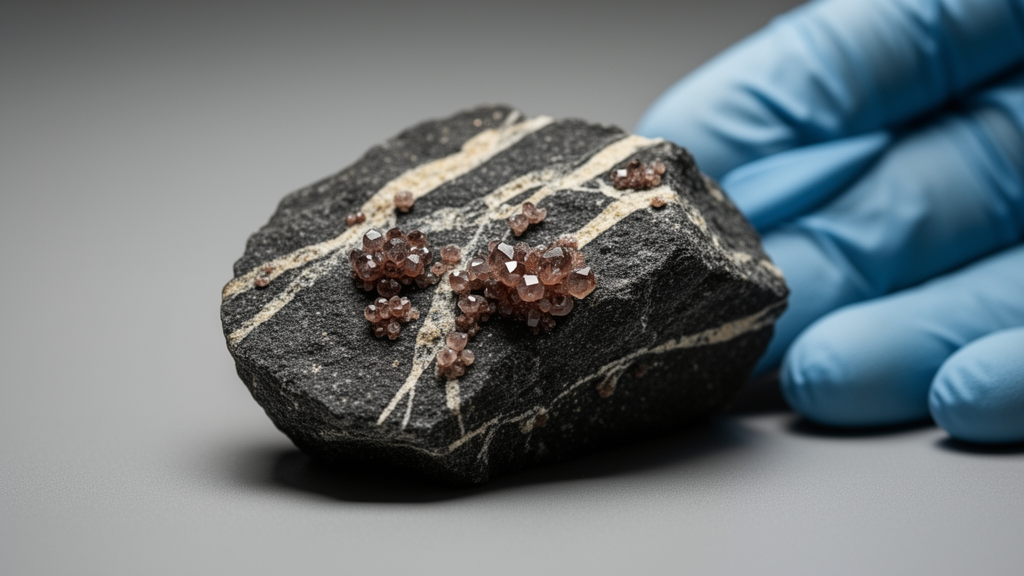
A new mineral species has been discovered at Mont Saint-Hilaire, Quebec, one of the world’s most celebrated mineral localities, and it carries a distinction that has never been observed before in nature. The mineral, named bainbridgeite-(NdCe), is the first known mineral in which cerium and neodymium atoms preferentially concentrate at two different crystallographic sites within the same structure. The discovery, published in the European Journal of Mineralogy by a team led by Inna Lykova of the Canadian Museum of Nature, adds a remarkable fifth chapter to the ongoing study of the mckelveyite group of rare carbonate minerals and offers fresh insight into how rare-earth elements behave in the final stages of magmatic crystallization.
Bainbridgeite-(NdCe) has the ideal chemical formula Na2Ba2NdCe(CO3)6·3H2O, meaning that each unit of the mineral combines two sodium atoms, two barium atoms, one neodymium atom, one cerium atom, six carbonate groups, and three water molecules. It belongs to the mckelveyite group, a family of rare hydrated carbonates whose general formula can be written as A3B3(CO3)6·3H2O, where the A sites are occupied by elements such as sodium, calcium, yttrium, zirconium, and neodymium, while the B sites host strontium, barium, cerium, and lanthanum. The new species is the neodymium analogue of bainbridgeite-(YCe), which was described from the same locality in 2024, and it is also the barium-neodymium analogue of alicewilsonite-(YCe). Both the mineral and its name were approved by the Commission on New Minerals, Nomenclature and Classification of the International Mineralogical Association under proposal number IMA 2023-018, and the holotype specimen has been deposited in the collection of the Canadian Museum of Nature in Ottawa under catalogue number CMNMC 90534.
The mineral was found at the Poudrette quarry, a site within the Mont Saint-Hilaire alkaline and agpaitic complex that has produced an extraordinary number of new mineral species over the decades. Bainbridgeite-(NdCe) turned up in two quite different geological settings. The first is an environment referred to in the literature as carbonate pegmatites or carbonate vugs, bodies rich in calcite that lack the pyroxene and amphibole minerals typical of alkaline pegmatites and whose origin remains poorly understood. In this setting, the type material was recovered from a heavily altered body consisting mostly of calcite and albite, collected by Elsa Pfenninger-Horváth and László Horváth in February 1978. There, bainbridgeite-(NdCe) forms thin rims, up to twenty to thirty micrometers thick, on barrel-shaped short prismatic crystals reaching two millimeters in size. Remarkably, the cores of those same crystals are composed of bainbridgeite-(YCe), with an intermediate zone corresponding to a member of the bainbridgeite-(YCe)-alicewilsonite-(YCe) series, so a single crystal records a sequence of changing chemical conditions during its growth.
The second occurrence is quite different. In a hornfels rock, bainbridgeite-(NdCe) appears as white or pale-grey tabular, saucer-shaped crystals up to half a millimeter across, commonly stacked together and associated with yellow acicular rutile, colourless hexagonal tabular gmelinite-Na, sphalerite, calcite, analcime, and pyrite. In these crystals, the entire grain is bainbridgeite-(NdCe), with no yttrium-dominant core. The coexistence of the mineral in both a carbonate-rich vug environment and a hornfels highlights the versatility of late-stage fluids in the Mont Saint-Hilaire complex, which apparently could deliver the right combination of sodium, barium, carbonate, and rare-earth elements in more than one geological context.
Physically, bainbridgeite-(NdCe) is a pale yellow, pale orange, white, or pale grey mineral with a white streak and a vitreous lustre. It shows no cleavage, has an uneven fracture, and a Mohs hardness of three, determined on material from the hornfels occurrence because the rims in the holotype are too thin for such a test. The mineral is non-fluorescent under ultraviolet light, and its calculated density is 3.49 grams per cubic centimeter. Optically it is biaxial positive, with refractive indices of 1.577, 1.592, and 1.657 for the three principal axes, and a measured axial angle of forty degrees. These modest, unassuming properties are typical of the mckelveyite group, whose members are usually recognized not by striking appearance but by careful chemical and crystallographic analysis.
Characterizing the new species demanded a battery of analytical techniques, and the researchers had to contend with some serious practical obstacles. Electron microprobe analyses were performed with a JEOL 8230 SuperProbe using wavelength-dispersive spectroscopy, but bainbridgeite-(NdCe) is unstable under the electron beam, so larger beam diameters of ten to twenty micrometers were used to minimize element migration, and time-dependent intensity corrections were applied for several elements. Water and carbon dioxide contents could not be measured directly because of the scarcity of material and were instead calculated from stoichiometry. Infrared spectroscopy, carried out at the Canadian Conservation Institute on a tiny fragment mounted in a diamond anvil cell, confirmed the presence of water molecules through characteristic oxygen-hydrogen stretching and hydrogen-oxygen-hydrogen bending bands, and revealed a band at 1064 wavenumbers indicating that the carbonate groups in the structure are polarized rather than symmetric.
X-ray diffraction work proved equally challenging. Powder diffraction data could not be collected from pure bainbridgeite-(NdCe), because not enough separate grains could be recovered, so the measured pattern represents an average of the new mineral and its yttrium-dominant neighbour. Single-crystal diffraction, performed at the Natural History Museum in Oslo on a Rigaku XtaLAB Synergy-S diffractometer, faced the same problem: because bainbridgeite-(NdCe) occurs only as a thin rim on bainbridgeite-(YCe) and the boundary between the two phases is not visually identifiable, the structural model represents an average of both phases. Even so, the structure was solved and refined to an R1 value of 0.036 in the triclinic space group P1, with unit-cell parameters a of 9.0525 angstroms, b of 9.1178 angstroms, c of 6.8518 angstroms, and a cell volume of 438.23 cubic angstroms. The structure is of the weloganite type and is strongly pseudotrigonal, with six independent large-cation sites forming two alternating layers parallel to the ab plane, three water molecules bonded to barium- and sodium-centred polyhedra, and six carbonate groups, three of which lie nearly coplanar with the (001) plane.
The heart of the discovery lies in the distribution of cations among those sites. By combining electron microprobe data, refined site-scattering factors from the diffraction experiment, interatomic distances, bond valence calculations, and charge balance, the team demonstrated that neodymium atoms overwhelmingly prefer the site designated Nd6, while cerium atoms concentrate at the Ce3 site. The evidence is compelling from chemistry alone: the neodymium content of the holotype, 0.35 atoms per formula unit, is significantly higher than that of any single heavier lanthanide, higher than the combined total of all heavier lanthanides from samarium through dysprosium, higher than the yttrium content, and far higher than the neodymium content of the yttrium-dominant holotype of bainbridgeite-(YCe). A specimen from the hornfels shows an even stronger pattern, with 0.41 atoms of neodymium per formula unit. Structural evidence reinforces the case: the site occupied predominantly by yttrium in bainbridgeite-(YCe) is instead dominated by neodymium and other lanthanides in the new mineral, consistent with a substitution of yttrium by rare-earth elements at that position.
Why does neodymium, an element that usually disperses among other rare-earth-bearing minerals rather than forming its own phases, concentrate here? The authors propose a mechanism rooted in crystal chemistry. Neodymium has a particular affinity for yttrium, and in late-stage agpaitic environments, as yttrium becomes depleted from the residual fluid, neodymium can rise to become the dominant rare-earth element in a newly forming phase. The team previously demonstrated this behaviour in piilonenite-(Nd), another neodymium-dominant carbonate from Mont Saint-Hilaire. The model makes a testable prediction: samarium and gadolinium, which are smaller than neodymium but larger than the heavy rare earths that typically follow yttrium, should show an even greater affinity for yttrium-favouring sites and should therefore also become enriched in late-stage phases. The chemical data bear this out. Samarium and gadolinium contents rise from negligible values of 0.01 and 0.03 atoms per formula unit in the yttrium-dominant cores of the crystals to 0.18 and 0.14 atoms per formula unit in the neodymium-dominant rims, with similar enrichment in the hornfels material.
Bainbridgeite-(NdCe) thus does more than add a name to the mineralogical record. It provides a natural experiment in element sorting, showing how the subtle size preferences of individual rare-earth atoms can drive their separation into distinct structural sites as a magmatic system evolves. Because rare-earth elements underpin modern technologies from permanent magnets to phosphors, understanding the crystallochemical rules that govern their partitioning in alkaline complexes has relevance well beyond mineral taxonomy. Mont Saint-Hilaire, which has yielded dozens of new species since quarrying began, once again demonstrates its unmatched ability to preserve the chemistry of late-stage fluids in exquisitely rare and structurally intricate minerals, and the mckelveyite group, now spanning five formally described parts, continues to reveal how nature organizes some of the rarest elements in the crust.
Subject of Research: Crystal chemistry and site-specific rare-earth element partitioning in a new mckelveyite-group carbonate mineral
Article Title: Mckelveyite group minerals – Part 5: Bainbridgeite-(NdCe), Na2Ba2NdCe(CO3)6●3H2O, a new neodymium and cerium-dominant species from Mont Saint-Hilaire, Canada
Article References: Lykova, I., Rowe, R., Poirier, G., Friis, H., Ojaste, K., & Barnes, S. (2026). Mckelveyite group minerals – Part 5: Bainbridgeite-(NdCe), Na 2 Ba 2 NdCe(CO 3 ) 6 ●3H 2 O, a new neodymium and cerium-dominant species from Mont Saint-Hilaire, Canada. European Journal of Mineralogy, 38(4), 419-429. https://doi.org/10.5194/ejm-38-419-2026
Image Credits: AI Generated
Keywords: bainbridgeite-(NdCe), new mineral species, Mont Saint-Hilaire, mckelveyite group, rare-earth elements, neodymium, cerium, carbonate mineral, crystal structure, X-ray diffraction, alkaline complex, mineralogy
Cite Scienmag News
Bethany Barker. (October 9, 2026). New Mineral Bainbridgeite-(NdCe) Reveals Rare-Earth Element Sorting in Canadian Alkaline Complex. Scienmag. https://scienmag.com/new-mineral-bainbridgeite-ndce-reveals-rare-earth-element-sorting-in-canadian-alkaline-complex/
Bethany Barker. "New Mineral Bainbridgeite-(NdCe) Reveals Rare-Earth Element Sorting in Canadian Alkaline Complex." Scienmag, 9 October 2026, https://scienmag.com/new-mineral-bainbridgeite-ndce-reveals-rare-earth-element-sorting-in-canadian-alkaline-complex/. Accessed 9 October 2026.
Bethany Barker. "New Mineral Bainbridgeite-(NdCe) Reveals Rare-Earth Element Sorting in Canadian Alkaline Complex." Scienmag. October 9, 2026. https://scienmag.com/new-mineral-bainbridgeite-ndce-reveals-rare-earth-element-sorting-in-canadian-alkaline-complex/


