


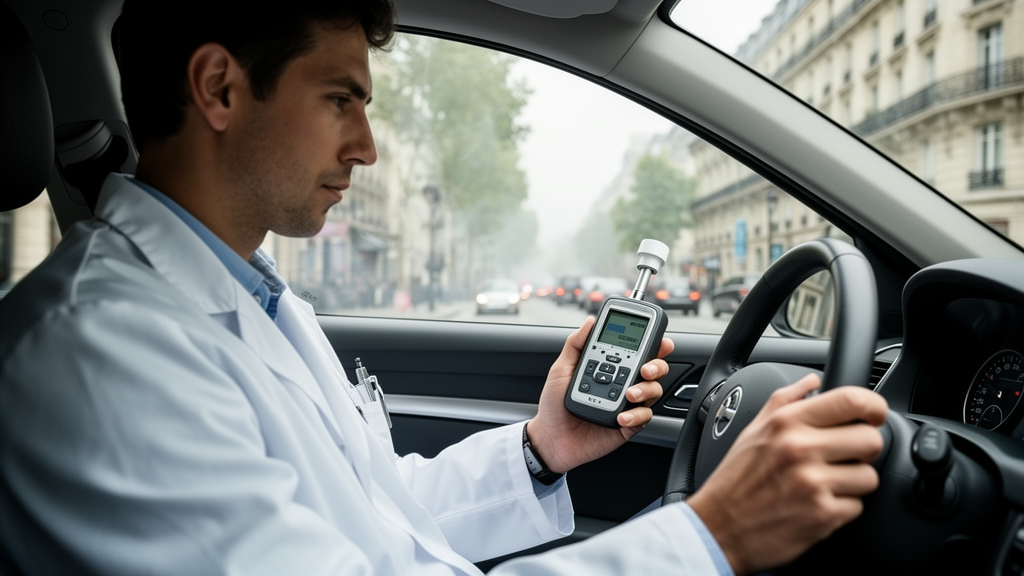
Every day, millions of commuters sit inside cars that draw in outside air through a small, often forgotten component: the cabin filter. This unassuming piece of engineered fabric is the primary barrier between passengers and the cocktail of airborne particles that swirl through urban traffic, from brake dust and tire wear debris to diesel soot and secondary aerosols. Yet nearly everything we know about how well these filters actually work comes from laboratory bench tests conducted under controlled, idealized conditions. A new study from French researchers, published as a preprint under review in the journal Aerosol Research, takes a different approach. A team led by Ambre Delater of the French National Institute for Industrial Environment and Risks (INERIS), working with colleagues from INERIS and the Université Paris Est Créteil, has developed and tested a methodology for evaluating cabin filtration efficiency in a moving vehicle on real roads in the Paris region, using reference-grade gravimetric particle measurements rather than relying solely on laboratory standards.
The motivation behind the study is straightforward but important. Laboratory assessments of cabin filters follow rigorous standardized protocols, and they are excellent for comparing products against one another. What they cannot capture is the full complexity of the real world: fluctuating vehicle speeds, turbulent airflow around a moving car body, changing weather conditions, humidity, and the actual way air is channeled into the heating, ventilation, and air conditioning system of a specific vehicle. These parameters can all influence how many particles reach the filter and how effectively it captures them. Until now, comparable on-road studies using reference particle measurements have been scarce or nonexistent, leaving a genuine gap between certified laboratory performance and the protection passengers actually experience on their daily drives.
Building a measurement system capable of delivering trustworthy data on a moving vehicle is far from trivial. The researchers designed a dedicated sampling line that draws air from an area located under the windscreen of an SUV, upstream of the cabin filter, and a second sampling point downstream of the filter on the front seat inside the cabin. By measuring particle concentrations at both locations simultaneously, they could calculate how much of the incoming particulate matter the filter removed. The placement of the upstream inlet was critical: it had to sample air that genuinely represents what the ventilation system feeds into the filter, without being biased by the complex aerodynamics of air flowing over a moving car.
To ensure the sampling line itself did not distort the measurements, the team carried out what they describe as transdisciplinary work combining computational fluid dynamics simulations, wind tunnel measurements, and numerical methods. The results showed that the sampling efficiency of the line was greater than 94 percent for PM1, meaning particles with an aerodynamic diameter of less than one micrometer, and greater than 77 percent for PM2.5, particles smaller than 2.5 micrometers. These figures quantify how reliably the inlet captures particles across the size ranges most relevant to health, since fine and ultrafine particles penetrate deepest into the human respiratory system. Without this validation step, any downstream calculation of filtration efficiency would have carried unquantified errors.
With the sampling system validated, the researchers took their instrumented SUV onto roads in the Paris region. They tested two different cabin filters, designated Filter A and Filter B, and also ran tests with no cabin filter installed at all, providing a baseline that reveals how much particles enter the cabin when essentially unfiltered. The gravimetric method, which involves physically collecting particles on a substrate and weighing them, served as the reference measurement technique throughout, in contrast to the optical particle counters that are more commonly used for convenience in field studies.
The results offer a nuanced picture of real-world cabin protection. For PM1, the average filtration efficiency was 51.4 percent for Filter A across fifteen tests, 52.7 percent for Filter B across fourteen tests, and just 9.5 percent without a cabin filter across four tests. For PM2.5, the corresponding averages were 57.3 percent for Filter A, 56 percent for Filter B, and 32 percent without a filter, each based on nine tests for the filtered conditions and four for the unfiltered baseline. The two commercial filters performed remarkably similarly to each other, despite being different products, while the no-filter condition demonstrated that even without any filtration some particles are naturally lost inside the ventilation ductwork and cabin, likely through deposition on surfaces.
One of the most consequential findings of the study concerns the instruments themselves. Alongside the gravimetric reference measurements, the team operated optical particle counters simultaneously. Optical counters infer particle concentration from the way particles scatter light, and they are widely used because they deliver real-time data at low cost. But the comparison revealed that the optical counters underestimated the concentration of PM2.5 under real road conditions. This matters far beyond the automotive context: it suggests that field studies relying on optical counting alone may systematically misjudge how much particulate pollution people are exposed to in traffic, and it underscores the researchers’ argument that reference gravimetric methods remain essential when accuracy is the priority.
The study, which is currently under peer review and has already attracted detailed referee comments, is explicitly framed as a contribution to an on-road methodology rather than a definitive consumer verdict on any particular filter brand. The reviewers have raised substantive points, including the need to demonstrate that particle concentrations were uniform across the sampling cross-section, to justify applying dilution characteristics derived from a gaseous tracer to aerosol particles, and to validate the software-based estimates of particle losses within the sampling line. They have also noted that the method, as designed, is tailored to one specific vehicle, since duct geometry and ventilation characteristics differ between models, which could limit general applicability. These are exactly the kinds of methodological challenges that the discussion phase of open peer review is designed to surface, and addressing them will be key to establishing the approach as a standard tool.
Even at this stage, the implications are significant. For researchers studying aerosol filtration, the protocol provides a template for investigating how filters behave under dynamic, real-world conditions, potentially revealing mechanisms that laboratory tests cannot reproduce, such as the effect of transient airflow surges when the fan speed changes or the influence of ambient humidity on particle capture. For the automotive industry and filter manufacturers, an on-road validation method could eventually complement existing standards and help close the gap between certified performance and lived experience. And for the public, the study is a reminder that the air inside a car is not automatically clean: even with a functioning cabin filter, roughly half of the finest particles in the incoming air made it through in these tests.
As cities worldwide grapple with the health burden of traffic-related air pollution, and as in-cabin air quality becomes a selling point for electric vehicles equipped with increasingly sophisticated filtration systems, the need for measurements grounded in reality will only grow. This Paris-based effort to move cabin filter testing out of the laboratory and onto the road, with the methodological transparency that open peer review demands, represents a meaningful step toward knowing not just what a filter can do on a test bench, but what it actually does for the people breathing behind the windscreen.
Subject of Research: On-road assessment of automotive cabin air filtration efficiency against particulate pollution
Article Title: Assessment of cabin filtration efficiency: contribution to an on-road methodology
Article References: Assessment of cabin filtration efficiency: contribution to an on-road methodology. (n.d.). https://doi.org/10.5194/ar-2026-25
Image Credits: AI Generated
DOI: 10.5194/ar-2026-25
Keywords: cabin air filters, aerosol filtration, PM2.5, PM1, air quality, on-road measurement, gravimetric analysis, computational fluid dynamics, vehicle ventilation, urban pollution, particle exposure, INERIS
Cite Scienmag News
Russell Cooper. (October 9, 2026). Scientists Test Car Cabin Filters on Real Paris Roads, Not Just in Labs. Scienmag. https://scienmag.com/scientists-test-car-cabin-filters-on-real-paris-roads-not-just-in-labs/
Russell Cooper. "Scientists Test Car Cabin Filters on Real Paris Roads, Not Just in Labs." Scienmag, 9 October 2026, https://scienmag.com/scientists-test-car-cabin-filters-on-real-paris-roads-not-just-in-labs/. Accessed 9 October 2026.
Russell Cooper. "Scientists Test Car Cabin Filters on Real Paris Roads, Not Just in Labs." Scienmag. October 9, 2026. https://scienmag.com/scientists-test-car-cabin-filters-on-real-paris-roads-not-just-in-labs/


