


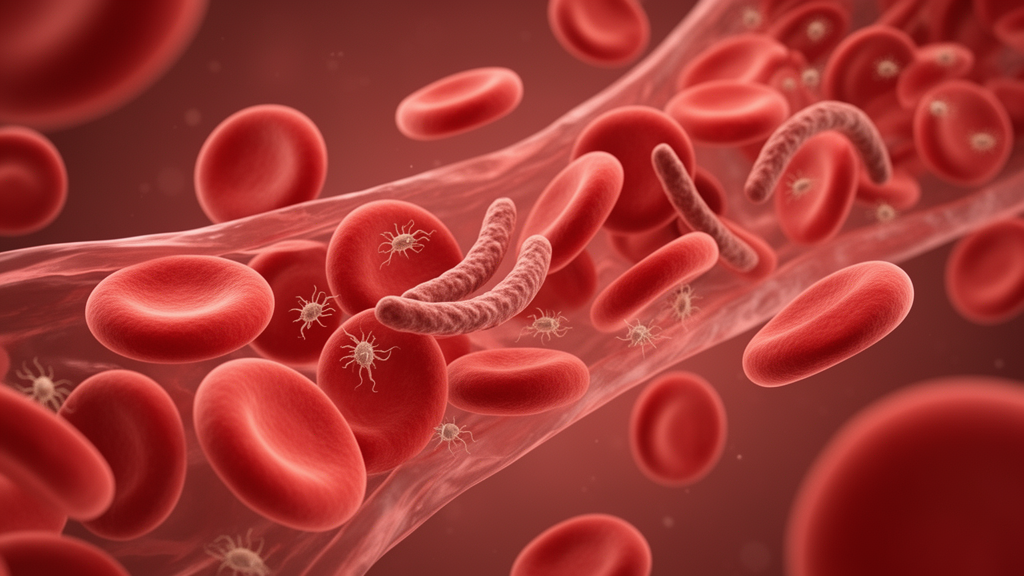
One of the most famous stories in human evolutionary biology is the balancing act between the sickle cell mutation and malaria. Carrying one copy of the sickle haemoglobin variant, known as HbS, protects children against life-threatening falciparum malaria, which is why the mutation remains common in tropical Africa despite causing devastating disease in those who inherit two copies. For decades, textbooks have framed this as a relatively one-sided arms race: the human host evolved a defence, and the parasite has been cast as the besieged party. A new study published in Nature Microbiology complicates that picture, showing that the malaria parasite itself carries genetic variants that appear to interact with, and perhaps partially counter, sickle cell protection even in people who never feel ill.
The research, led by Helena D. Hopson and Ellen M. Leffler of the University of Utah School of Medicine together with Sandrine E. Nsango of the Centre Pasteur du Cameroun and colleagues, focused on a question that has long been underexplored: what happens to the parasite’s genotype in asymptomatic infections? Most previous work on parasite adaptation to sickle haemoglobin examined children who were visibly sick with malaria. But in regions of intense transmission, a large share of infections produce no fever or other symptoms at all, and these silent infections are a major reservoir that keeps transmission going. Understanding whether the parasite’s sickle-associated alleles persist in these quiet infections offers a window into how the host-parasite relationship is actually playing out on the ground.
To answer it, the team conducted a cross-sectional survey of 2,246 healthy schoolchildren in the Mfou region of Cameroon, an area of about 3,300 square kilometres near the capital Yaoundé where malaria transmission is high. Samples were collected across three high-transmission seasons, spanning October to December 2022, April to May 2023, and November to December 2023, from eleven villages with individual sample sizes ranging from 6 to 638 children. The researchers genotyped each child for the human HbS variant and, using multiplexed amplicon deep sequencing, characterised the parasite genotypes in the blood samples, including the parasite loci known as Pfsa1 and Pfsa3, which carry alleles previously associated with sickle haemoglobin in studies of symptomatic disease.
The first key result was, in a sense, a negative finding. Children with the heterozygous sickle cell trait, genotype HbAS, and children with two normal haemoglobin copies, genotype HbAA, showed similar rates of asymptomatic infection. Out of the schoolchildren surveyed, 1,701 carried asymptomatic Plasmodium falciparum infections that could be genotyped. This means that sickle cell trait does not appear to prevent infection altogether in this setting; carriers are being infected at rates comparable to their non-carrier peers. The protection that HbS confers is therefore not a simple wall against the parasite, at least not against the parasite populations circulating in Mfou.
However, the composition of those infections differed dramatically by host genotype. The HbS genotype was strongly associated with parasites carrying the sickle-associated alleles, designated Pfsa-positive, at both the Pfsa1 and Pfsa3 loci. In other words, among children carrying one sickle haemoglobin copy, the parasites they harboured were significantly enriched for these specific variants, indicating a selective advantage for the Pfsa-positive alleles specifically within HbAS hosts. The association held up across villages and seasons, and additional analyses showed that HbS carriers had lower complexity of infection, meaning fewer distinct parasite genotypes per person, and lower parasitaemia, meaning fewer parasites in the bloodstream, compared with HbAA children.
These parasite alleles were first identified in a 2022 Nature study by Gavin Band and colleagues, who showed that the protective effect of sickle haemoglobin against symptomatic malaria depends on the parasite’s own genotype. Parasites carrying Pfsa-positive alleles appear to partially overcome HbS-mediated protection, which is why they are overrepresented among infections that make HbAS carriers sick. The new Cameroon study extends that logic backwards in the disease course: even before any symptoms appear, the host’s haemoglobin genotype is already shaping which parasite genotypes can establish and persist. The selective pressure exerted by sickle cell trait is visible in the silent reservoir of infection, not just in the clinic.
The authors interpret these findings through the framework of resistance and tolerance, two distinct biological strategies for dealing with infection. Resistance mechanisms reduce the number of parasites in the host, while tolerance mechanisms limit the damage caused by a given parasite burden without reducing the burden itself. Previous work has suggested that sickle haemoglobin acts through both routes: laboratory studies going back to 1978 showed impaired parasite growth in sickle trait red blood cells, driven in part by oxygen-dependent growth inhibition, while a 2011 Cell paper by Ferreira and colleagues argued that sickle haemoglobin confers tolerance to infection. The new data suggest that HbS protects against Pfsa-negative parasites before symptoms appear, consistent with a resistance effect, while the enrichment of Pfsa-positive parasites in asymptomatic carriers hints that these variants may contribute to the lower rates of symptomatic disease observed in HbAS individuals, a pattern more consistent with tolerance.
There is also a striking population-genetic detail in the study. The Pfsa1 and Pfsa3 loci showed strong inter-chromosomal linkage disequilibrium, meaning the sickle-associated alleles at the two loci tend to be inherited together on different chromosomes far more often than chance would predict. This non-random association suggests that the combination of Pfsa-positive alleles at both loci functions as a coordinated adaptation, and that recombination has not yet broken it apart in the Cameroonian parasite population. Such structure in a recombining parasite genome is a signature of recent or ongoing selection, consistent with the idea that P. falciparum is actively evolving in response to the sickle cell variant in human populations.
The broader implication is that the classic red-queen narrative of malaria and sickle cell is more accurately described as a genuine two-sided co-evolution. The sickle cell mutation arose in African populations and was driven to high frequency by the enormous mortality toll of falciparum malaria; recent work suggests rainforest hunter-gatherers acquired the mutation as recently as the Late Pleistocene. But the parasite, with its enormous population sizes and rapid generation times, has not stood still. Alleles that partially mitigate sickle-mediated protection have arisen and spread, and the new study demonstrates that this adaptation is detectable in the everyday, symptomless infections that sustain transmission between seasonal peaks. Host genotype and parasite genotype are locked in a reciprocal dance, and neither side’s moves can be understood in isolation.
For public health, the findings carry practical weight. Asymptomatic infections are increasingly recognised as the silent engine of malaria transmission, persisting through dry seasons and fuelling resurgent outbreaks even where control measures reduce clinical disease. If the parasite genotypes that dominate these reservoirs differ systematically by host haemoglobin status, then surveillance and intervention strategies may need to account for host genetics when interpreting parasite population structure. The study’s data, including human and parasite amplicon sequence reads deposited in the NCBI Sequence Read Archive under BioProject PRJNA1503656, and its analysis code released on GitHub, provide a resource for such efforts. What emerges is a refined view of a celebrated evolutionary story: sickle haemoglobin does protect against malaria, but the protection is a shifting, genotype-specific equilibrium, negotiated afresh by every parasite lineage that encounters a carrier’s red blood cells.
Subject of Research: How sickle cell haemoglobin genotype shapes Plasmodium falciparum parasite genotypes in asymptomatic malaria infections
Article Title: Sickle cell haemoglobin status shapes malaria parasite genotype in asymptomatic infections
Article References: Hopson, H. D., Herbert-Mainero, A., Bouopda-Tuedom, A. G., Nanssong-Vomo, C. T., Tumamo Fotso, B., Kiam, B. C., Ibrahima, I., Onguene, C., Abate, L., Omelianczyk, R. I., Evans, H. D., Horton, L. E., Band, G., Lamb, T. J., Ayong, L. S., Nsango, S. E., & Leffler, E. M. (2026). Sickle cell haemoglobin status shapes malaria parasite genotype in asymptomatic infections. Nature Microbiology. https://doi.org/10.1038/s41564-026-02502-4
Image Credits: AI Generated
DOI: 10.1038/s41564-026-02502-4
Keywords: sickle cell trait, HbS, malaria, Plasmodium falciparum, asymptomatic infection, Pfsa alleles, host-parasite coevolution, genetic association study, Cameroon, disease tolerance, parasite genotype, Nature Microbiology
Cite Scienmag News
Juliet Wilcox. (October 9, 2026). Sickle Cell Trait Quietly Rewrites the Genetics of Silent Malaria Infections. Scienmag. https://scienmag.com/sickle-cell-trait-quietly-rewrites-the-genetics-of-silent-malaria-infections/
Juliet Wilcox. "Sickle Cell Trait Quietly Rewrites the Genetics of Silent Malaria Infections." Scienmag, 9 October 2026, https://scienmag.com/sickle-cell-trait-quietly-rewrites-the-genetics-of-silent-malaria-infections/. Accessed 9 October 2026.
Juliet Wilcox. "Sickle Cell Trait Quietly Rewrites the Genetics of Silent Malaria Infections." Scienmag. October 9, 2026. https://scienmag.com/sickle-cell-trait-quietly-rewrites-the-genetics-of-silent-malaria-infections/


