


Iron is the ocean’s most famous micronutrient, the element that can make or break a phytoplankton bloom. In the Arctic Ocean, where vast continental shelves, rivers, and the Transpolar Drift have long been assumed to dominate the iron budget, a new study suggests that the atmosphere deserves far more attention than it has received. Chris Marsay of the University of Delaware and colleagues from Villanova University, Texas A&M University, Florida State University, and the University of Georgia’s Skidaway Institute of Oceanography measured how much of the iron riding on Arctic aerosol particles actually dissolves into seawater, and their results reveal a striking seasonal rhythm governed by one of the region’s most distinctive atmospheric phenomena: Arctic haze.
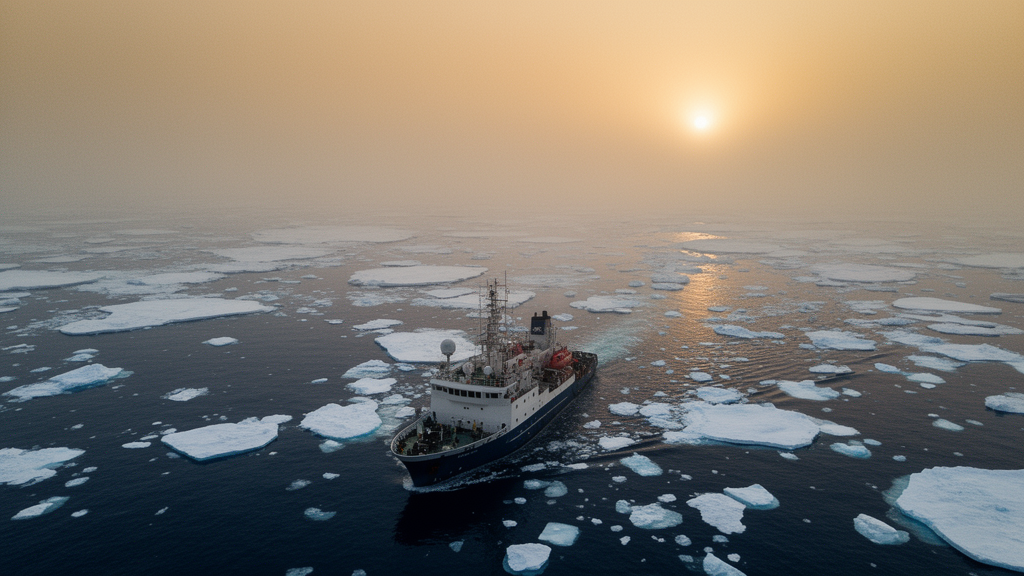
The team analyzed aerosol samples collected during the U.S. GEOTRACES GN01 expedition aboard the U.S. Coast Guard icebreaker Healy between August and October 2015. The cruise traced a northward path from Dutch Harbor across the Bering Sea and the Makarov Basin all the way to the North Pole, before returning across the Canada Basin along the northern coast of Alaska. High-volume samplers mounted above the ship’s bridge, roughly 23 meters above sea level, pulled air through acid-washed cellulose filters, collecting bulk aerosol particles whose iron content could then be interrogated in the laboratory. Sampling was restricted to periods when the wind blew from ahead of the ship, preventing contamination from the vessel’s own exhaust.
What makes the study methodologically interesting is that the researchers did not rely on a single definition of “soluble” iron. Instead, they applied three different leaching techniques to replicate filters from each deployment. The first two were rapid, flow-through extractions with ultrapure water and with filtered seawater, designed to mimic the instantaneous release of iron when a particle hits the sea surface or is scavenged by raindrops. The third was a far more aggressive treatment: a hot acetic acid solution containing a reducing agent, heated to 90 degrees Celsius and left in contact with the sample for 12 to 16 hours, intended to capture the fraction of iron that phytoplankton could access over days through photochemistry, grazing, and ligand-assisted dissolution.
The results exposed just how much the answer depends on the question being asked. In the gentle ultrapure water leach, iron solubility averaged a mere 0.7 percent, and in filtered seawater it averaged 1.6 percent. Yet the aggressive acetic acid leach dissolved a median of 44 percent of the total aerosol iron, with individual samples reaching as high as 96 percent. Because the aerosol iron-to-aluminum and iron-to-titanium ratios hovered near crustal averages, the team concluded that the particles were dominated by mineral dust rather than combustion emissions, meaning that a substantial portion of even ordinary mineral aerosol iron was chemically accessible under sufficiently harsh conditions, possibly because the material had been heavily weathered before or during its atmospheric journey.
Air mass history turned out to be a decisive control on the water-soluble fraction. Using 100-hour back trajectories calculated with the NOAA HYSPLIT model, the researchers grouped their samples by origin. One sample, collected while the ship traversed the Bering and Chukchi Seas, stood out dramatically: its ultrapure water solubility reached 8.8 percent, more than ten times the median of the rest of the cruise. That same sample carried elevated concentrations of non-sea-salt sulfate, nitrate, and vanadium relative to aluminum, all classic fingerprints of fossil fuel combustion. Iron in combustion aerosols, present as adsorbed impurities or ferric sulfate salts rather than locked inside mineral lattices, dissolves rapidly regardless of pH, which explains why anthropogenic influence can inflate the soluble fraction even when total iron loading stays modest.
The most consequential finding emerged when the GN01 data were placed alongside measurements from the MOSAiC expedition, during which the same team used identical sampling and leaching protocols aboard a research vessel frozen into the Arctic pack ice between December 2019 and May 2020. In winter, the median ultrapure water solubility was 6.5 percent; in spring it fell to 1.9 percent; and in the GN01 summer samples it dropped to just 0.7 percent. This pronounced seasonal staircase tracks the life cycle of Arctic haze, the wintertime accumulation of anthropogenic aerosols transported from lower latitudes under conditions of weak precipitation and stable stratification. The haze carries acidic sulfate and nitrate species, derived from sulfur dioxide and nitrogen oxides, that can react with the surfaces of mineral dust particles and mobilize their iron.
Statistical analysis reinforced the connection. Across the combined GN01 and MOSAiC dataset, iron solubility correlated strongly and positively with non-sea-salt sulfate concentration, with a Spearman rank coefficient of 0.75 and a p-value below 0.001. Intriguingly, the relationship was steeper in winter than in spring even though sulfate levels themselves did not differ significantly between the two seasons. The authors propose that wintertime aerosols rich in black carbon, which peaked during January and February of MOSAiC and were traced to sources in northern Asia and Siberia, arrived together with combustion-derived organic compounds such as oxalate. Water-soluble organic ligands like oxalate are known to bind iron and enhance its dissolution, offering a plausible mechanism for why the same amount of sulfate appears to do more chemical work in the dark of winter than during the spring transition.
When the solubility measurements were converted into deposition fluxes using the beryllium-7 tracer method, the seasonal picture inverted in a counterintuitive way. Beryllium-7, a short-lived radioisotope produced in the upper atmosphere and delivered to the surface on aerosol particles, allowed the team to calculate bulk deposition velocities of roughly 1,140 meters per day during GN01 and 613 meters per day during MOSAiC. Multiplying these velocities by aerosol iron concentrations yielded summertime fluxes of 0.9 nanomoles of ultrapure-water-soluble iron per square meter per day, compared with 15 nanomoles per square meter per day in winter. In other words, even though particles are removed from the Arctic atmosphere more slowly in winter, the far greater solubility of haze-laden iron means that the largest atmospheric delivery of readily soluble iron occurs in the darkest, coldest months, when most of it lands on sea ice rather than open water.
That timing matters for biology. Iron deposited onto ice in winter is not lost; it is stored in the snowpack, potentially transformed by photochemistry and microbial activity, and eventually released through melt ponds into surface waters as the ice breaks up. The acetic-acid-soluble flux, a better proxy for this delayed but labile supply, was remarkably similar between seasons, at a median of 32 nanomoles per square meter per day in summer versus 31 in the MOSAiC period. As climate change shrinks summer sea ice extent, already down 43 percent since 1979, and shifts deposition from ice to ocean, the fraction of atmospheric iron that reaches phytoplankton directly could grow, particularly in regions where summer iron limitation has been documented, such as the Nansen Basin.
The study also carries a warning about the future chemistry of the Arctic atmosphere. Stricter emissions regulations south of the Arctic are steadily reducing sulfate concentrations in the haze, which could depress wintertime iron solubility in the decades ahead. At the same time, growing shipping traffic, industrial development, and increasingly frequent and intense boreal wildfires promise new sources of combustion aerosols during summer, when deposition increasingly falls directly onto sunlit open water. A warmer, wetter Arctic will also scavenge particles more efficiently, shortening their atmospheric residence time and cutting the window during which acidic and organic species can chemically attack mineral iron. Disentangling these competing effects, the authors argue, is essential for predicting how the ocean’s smallest inhabitants will fare as the top of the world transforms.
Subject of Research: Seasonal and methodological controls on iron solubility in Arctic Ocean aerosols
Article Title: Variations in Arctic aerosol iron solubility in relation to leaching methodology, air mass characteristics, and seasonality
Article References: Marsay, C. M., Ebling, A. M., Morton, P. L., Landing, W. M., & Buck, C. S. (2026). Variations in Arctic aerosol iron solubility in relation to leaching methodology, air mass characteristics, and seasonality. Biogeosciences, 23(19), 6857-6877. https://doi.org/10.5194/bg-23-6857-2026
Image Credits: AI Generated
Keywords: Arctic Ocean, aerosol iron solubility, GEOTRACES, MOSAiC expedition, Arctic haze, phytoplankton, atmospheric deposition, mineral dust, combustion aerosols, beryllium-7, biogeochemistry, climate change
Cite Scienmag News
Violet Maxwell. (October 9, 2026). Arctic Haze Controls How Much Iron Reaches the Ocean, Study Finds. Scienmag. https://scienmag.com/arctic-haze-controls-how-much-iron-reaches-the-ocean-study-finds/
Violet Maxwell. "Arctic Haze Controls How Much Iron Reaches the Ocean, Study Finds." Scienmag, 9 October 2026, https://scienmag.com/arctic-haze-controls-how-much-iron-reaches-the-ocean-study-finds/. Accessed 9 October 2026.
Violet Maxwell. "Arctic Haze Controls How Much Iron Reaches the Ocean, Study Finds." Scienmag. October 9, 2026. https://scienmag.com/arctic-haze-controls-how-much-iron-reaches-the-ocean-study-finds/


