


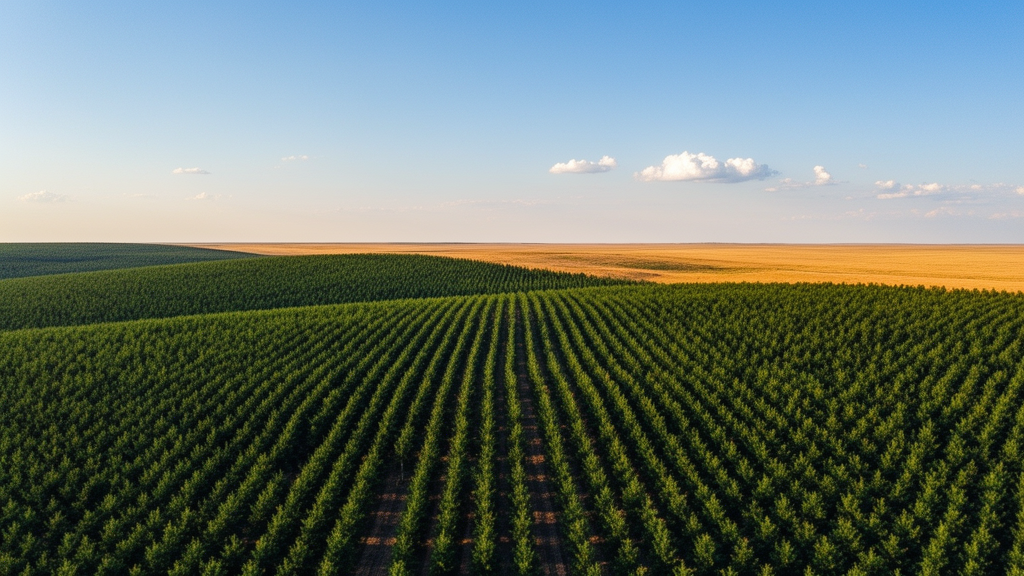
Planting trees has become the world’s favorite climate remedy, a strategy celebrated for its simplicity: put more forests on the land, and they will pull carbon dioxide out of the sky. But a new modeling study published in Atmospheric Chemistry and Physics suggests that the story is far more complicated than the carbon ledger alone. When researchers simulated large-scale forest and bioenergy expansion through the end of the century, they found that these land-use transformations can quietly sabotage one of the planet’s most important cooling mechanisms, the low-level clouds that shade the surface from sunlight. In the worst-case scenario, the loss of these clouds was fast enough to amplify regional warming rather than restrain it.
The research team, led by Nanjian Liu and Zhixin Hao of the Institute of Geographic Sciences and Natural Resources Research at the Chinese Academy of Sciences, together with colleagues at the University at Buffalo and the Institute of Mountain Hazards and Environment, ran transient simulations with the fully coupled Community Earth System Model, or CESM, under a moderate emissions pathway spanning 2015 to 2100. They compared four futures: a control run in which land cover stayed frozen at 2015 levels, an idealized scenario in which roughly 29.3 million square kilometers of grassland and shrubland were converted to forest, an idealized bioenergy expansion in which sugarcane cultivation grew by 6.4 million square kilometers, and a realistic afforestation pathway drawn from published mitigation scenarios, involving about 7.5 million square kilometers of new forest concentrated in tropical South America, Central Africa, and central North America.
The numbers that emerged are striking. In the control simulation, global low-level cloud cover declined at a rate of 0.0153 percent per year. Under the idealized afforestation scenario, that loss accelerated to 0.0175 percent per year, a factor of 1.14 globally, but a factor of 1.52 over land. In the Northern Hemisphere mid-to-high latitudes, the effect was even more dramatic: the rate of low-cloud loss in affected land regions reached twenty times that of the Southern Hemisphere overall. Meanwhile, high-level clouds, the thin cirrus veils that trap outgoing heat and warm the planet, increased 1.5 times faster than in the control run. Bioenergy expansion produced a similar but weaker signature, while the realistic afforestation scenario did the opposite, slowing the loss of low- and mid-level clouds and suppressing regional warming.
The physical mechanism the authors identify is a cascade that begins with color. Forests are darker than grasslands and shrublands, so replacing those biomes reduces surface albedo, causing the land to absorb more solar radiation. In the late stages of the idealized afforestation simulation, land surface albedo dropped by 0.0142 in Northern Hemisphere mid-to-high latitudes, about 2.4 times the global average, and net surface radiation over land rose by 2.43 watts per square meter, roughly 3.3 times the global mean. That extra energy is preferentially channeled into sensible heat, the turbulent heat that warms the air directly, rather than into evaporation. The result is a deeper, more vigorously mixed planetary boundary layer that entrains dry air from the free troposphere above.
That drying of the boundary layer is what kills the clouds. As relative humidity falls, the lifting condensation level, the altitude at which water vapor begins to condense into droplets, rises faster than the boundary layer itself grows. When moisture can no longer reach saturation before escaping into the overlying subsaturated air, shallow cumulus clouds fail to form or dissipate prematurely. The study’s interpretable machine-learning analysis, which used an XGBoost model with SHAP attribution to rank the drivers of simulated cloud trends, independently confirmed this chain of logic: changes in relative humidity were the highest-ranked predictor of low-level cloud trends under all three land-use scenarios, with normalized importance values of 20.4 percent, 20.4 percent, and 15.3 percent for the idealized afforestation, bioenergy, and realistic scenarios respectively. For total cloud cover, total precipitable water dominated, underscoring how profoundly large-scale land conversion disturbs the hydrological cycle.
The radiative consequences follow directly. Low clouds are the planet’s parasol, reflecting sunlight with high albedo, so their accelerated loss strengthens positive shortwave cloud radiative forcing, meaning clouds reflect less and less of the sun’s energy. At the same time, the growth of high-level clouds enhances longwave warming by trapping infrared radiation. In the boreal zone between 50 and 90 degrees north, idealized afforestation amplified warming to 2.15 times the global average, and bioenergy expansion to 1.71 times, while realistic afforestation produced cooling there. The team also quantified the geography of this disruption using Gini coefficients, an inequality metric borrowed from economics: under idealized afforestation, the Northern Hemisphere Gini index for low-cloud loss rose from 0.41 to 0.50, showing that cloud depletion became intensely concentrated in specific latitudinal bands rather than spread evenly across the globe.
Perhaps the most unsettling finding is that the damage does not stay where the trees are planted. The simulations show that surface darkening and sensible heating generate anomalous wind fields that transport warm air downwind, and that the resulting thermal anomalies excite quasi-stationary Rossby waves whose energy propagates eastward and poleward through the mid-troposphere. In one striking example, realistic afforestation accelerated low-level cloud loss on the western side of South America even though the forests in that scenario were planted on the continent’s eastern side, a spatial decoupling the authors attribute to remote biophysical teleconnections. Such remotely driven cloud loss, they note, could carry serious implications for cloud-mediated drought risk in dynamically linked regions hundreds or even thousands of kilometers from the original land conversion.
The contrast between the idealized and realistic scenarios carries the study’s central policy message. The idealized experiment followed the strict Food and Agriculture Organization definition of afforestation, establishing new forest on land that was never forest, in this case grasslands and shrublands, much of it in water-limited mid-to-high latitudes where the transpiration boost from trees is too weak to offset the albedo-driven drying. The realistic pathway, by contrast, distributed forest expansion more selectively, sustaining evapotranspiration efficiency and allowing atmospheric cooling to partially neutralize the albedo effect. The authors caution that their idealized scenario is not a recommendation but a warning: because many real-world tree-planting initiatives have indeed targeted natural grasslands and shrublands, the climate benefits conventionally attributed to afforestation may be substantially overestimated, and conflating true afforestation with reforestation or forest enhancement distorts assessments of mitigation efficiency.
The researchers are candid about the limits of their work. CESM’s cloud microphysics, governed by the MG2 two-moment scheme and the CLUBB turbulence parameterization, carries documented uncertainties in ice nucleation, autoconversion rates, and mixed-phase cloud partitioning, which means the simulated cloud loss and its downstream warming hotspots may represent an upper bound of the model-dependent range. The high-cloud response, defined purely by cloud-top pressure, aggregates cirrus and convective anvils and cannot be pinned to a single mechanism. Still, the qualitative conclusion is robust within the model framework and consistent with satellite-observed declines in low-level cloud cover that have been linked to recent record temperatures and a widening planetary energy imbalance. As governments pour billions into tree-planting pledges and bioenergy deployment, the study argues that climate policy must look beyond carbon sequestration alone and explicitly account for albedo, moisture, and the clouds that hang in the balance. The right trees in the right places can still help cool the planet; the wrong conversions, at the wrong scale, may do the opposite.
Subject of Research: Cloud cover responses to large-scale afforestation and bioenergy crop expansion in coupled climate model simulations
Article Title: Forest and bioenergy expansion amplifies climate warming by accelerating regional cloud loss
Article References: Liu, N., Hao, Z., Xia, S., & Zhao, P. (2026). Forest and bioenergy expansion amplifies climate warming by accelerating regional cloud loss. Atmospheric Chemistry and Physics, 26(19), 14133-14163. https://doi.org/10.5194/acp-26-14133-2026
Image Credits: AI Generated
DOI: 10.5194/acp-26-14133-2026
Keywords: afforestation, bioenergy crops, low-level clouds, cloud radiative effect, CESM climate model, surface albedo, planetary boundary layer, relative humidity, warming hotspots, land use change, Northern Hemisphere, climate mitigation
Cite Scienmag News
Russell Cooper. (October 9, 2026). Massive tree-planting schemes may backfire by stripping away cooling clouds. Scienmag. https://scienmag.com/massive-tree-planting-schemes-may-backfire-by-stripping-away-cooling-clouds/
Russell Cooper. "Massive tree-planting schemes may backfire by stripping away cooling clouds." Scienmag, 9 October 2026, https://scienmag.com/massive-tree-planting-schemes-may-backfire-by-stripping-away-cooling-clouds/. Accessed 9 October 2026.
Russell Cooper. "Massive tree-planting schemes may backfire by stripping away cooling clouds." Scienmag. October 9, 2026. https://scienmag.com/massive-tree-planting-schemes-may-backfire-by-stripping-away-cooling-clouds/


