


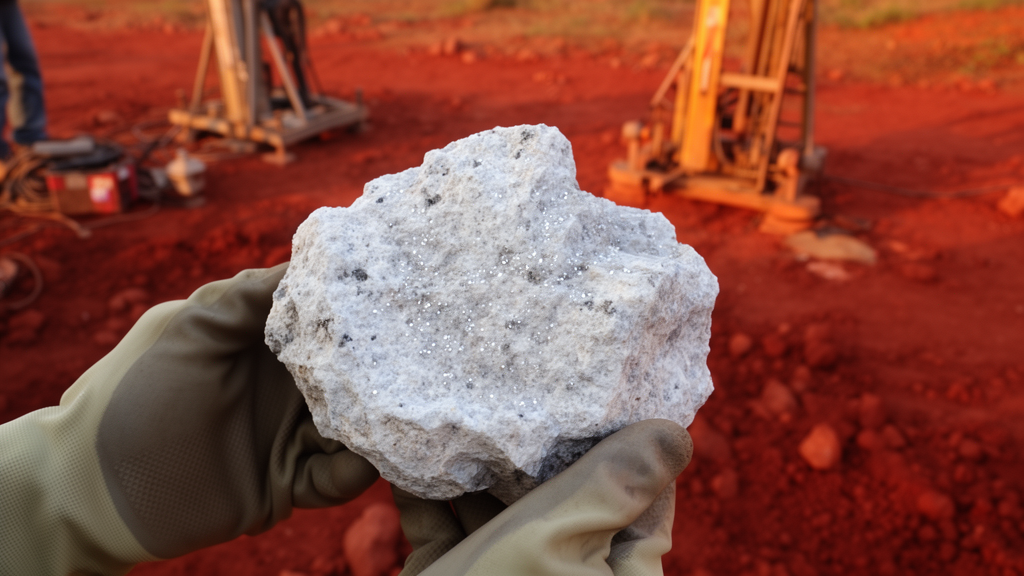
Deep beneath the sun-baked farmlands of Andhra Pradesh in southern India, a small volcanic plug is quietly rewriting what geologists thought they knew about rare earth elements. At Khaderpet, within the Wajrakarur Kimberlite Field of the Eastern Dharwar Craton, researchers have documented a carbonatite intrusion so rich in light rare earth elements that it may rank among the most promising unexplored occurrences in the country. What makes the discovery even more remarkable is its company: the carbonatite sits alongside diamond-bearing kimberlitic rocks, an association so rare that only a handful of localities worldwide, from Arkhangelsk in Russia to the Cullinan mine in South Africa, can claim anything similar. A new study published in Discover Geoscience by Pothuri Ramesh Chandra Phani and Prabir Sengupta presents the petrography, whole-rock geochemistry and stable isotope data that together confirm the Khaderpet carbonatite is a primary, mantle-derived, mineralised body worthy of serious economic scrutiny.
Carbonatites are among the strangest rocks on Earth. They are igneous rocks composed of more than fifty percent carbonate minerals, yet they crystallise from molten carbonate rather than forming in oceans or lakes. They are volumetrically tiny, arising from extremely low degrees of partial melting of carbonated peridotite in the mantle, with melt fractions below roughly 0.05 weight percent. Despite their scarcity, carbonatites punch far above their weight economically: they host the highest rare earth element concentrations of any igneous rock type and have supplied the world with niobium, phosphate and light rare earths for nearly half a century. China’s Bayan Obo, the largest carbonatite-hosted rare earth deposit on the planet, illustrates the scale of what these rocks can deliver. With rare earth elements now classified as critical metals by most industrialised nations because of their indispensable role in green energy technologies, electric vehicle motors and wind turbines, every new carbonatite occurrence attracts immediate attention.
The Khaderpet carbonatite was discovered in 2002 by Rio Tinto Exploration during diamond-focused work on their 3-016 prospect in the Anumpalli Kimberlite Cluster. The plug intrudes an ultramafic lamprophyre known as aillikite, which itself was emplaced into Archaean granites, producing a distinctive granitoid breccia that geologists have likened to the carapace of a tortoise. Field relationships tell a clear story: the carbonatite contains angular clasts of the host granite but lacks any fragments of the lamprophyre, indicating that the carbonate magma arrived late, punching through the older breccia at the periphery of the complex. The rock weathers in the classic ‘panther skin’ pattern typical of carbonatites, and the surrounding granitoids display intense fenitisation, the brick-red alkali metasomatism produced by fluids exsolved from the carbonatitic magma. Caustic fusion of drill core from the prospect has even yielded good quality octahedral diamonds of transparent and grey varieties, adding a second commodity to an already unusual package.
Under the microscope, the Khaderpet carbonatite reveals an equigranular fabric dominated by calcite, which makes up ninety to ninety-five percent of the rock. The calcite grains display rhombohedral cleavage, twinkling relief and the high-order interference colours characteristic of carbonate under cross-polarised light. Scattered through this groundmass are accessory phases of considerable economic interest: euhedral fluorite crystals, apatite, phlogopite, garnet, magnetite and chromite, along with the rare earth bearing minerals monazite, titanite and allanite. These three minerals are the storehouses of the light rare earths, and their presence in thin section directly explains the exceptional whole-rock compositions. Flow banding in the finer grained portions of the rock, with aligned calcite crystals recording the movement of the magma, further attests to the intrusive, magmatic character of the body. Alteration of calcite to dolomite is common, particularly toward the rock margins.
The geochemistry is where Khaderpet truly stands out. Ten fresh outcrop samples analysed by X-ray fluorescence and inductively coupled plasma mass spectrometry show calcium oxide contents of 46.8 to 53.8 weight percent with negligible magnesium and iron, classifying the rock unambiguously as a calcio-carbonatite. Total rare earth element concentrations range from about 4100 to 4500 parts per million, of which the light rare earths contribute nearly everything, between 4092 and 4509 parts per million, while the heavy rare earths amount to a mere 19 to 24 parts per million. The ratio of light to heavy rare earths reaches values of 180 to 230, and the chondrite-normalised patterns show the steep, step-like profile typical of carbonatites worldwide, with a lanthanum-to-lutetium ratio of about 29 and an extraordinarily high lanthanum-to-ytterbium ratio near 282. Strontium concentrations of nearly 11,000 parts per million, barium around 900 parts per million, and elevated niobium, thorium and uranium complete the classic carbonatite trace element signature.
This extreme fractionation of light over heavy rare earths carries a profound petrogenetic message. It indicates that the Khaderpet magma formed by very low degrees of partial melting of carbonated mantle peridotite, followed by liquid immiscibility that separated the carbonate melt from its silicate sibling. Ratios of zirconium to hafnium, ranging from 85 to 115, and niobium to tantalum, from 110 to 270, show positive correlations consistent with a mantle origin. The primitive mantle-normalised trace element patterns display peaks for uranium, lanthanum, cerium and neodymium with troughs for rubidium and niobium, matching the fingerprints of metasomatised upper mantle sources. In short, the Khaderpet carbonatite is a genuine window into processes operating deep within the lithospheric mantle beneath the Eastern Dharwar Craton, a region whose thick lithospheric root has already proven fertile ground for more than 150 kimberlite and related intrusions.
Stable isotope analysis provides the final confirmation of primary character. Carbon and oxygen isotope measurements on five samples, performed at the Wadia Institute of Himalayan Geology, yield oxygen isotope values between 6.6 and 8.76 per mil and carbon isotope values between minus 7.45 and minus 6.33 per mil. These compositions fall squarely within the ‘primary igneous carbonatite’ box defined by decades of global data, overlapping the fields established for unaltered carbonatites from Precambrian terranes. Primary isotopic compositions essentially mean the rocks escaped crustal contamination and represent unmodified partial melts of the mantle. Combined with the petrography and trace element systematics, the isotope data leave little doubt that the Khaderpet carbonatite is a magmatic rock of deep origin, not a hydrothermal or secondary carbonate.
Perhaps the most consequential finding is economic. On geochemical discrimination diagrams plotting strontium-to-barium ratios and barium against total rare earth content, the Khaderpet samples plot in the ‘mineralised’ field, the same territory occupied by the Weishan rare earth deposit in China. The total rare earth content of Khaderpet exceeds that of several better-known south Indian carbonatites and approaches the values recorded at Hogenakkal, although it remains below the concentrations at Samalpatti, Pakkanadu and the Kamthai deposit, which to date is the only carbonatite-hosted rare earth occurrence in India proven feasible for mining. A drone magnetic survey has delineated an areal extent of roughly 100 by 200 metres with an average depth of 40 metres for the intrusion, but previous exploration drilled only a single shallow hole targeting diamonds. The authors argue that detailed drilling, ore characterisation and beneficiation studies are now essential to establish the order of magnitude of the rare earth oxide resource and to determine whether profitable extraction is possible.
The broader context amplifies the stakes. India currently hosts more than fifty confirmed and suspected carbonatite occurrences, and the Geological Survey of India has expanded its critical mineral exploration projects from 65 in 2020-2021 to 195 in 2024-2025, with several alkaline and carbonatite complexes among the targets. Recent discoveries across the Dharwar Craton, at Gollapalli in Telangana, Gundlupet in Karnataka and Krishtipadu in Andhra Pradesh, suggest the craton is far more carbonatite-fertile than previously recognised. The Khaderpet occurrence carries a double dividend: if the rare earth potential is confirmed, the site benefits from well-developed roads, water infrastructure and abundant local labour, and development would create employment while adding to national rare earth production. The study also issues a practical warning for explorers: carbonatites can hide alongside kimberlites, so any investigation of mantle-derived exotic rocks in the Indian Shield should watch carefully for associated carbonate intrusions. A small plug in a farmer’s field may yet prove to be a strategic national asset.
Subject of Research: Geochemistry and economic potential of a light rare earth element enriched carbonatite intrusion associated with kimberlitic rocks in the Eastern Dharwar Craton, India
Article Title: Geochemical studies and economic perspective of light rare earth element (LREE) enriched carbonatite from Khaderpet, Eastern Dharwar Craton
Article References: Phani, P. R. C., & Sengupta, P. (2026). Geochemical studies and economic perspective of light rare earth element (LREE) enriched carbonatite from Khaderpet, Eastern Dharwar Craton. Discover Geoscience, 4(1), Article 308. https://doi.org/10.1007/s44288-026-00663-7
Image Credits: AI Generated
DOI: 10.1007/s44288-026-00663-7
Keywords: carbonatite, rare earth elements, LREE, kimberlite, Dharwar Craton, India, geochemistry, stable isotopes, monazite, critical minerals, diamonds, mineral exploration
Cite Scienmag News
Violet Maxwell. (October 9, 2026). Diamond-Bearing Carbonatite in India Emerges as a Potential Rare Earth Bonanza. Scienmag. https://scienmag.com/diamond-bearing-carbonatite-in-india-emerges-as-a-potential-rare-earth-bonanza/
Violet Maxwell. "Diamond-Bearing Carbonatite in India Emerges as a Potential Rare Earth Bonanza." Scienmag, 9 October 2026, https://scienmag.com/diamond-bearing-carbonatite-in-india-emerges-as-a-potential-rare-earth-bonanza/. Accessed 9 October 2026.
Violet Maxwell. "Diamond-Bearing Carbonatite in India Emerges as a Potential Rare Earth Bonanza." Scienmag. October 9, 2026. https://scienmag.com/diamond-bearing-carbonatite-in-india-emerges-as-a-potential-rare-earth-bonanza/


