


A team of leading climate scientists has published the most comprehensive quantification to date of what they call warming-induced emissions: greenhouse gases released by natural systems as the planet heats up. According to the new study, published in Environmental Research Letters, these feedback-driven emissions could amplify global warming by roughly 20 to 30 percent and add an estimated 0.2 to 0.4 degrees Celsius of additional warming this century on top of the warming caused directly by human activities, depending on the emissions scenario. What makes the finding so consequential is that these additional drivers of warming are largely absent from the Earth system models and policy frameworks that governments currently rely on to chart the path toward climate stability, meaning official projections may systematically underestimate how much heating is actually in store.
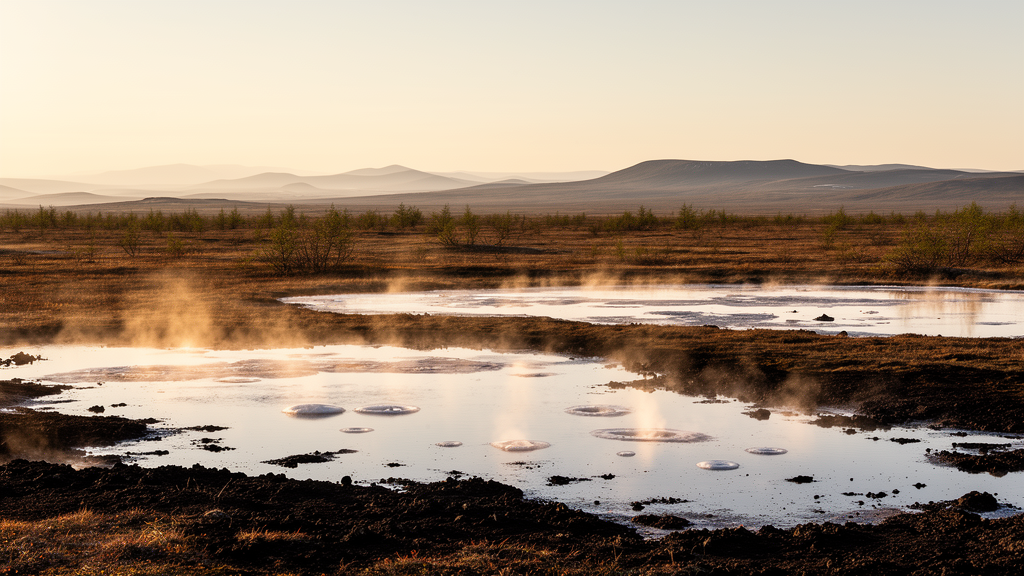
The physics behind the concern is not new. Scientists have anticipated for decades that rising temperatures could trigger additional emissions from natural reservoirs of carbon, creating feedback loops in which warming causes releases that cause further warming. Thawing permafrost exposes ancient frozen organic matter to decomposition, converting long-sequestered carbon into carbon dioxide and methane. Warmer wetlands and lakes, particularly in the tropics, host microbial communities that produce more methane as conditions grow hotter and more anoxic. And hotter, drier conditions fuel larger and more intense wildfires that burn through carbon stored in forests and soils, releasing it to the atmosphere in pulses that can be difficult for ecosystems to reabsorb. Each of these mechanisms has been studied individually; the challenge has always been adding them up.
The new paper, titled Projected Amplification of Global Warming by Warming-Induced Greenhouse Gas Emissions, represents the largest coordinated effort so far to quantify the combined effect of four major feedback loops covering both carbon dioxide and methane: permafrost thaw, wildfires, wetlands, and inland waters. The author team includes researchers from Stanford University, Spark Climate Solutions, the Environmental Defense Fund, and the Woodwell Climate Research Center, institutions that collectively span much of the leading work on carbon cycle science. By treating the feedbacks together rather than in isolation, the study captures interactions and compounding effects that single-system analyses miss, producing a more realistic picture of how natural emissions scale with temperature.
The quantitative results are striking in both scenarios examined. Under SSP1-2.6, a scenario representing relatively strong climate action in which human emissions reach net zero, warming-induced feedbacks could still add an estimated 0.2 degrees Celsius of warming by 2100, with a one-standard-deviation uncertainty of plus or minus 0.2 degrees. Under SSP4-6.0, a higher-emissions pathway, the feedbacks could contribute an estimated 0.4 degrees Celsius by the end of the century, again with an uncertainty of plus or minus 0.2 degrees. In a world where the difference between 1.5 and 2 degrees of warming is understood to mark the boundary between manageable adaptation and serious harm, tenths of a degree carry enormous weight for ice sheets, coral reefs, agriculture, and extreme weather.
The critical gap the authors identify is structural rather than merely scientific. Most Earth system models used to estimate how global temperature responds to anthropogenic emissions do not fully represent these warming-induced emissions. As a result, the climate projections that inform national pledges, carbon budgets, and international assessments likely understate future warming and overstate the amount of carbon humanity can still afford to emit while staying within agreed temperature limits. To close this gap, scientists from around the world are convening under a coordinated model intercomparison effort to test and compare different representations of warming-induced emissions, and to advocate that these processes be reflected in major policy and planning vehicles such as future IPCC assessment reports.
The study’s lead author, Dr. Sam Abernethy, a research scientist at Spark Climate Solutions, said the magnitude of the effect surprised the team. We found that natural systems could amplify global warming by 20 to 30 percent, he noted, describing it as a hidden multiplier missing from the models guiding climate policy. Because those models omit the multiplier, he argued, they are likely underestimating how much warming is coming and overestimating how much carbon can still be emitted. His prescription is twofold: deepen the scientific understanding of the underlying processes, and build them into the models on which policy decisions depend, so that carbon budgets reflect the full picture rather than an artificially favorable subset of it.
Permafrost emerges from the analysis as the single largest contributor, accounting for roughly half of the anticipated warming-induced emissions. Dr. Christina Schädel, a senior research scientist at the Woodwell Climate Research Center and a co-author, emphasized that permafrost scientists have long warned that thawing soils would become a significant emissions source as the planet warms, and that the new paper puts firm numbers on that expectation. Her central message is that warming-induced emissions are already in motion and scale with every fraction of a degree of additional heating, which means that every increment of warming averted today translates directly into less feedback-driven warming in the long term. The feedback is not a distant hypothetical; it is a process that responds to near-term choices.
Dr. Robert Jackson, Provostial Professor at Stanford University and chair of the Global Carbon Project, framed the results as confirmation of a long-anticipated shift in the carbon cycle. Researchers have expected warming to boost the carbon cycle for years, he said, and the evidence that it is happening in real time is now accumulating. In his view, the paper supplies the numbers needed to substantiate substantial emissions increases from permafrost, wetlands, freshwaters, and wildfires, and the results should function as a wake-up call for policymakers. If the next generation of climate policies fails to incorporate these feedback emissions, he warned, meeting the world’s climate goals will become progressively less likely, because targets calibrated on incomplete models will be systematically too optimistic.
Dr. Brian Buma, a senior climate scientist at the Environmental Defense Fund and a co-author, highlighted the policy implication in stark terms: the Earth and climate system does not stand still while societies debate policy. Emissions from permafrost, wetlands, and wildfire could meaningfully erode the remaining time before critical warming thresholds are crossed, and because they are unaccounted for in most scenarios, the urgency of rapid fossil fuel emissions reductions is even greater than current projections suggest. Yet his assessment also carries the study’s most encouraging message. The size of the feedback is not fixed; it scales with the warming that human emissions produce. Lower emissions now limit how severe these natural feedbacks become, keeping a meaningful degree of control in human hands.
Dr. Ben Poulter, director of the Warming-Induced Emissions Program at Spark Climate Solutions and a co-author of the paper, described the dynamic as a threat that human greenhouse gas emissions feed further warming as permafrost, wetlands, and wildfires destabilize and respond by releasing carbon dioxide, methane, and nitrous oxide. He characterized the study as both a critical estimate of the magnitude of the temperature response and a call to action to accelerate the accounting and monitoring of warming-induced emissions, so that mitigation pathways can be designed around phasing out fossil emissions quickly enough to stabilize the planet’s climate. Taken together, the study’s findings redraw the margin of error in climate planning: the feedbacks are real, they are quantifiable, they amplify whatever warming humans cause, and they respond in kind to every ton of emissions avoided. The authors declare no competing interests, and the research was published with the aim of informing the scientific community and the policy processes that depend on it.
Subject of Research: Quantification of warming-induced greenhouse gas emissions from natural climate feedbacks including permafrost thaw, wildfires, wetlands, and inland waters
Article Title: New study shows unaccounted climate feedback loops may amplify warming by up 20–30% this century, but cutting emissions will reduce risks
Article References: New study shows unaccounted climate feedback loops may amplify warming by up 20–30% this century, but cutting emissions will reduce risks. (n.d.). Original publication
Image Credits: AI Generated
DOI: Not provided
Keywords: climate feedbacks, warming-induced emissions, permafrost thaw, wildfires, wetlands, methane, carbon dioxide, Earth system models, climate policy, carbon budget, IPCC, Environmental Research Letters
Cite Scienmag News
Courtney Benton. (October 9, 2026). Hidden Climate Feedbacks Could Add Up to 30% More Warming This Century, Scientists Warn. Scienmag. https://scienmag.com/hidden-climate-feedbacks-could-add-up-to-30-more-warming-this-century-scientists-warn/
Courtney Benton. "Hidden Climate Feedbacks Could Add Up to 30% More Warming This Century, Scientists Warn." Scienmag, 9 October 2026, https://scienmag.com/hidden-climate-feedbacks-could-add-up-to-30-more-warming-this-century-scientists-warn/. Accessed 9 October 2026.
Courtney Benton. "Hidden Climate Feedbacks Could Add Up to 30% More Warming This Century, Scientists Warn." Scienmag. October 9, 2026. https://scienmag.com/hidden-climate-feedbacks-could-add-up-to-30-more-warming-this-century-scientists-warn/


