


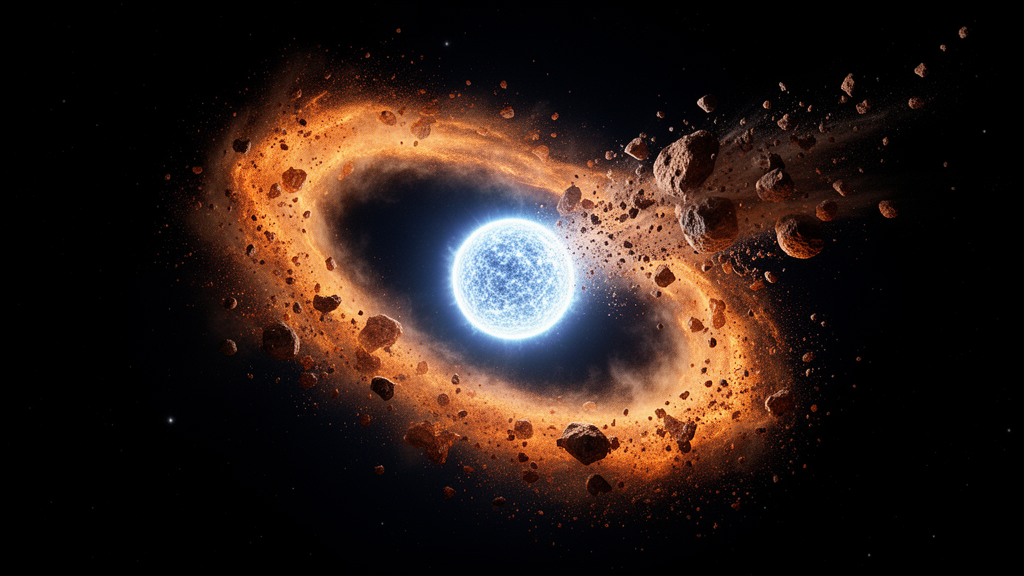
Astronomers have identified what they believe is the first known example of a second-generation planet orbiting a white dwarf — a world that appears to have formed not from the original cloud of gas and dust that built the star, but from the material its dying predecessor hurled into space. The white dwarf, catalogued as HS 0209+0832, is accreting matter whose chemical fingerprint matches nothing in our Solar System: it is loaded with exotic trans-iron elements such as zinc, copper and niobium, yet strikingly poor in the silicon and iron that make up most rocky planets, including Earth. The discovery, published in Nature Astronomy, suggests that planet formation can reignite around stellar corpses, opening a new chapter in the search for worlds born after their stars have died.
HS 0209+0832 is a hot, young white dwarf with an effective temperature of roughly 35,800 kelvin and a cooling age of only about five million years. Its atmosphere is dominated by hydrogen with about one percent helium — a peculiar mixture, because at this temperature helium should sink out of the visible layers within months. When the Hubble Space Telescope’s Space Telescope Imaging Spectrograph recorded an ultraviolet spectrum of the star in 1999, it revealed carbon, aluminium, silicon, calcium, titanium, nickel and zinc, along with roughly one hundred absorption lines that no one could identify. The presence of helium and metals pointed to ongoing accretion from an external source, but for a quarter of a century the nature of that source remained a mystery.
The breakthrough came from a modern reanalysis of archival data from Hubble, the Far Ultraviolet Spectroscopic Explorer and the Very Large Telescope’s UVES spectrograph, combined with Pan-STARRS photometry and Gaia parallax measurements. Using updated model atmosphere grids and revised atomic data, the team matched most of the previously unidentified lines to transitions of copper and niobium — the latter pinned down through five Nb III lines and a remarkable 57 Nb IV lines. A survey of archival FUSE spectra of 33 other metal-enriched white dwarfs confirmed that niobium has never been seen in any of them, making HS 0209+0832 unique among its peers.
The measured abundances tell a story that defies every known class of planetary debris. In the inner Solar System, silicon and iron together account for roughly 48 percent of Earth’s bulk mass, yet the material falling onto HS 0209+0832 contains only traces of silicon — explainable by radiative levitation, the process by which stellar radiation pushes certain ions upward against gravity — and no iron at all. Nickel, which shares iron’s geochemical behaviour, is abundant, yielding a nickel-to-iron ratio greater than 2.09 by number, compared with about 0.05 in CI chondrite meteorites and the bulk Earth. Most striking of all, niobium is over three orders of magnitude more abundant relative to calcium than it is in the Sun.
This chemical signature is the smoking gun for a second-generation origin. Asymptotic giant branch (AGB) stars — the bloated, wind-shedding phase that precedes the white dwarf stage — are the Universe’s dominant factories of elements built by the slow neutron-capture process, the so-called s-process. Theoretical models of AGB nucleosynthesis predict that their ejected envelopes are carbon-rich, modestly enhanced in nickel, copper and zinc, and dramatically enriched in niobium, while showing no enhancement in oxygen, silicon, calcium or iron. That predicted pattern matches the accreting material almost element for element. The team also ruled out simpler explanations: the pattern cannot come from direct fallback of AGB wind, because strontium, which should track niobium, is absent, and it does not match the accretion sequence expected from post-AGB discs, where volatile and refractory elements should appear in distinct stages rather than together.
How does a planet form around a dying star? Spherically symmetric mass loss from a single AGB star would rarely produce a disc, but a binary companion changes everything. A close-in low-mass companion entering the star’s envelope would trigger a common envelope event, ejecting the envelope and leaving behind a circumstellar disc seeded with s-process-rich material. A second-generation giant planet could then form by direct gravitational collapse near the white dwarf, or a first-generation rocky core could wander into the new disc and grow a second-generation atmosphere. The helium detected in the white dwarf’s atmosphere must be actively accreted, which rules out an ordinary rocky body as the pollution source. A brown dwarf companion is also excluded: Spitzer data place an upper limit of about 20 Jupiter masses, and a brown dwarf could not accrete enough AGB material to become sufficiently enriched in s-process elements.
The case gained decisive support from NASA’s Transiting Exoplanet Survey Satellite. Combining four TESS sectors of two-minute cadence photometry, the team detected a sinusoidal signal with a period of 4.399 ± 0.026 days and an amplitude of 0.120 ± 0.018 percent, with a false alarm probability of about 4.4 × 10⁻¹⁶. White dwarf spin periods cluster tightly around 1.25 days, and only one of twenty white dwarfs monitored by Kepler rotates more slowly than four days, so the signal is unlikely to be stellar rotation. Instead, it fits a giant planet on a 0.04 AU orbit — squarely within the 0.02 to 0.07 AU range of known close-in white dwarf planets — whose thermal emission varies as the tidally locked, intensely irradiated world rotates through its day–night cycle.
That same brutal irradiation explains how the planet feeds its dead star. Energy-limited atmospheric escape calculations, using the white dwarf’s expected extreme ultraviolet and X-ray output, yield evaporation rates of roughly 0.11 × 10¹³ grams per second for a one-Jupiter-mass planet and 1.43 × 10¹³ grams per second for a 13-Jupiter-mass body — far exceeding the measured accretion rate of at least 4.45 × 10⁸ grams per second onto the white dwarf, a gap partly explained by hydrogen and helium escaping the system and by radiation pressure expelling material altogether. An alternative reading of the photometric wobble is a comet-like tail of evaporating gas crossing the line of sight, which would also account for the white dwarf’s known spectroscopic variability, in which the helium abundance fluctuates by a factor of two to three, and the strange profile of the He II line at 1,640 angstroms.
The implications stretch well beyond one peculiar star. Only the pulsar planets have previously been credited with a comparable second-generation origin, and no equivalent had ever been identified around a white dwarf. Because carbon and s-process elements produce strong lines in the ultraviolet spectra of hot white dwarfs, the authors propose a practical search strategy: hunt for high carbon abundances paired with s-process enhancements. Building a sizeable sample of such systems would transform second-generation planet formation from a theoretical curiosity into an observable population — worlds whose very atoms were forged in the final breaths of a dying star, now orbiting the cinder it left behind.
Subject of Research: Discovery of a candidate second-generation planet accreting onto the white dwarf HS 0209+0832
Article Title: Discovery of a second-generation planet candidate accreting onto a white dwarf
Article References: Williams, J. T., Gänsicke, B. T., Stone, N. C., Koester, D., Davies, B. D. R., Tong, C., Wilson, D. J., Sahu, S., Swan, A., Beatty, T. G., Ramírez, S. H., Cunningham, T., & Long, K. S. (2026). Discovery of a second-generation planet candidate accreting onto a white dwarf. Nature Astronomy. https://doi.org/10.1038/s41550-026-02983-7
Image Credits: AI Generated
DOI: 10.1038/s41550-026-02983-7
Keywords: white dwarf, second-generation planet, exoplanet, s-process elements, niobium, planetary debris, stellar evolution, asymptotic giant branch, TESS, atmospheric escape, HS 0209+0832, Nature Astronomy
Cite Scienmag News
Grant Pearson. (October 9, 2026). A White Dwarf Is Eating a Planet Born from a Dead Star’s Ashes. Scienmag. https://scienmag.com/a-white-dwarf-is-eating-a-planet-born-from-a-dead-stars-ashes/
Grant Pearson. "A White Dwarf Is Eating a Planet Born from a Dead Star’s Ashes." Scienmag, 9 October 2026, https://scienmag.com/a-white-dwarf-is-eating-a-planet-born-from-a-dead-stars-ashes/. Accessed 9 October 2026.
Grant Pearson. "A White Dwarf Is Eating a Planet Born from a Dead Star’s Ashes." Scienmag. October 9, 2026. https://scienmag.com/a-white-dwarf-is-eating-a-planet-born-from-a-dead-stars-ashes/


