


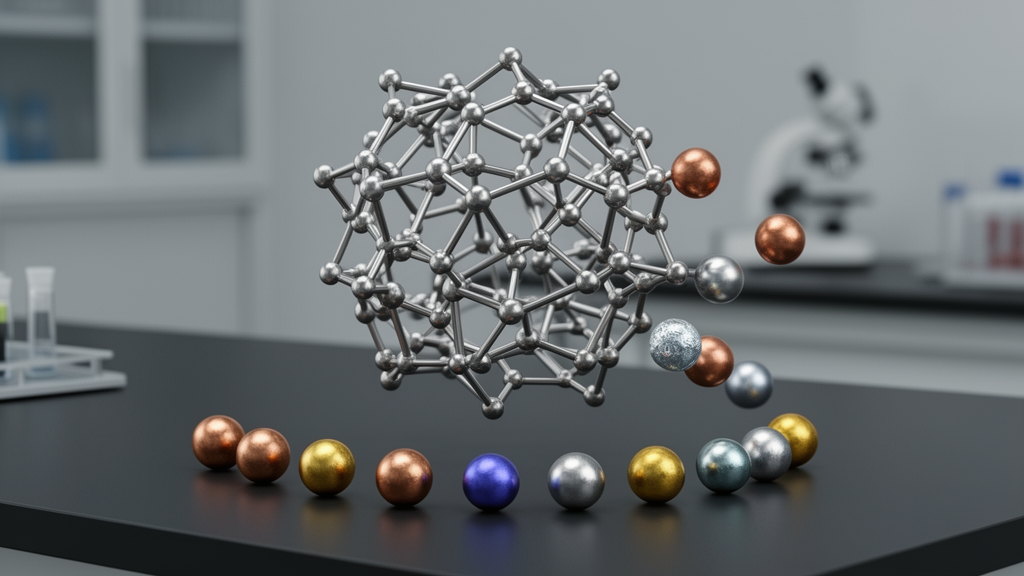
Chemists at the University of Birmingham, working with colleagues at the Universities of Nottingham and Limerick, have unveiled a metal-organic framework that can host sixteen different metals within a single crystal structure — the highest number yet reported for this class of materials. The achievement, described in the journal Angewandte Chemie, points toward a future in which scientists no longer need to invent a brand-new compound every time they want a material with different magnetic, optical, or gas-adsorption behaviour. Instead, they could simply adjust the metallic recipe inside the same underlying framework, much as a chef alters the proportions of ingredients in a dish without changing the recipe card itself.
Metal-organic frameworks, commonly abbreviated as MOFs, are built from metal atoms or clusters connected by organic molecules into highly ordered, repeating lattices. The geometry of these connections produces structures riddled with pores measured in fractions of a nanometre, giving MOFs an enormous internal surface area relative to their mass. That porosity is the key structural feature that creates the internal space necessary for MOFs to interact with target molecules, which is why the materials are under intense investigation for applications ranging from gas storage and separation to sensing, catalysis, bio-imaging, and magnetic materials. Because both the metal nodes and the organic linkers can be varied, MOFs have long been regarded as among the most customisable classes of solid materials in modern chemistry.
The new material, designated UoB-116, belongs to a subset of the MOF family built around rare-earth metals. In the first stage of the study, the researchers created and structurally characterised fifteen individual versions of the framework, each incorporating a different rare-earth metal. This step established that the underlying structure was robust enough to accommodate a wide range of metal ions without collapsing or losing its crystalline order. The team then moved to progressively more complex compositions, combining two, four, twelve, and finally fifteen different metals within the same framework, demonstrating at each stage that the crystal retained its ordered architecture.
The final and most striking step was the addition of indium, a metal drawn from outside the rare-earth family. The resulting MOF contained sixteen different metals simultaneously: yttrium, indium, and fourteen of the lanthanides. According to the researchers, UoB-116 is the first reported MOF to combine metals drawn from three different regions of the periodic table — the d-block, the p-block, and the f-block — within a single framework. That breadth of chemical compatibility is what gives the material its mix-and-match character, allowing elements with very different electronic structures to sit side by side in one ordered lattice.
To show that this compositional freedom translates into functional control, the team focused on two of the sixteen metals, dysprosium and lanthanum, and systematically varied the balance between them. The results were unambiguous. Increasing the dysprosium content increased the material’s magnetic response, while the characteristic near-infrared light absorption associated with dysprosium could be adjusted simply by altering its concentration. Porosity responded in the opposite direction: adding more lanthanum progressively reduced the material’s measured surface area. Most dramatically, the amount of carbon dioxide the material could take up under the conditions tested fell from 5.72 millimoles per gram for the all-dysprosium version to 1.23 millimoles per gram for the all-lanthanum version — a demonstration that gas-storage behaviour can be changed by adjusting the metals alone, with no change to the framework’s underlying architecture.
Corresponding author Professor Neil Champness of the University of Birmingham framed the advance as a step toward materials that behave almost like software. “Our findings confirm a route towards ‘programmable’ porous materials, where scientists could choose a combination of metals to dial magnetic, optical, chemical, or gas-adsorption behaviour,” he said. “The ability to predict how strongly particular metals will be incorporated potentially offers much finer control over future multi-metal materials. Rather than having to invent a completely new material every time they want different properties, researchers can potentially change the metallic ‘recipe’ within the same underlying structure.”
That question of predictability is central to why the work matters beyond its record-setting composition. In many multicomponent materials, different metal ions compete for the same structural sites in ways that are difficult to anticipate, and the final distribution of metals can be chaotic. The Birmingham-led team reports that the incorporation of particular metals into UoB-116 follows a bias linked to the radius of the cations, meaning that how strongly each metal is taken up into the framework can be predicted from its ionic size. If that predictive relationship holds across other metal combinations, it would give chemists a design rule for dialling in specific property profiles rather than discovering them by trial and error.
The practical stakes are considerable, because MOFs already serve as custom molecular sponges across several major industries. In clean energy, they are studied for compact hydrogen storage in fuel-cell vehicles and for selective carbon capture from industrial emissions. In environmental safety, related frameworks are being explored for harvesting drinkable water from arid air and for the safe storage of toxic gases used in semiconductor manufacturing. In industrial chemistry, energy-saving adsorptive separations based on MOFs could replace cryogenic distillation, one of the most energy-intensive unit operations in the chemical industry. In biomedicine, high-capacity frameworks are being developed for targeted drug delivery and as imaging contrast agents. A single tunable platform that can be re-optimised for each of these tasks by swapping metals could dramatically shorten development cycles.
The study, titled “Rare-Earth Multivariate Metal–Organic Frameworks: Cationic Radius Biased Compositional Control and Property Tuning,” was led by Adnan Ishaq and Professor Neil R. Champness at Birmingham, with contributions from Joseph O. Ogar, Asif Raza, Danielle E. Schier, Stephen P. Argent, Musa M. Mahmud, Lucy Clark, Jacob L. Brownlee, and Soumya Mukherjee across the collaborating institutions. The work appeared in Angewandte Chemie on 26 September 2026, and its publication marks one of the most extensive demonstrations yet of compositional control in a multivariate framework.
For the broader field of materials chemistry, UoB-116 offers a proof of concept that the boundary between designing new materials and tuning existing ones can be blurred. If the same principle — a robust framework that tolerates many metals in predictable proportions — can be extended to other linker chemistries and other metal families, the result could be a generation of porous materials whose properties are specified on demand: more magnetic here, more porous there, tuned for carbon capture or near-infrared optics by nothing more than a change in the recipe. For now, the sixteen-metal framework stands as evidence that the periodic table itself can be treated as a palette, and that the next breakthrough material may not need to be built from scratch at all.
Subject of Research: Multivariate rare-earth metal-organic frameworks with tunable properties through compositional control of incorporated metals
Article Title: ‘Mix-and-match’ material’s properties can be tuned by changing its metallic ‘recipe’
Article References: ‘Mix-and-match’ material’s properties can be tuned by changing its metallic ‘recipe’. (n.d.). Original publication
Image Credits: AI Generated
DOI: Not provided
Keywords: metal-organic frameworks, MOFs, rare-earth metals, lanthanides, porous materials, gas storage, carbon capture, magnetism, light absorption, materials chemistry, University of Birmingham, Angewandte Chemie
Cite Scienmag News
Denise Maddox. (October 9, 2026). Sixteen metals, one framework: chemists tune material properties by swapping its metallic recipe. Scienmag. https://scienmag.com/sixteen-metals-one-framework-chemists-tune-material-properties-by-swapping-its-metallic-recipe/
Denise Maddox. "Sixteen metals, one framework: chemists tune material properties by swapping its metallic recipe." Scienmag, 9 October 2026, https://scienmag.com/sixteen-metals-one-framework-chemists-tune-material-properties-by-swapping-its-metallic-recipe/. Accessed 9 October 2026.
Denise Maddox. "Sixteen metals, one framework: chemists tune material properties by swapping its metallic recipe." Scienmag. October 9, 2026. https://scienmag.com/sixteen-metals-one-framework-chemists-tune-material-properties-by-swapping-its-metallic-recipe/


