


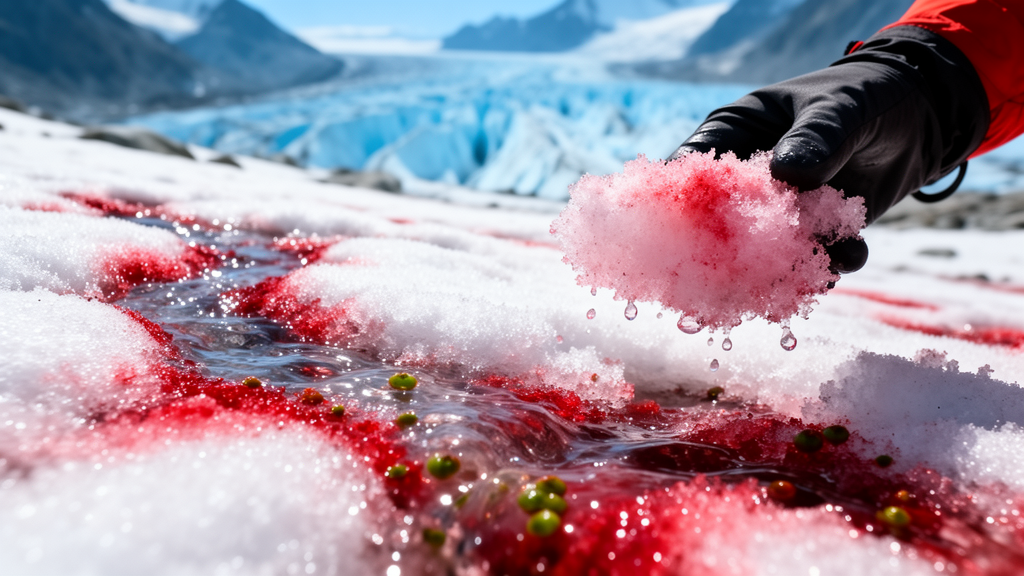
Every summer, patches of snow across the polar and alpine world turn an eerie crimson or watermelon pink. The phenomenon, long known as blood snow or watermelon snow, is caused by blooms of snow algae, photosynthetic microorganisms that thrive in some of the harshest environments on Earth. A new review published in the journal Biogeosciences by Caitlin de Vries of Newcastle University and colleagues takes the most comprehensive biophysical look yet at how these tiny cells actually move through their frozen habitat, and the picture that emerges is one of remarkable complexity at the intersection of biology, fluid dynamics and climate science.
Snow algae are found on every continent, predominantly in polar and alpine settings. They are keystone primary producers, acting as terrestrial carbon sinks, facilitating nutrient cycling, shaping microbial communities and providing nutrition for higher organisms. But they also have a darker climatic significance: by darkening snow surfaces, they reduce albedo, the fraction of incoming solar radiation that snow reflects, and thereby accelerate melting. Snow algae have been shown to reduce snow albedo by up to 44 percent. In one Antarctic Peninsula study, albedo fell from 0.85 at algae-free control sites to 0.44 over green-dominated blooms and 0.65 over red ones, corresponding to roughly 40 percent and 20 percent reductions respectively. Despite this ecological weight, the mechanisms governing how snow algae migrate within snow remain poorly understood, which is precisely the gap the review sets out to fill.
The authors frame snow algae as biologically active particles within the framework of active matter physics, a class of non-equilibrium soft matter whose motion cannot be explained by equilibrium physics alone. Unlike passive particles, microalgae harvest energy from their environment and convert it into directed motion. Their propulsion comes from flagellar beating, a process in which adenosine triphosphate is converted to adenosine diphosphate, releasing energy that powers microtubule sliding within the flagella. The motile species examined in the review are typically biflagellated, and the symmetry and phase relationships of their two flagella produce distinctive swimming gaits, including the helical swimming pattern well characterised in the model freshwater alga Chlamydomonas reinhardtii, which the authors use as a proxy where snow algae data are lacking.
Scale matters enormously in this world. The review walks through the dimensionless Reynolds number, the ratio of inertial to viscous forces, to illustrate just how alien the algal fluid environment is. For Chlamydomonas reinhardtii, with a swimming speed of roughly 130 micrometres per second and a cell length of about 10 micrometres, the Reynolds number is around 1.3 times ten to the minus three. For a human swimmer it is about 1.7 times ten to the sixth, roughly a billion times larger. At such low Reynolds numbers, inertia is negligible and reciprocal strokes produce no net motion, which is why microalgae have evolved helical flagella and whip-like techniques to navigate. Any understanding of how algae move through snow must therefore begin with the physics of viscous-dominated swimming.
The snowpack itself is a dynamic, porous and evolving medium. Snow crystals, typically between half a millimetre and three millimetres across, are up to three orders of magnitude larger than the algae, which measure roughly 5 to 40 micrometres. Within the pack, crystals continuously metamorphose under temperature and pressure gradients, forming rounded grains in the upper layers and large depth hoar crystals at the base. In melting snow, where algae flourish, water films bind crystals into clusters. At the macroscopic scale, the algae follow a seasonal cycle: they overwinter as dormant cysts, germinate into green motile flagellated cells with the spring melt, migrate upward toward the surface in response to meltwater, light and released nutrients, and then transform back into non-motile, pigmented cysts. Field experiments on an Alaskan ice field suggest that at the peak of the growing season, actively resurfacing cells account for about 65 percent of surface algal abundance, with passive dispersal by wind, water and birds making up the remaining 35 percent.
At the microscopic scale, the story becomes subtler. Snow algae were long thought to inhabit the quasi-liquid layer, a thin film of liquid water that coats snow crystals even at sub-zero temperatures. But that layer is astonishingly thin, ranging from a few molecular layers, roughly 0.37 nanometres each, up to about 10 nanometres as temperature rises. Motile snow algae cells are six to twenty micrometres across, several orders of magnitude too large to swim within it. In non-melting snow, moreover, about 80 percent of the limited liquid water is held in menisci at crystal contact points. This size disparity suggests that active swimming within the quasi-liquid layer is unlikely, and helps explain why algal migration and bloom development peak during snowmelt, when larger interconnected water channels form. X-ray tomography of the red snow alga Sanguina nivaloides has shown that its dormant cysts occur only in the liquid water fraction of the snowpack, never inside ice grain cores.
Fluid flow within the pack adds another layer of physics. Preferential flow paths carry meltwater at speeds between 12 and 30 millimetres per second, far exceeding the reported mean swimming speed of the snow alga Chlamydomonas nivalis, a mere 0.061 millimetres per second. Whether algae can swim against such flows depends on the viscous diffusion timescale, which scales with the square of channel width divided by kinematic viscosity. In narrow channels or saturated capillary zones, where flow is effectively stagnant, algae can move independently of the bulk water. In wider channels they are likely transported passively by advection. The review also highlights interfacial pre-melting and thermal regelation as possible migration aids: when an algal cell is embedded in ice near its melting point, surface forces induce a thin melted film, and a temperature gradient can drive the cell toward warmer regions through cycles of melting and refreezing. Some Chlamydomonas species even produce ice-binding proteins that hinder ice crystal growth, and exopolymeric substances and antifreeze glycoproteins may further enhance survival and motility in icy conditions.
Much of the review is devoted to tactic behaviour, the biased swimming of cells toward or away from stimuli. Phototaxis is the best documented. Motile snow algae swim toward light at low to moderate intensities but switch to negative phototaxis above a critical threshold; in a Japanese alpine snowpack, motile cells ascended nearly to the surface during low-light hours and descended 10 to 20 centimetres when solar radiation peaked at up to 755 watts per square metre. Cell density at the surface was negatively correlated with solar radiation and air temperature, and because solute gradients showed no day-night variation, light rather than nutrients drove the migration. Intriguingly, some snow algal species lack eyespots yet still exhibit phototaxis, while close relatives with eyespots do not, raising questions about how light sensing works in snow, where reflections off countless crystals could produce confusing signals. Ultraviolet-B radiation, meanwhile, appears to act mainly as a physiological stressor that suppresses motility rather than as a directional cue.
Chemotaxis, gravitaxis, gyrotaxis and thermotaxis complete the picture, though each is far less understood in snow algae specifically. Snowpacks are oligotrophic, and laboratory experiments suggest phosphorus, rather than nitrogen, is the limiting nutrient for the snow alga Chloromonas typhlos, making phosphorus gradients a plausible but untested driver of chemotactic movement. Gravitaxis, the orientation of cells relative to gravity, remains debated between passive mechanisms such as bottom-heavy mass distribution and differential sedimentation, and active physiological sensing; mutant studies in Chlamydomonas point to active, membrane-excitability-dependent signalling. Gyrotaxis, the combination of gravitational and viscous torques in flowing fluid, has been shown experimentally to generate bioconvective patterns in snow algal suspensions, and may focus swimming algae into downward meltwater flows, accelerating their transport to the base of the pack. Thermotaxis has never been demonstrated in snow algae, though psychrophilic species show optimal swimming speeds below 10 degrees Celsius, in sharp contrast to mesophilic species that peak above 20 degrees.
The review closes with a call to arms. The seasonal cyst-to-flagellate cycle is broadly accepted, but the quantitative biophysics of how algae interact with quasi-liquid layers, navigate meltwater channels and respond to evolving snowpack structure remains undocumented. Filling these gaps, the authors argue, would improve predictions of snow algal blooms and their climatic consequences, refine hydrological and cryospheric models, advance our understanding of microswimmer behaviour in active matter physics, and even inform emerging biotechnologies, from low-temperature algal cultivation for astaxanthin production to medical microrobotics inspired by algal motility. The pink patches staining the world’s snowfields, it turns out, are not just a curiosity but a living laboratory for physics, ecology and climate science all at once.
Subject of Research: Biophysical mechanisms of snow algae motility and migration within snowpacks
Article Title: Reviews and syntheses: Snow algae on the move – biased motility and snowpack interaction from a biophysics perspective
Article References: de Vries, C. S., Sandells, M. J., Davey, M. P., Caldwell, G. S., & Croze, O. A. (2026). Reviews and syntheses: Snow algae on the move – biased motility and snowpack interaction from a biophysics perspective. Biogeosciences, 23(19), 6835-6855. https://doi.org/10.5194/bg-23-6835-2026
Image Credits: AI Generated
Keywords: snow algae, biophysics, active matter, phototaxis, chemotaxis, gravitaxis, gyrotaxis, snowpack, albedo, cryosphere, microswimmers, flagella
Cite Scienmag News
Hope Haney. (October 9, 2026). Blood Snow on the Move: The Biophysics of How Algae Swim Through Melting Snowpacks. Scienmag. https://scienmag.com/blood-snow-on-the-move-the-biophysics-of-how-algae-swim-through-melting-snowpacks/
Hope Haney. "Blood Snow on the Move: The Biophysics of How Algae Swim Through Melting Snowpacks." Scienmag, 9 October 2026, https://scienmag.com/blood-snow-on-the-move-the-biophysics-of-how-algae-swim-through-melting-snowpacks/. Accessed 9 October 2026.
Hope Haney. "Blood Snow on the Move: The Biophysics of How Algae Swim Through Melting Snowpacks." Scienmag. October 9, 2026. https://scienmag.com/blood-snow-on-the-move-the-biophysics-of-how-algae-swim-through-melting-snowpacks/


