


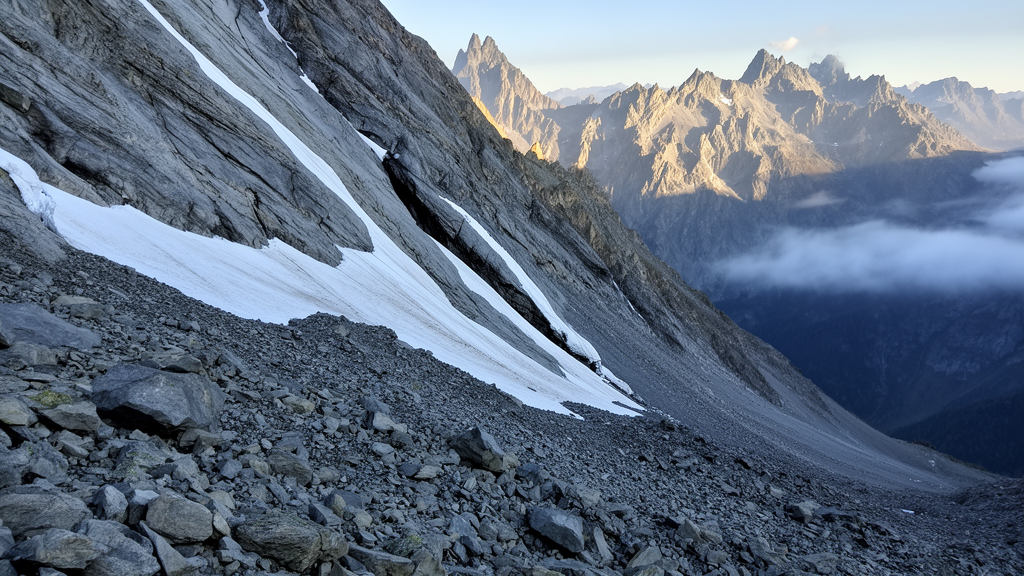
High above the Vernagtferner glacier in Austria’s Ötztal Alps, a slab of fractured gneiss roughly the size of twenty Olympic swimming pools peeled away from the Platteikogel ridge in spring 2024. The detachment, which occurred at around 3,395 meters above sea level, sent an estimated 50,000 cubic meters of rock crashing onto the glacier below. Now, a team of researchers led by Felix Pfluger of the Technical University of Munich has reconstructed the decades-long chain of cryospheric changes that set the stage for the collapse, and their findings carry a stark warning: the small, overlooked ice bodies clinging to steep alpine faces may be quietly priming entire mountainsides for failure.
Ice aprons are irregular, often less than 0.1 square kilometers in area, and cling to slopes steeper than 40 degrees. Unlike glaciers, which retreat upward from their toes, ice aprons thin and vanish from the top down, progressively exposing bedrock to the atmosphere. In the Mont Blanc massif, ice apron area declined by 47 percent between 1952 and 2019. Scientists had suspected that their disappearance could destabilize the permafrost rock beneath, but the actual physical processes remained poorly constrained. The Platteikogel failure offered a rare opportunity to test that hypothesis against a real, documented collapse.
The research team combined three complementary lines of evidence. First, they analyzed historical orthophotographs and high-resolution aerial imagery to map how ice cover and rockfall activity changed over more than five decades. Second, they used a two-dimensional conductive heat flow model, CryoGrid 2D, to reconstruct the thermal evolution of the mountain ridge from 1900 to 2024. Third, they fed those temperature fields into a distinct element mechanical model, UDEC, which simulates a rock mass as thousands of discrete blocks separated by joints that can slide, open, or rotate. This coupled thermo-mechanical workflow allowed the team to ask, quantitatively, whether warming alone could have brought the slope down.
The observational record was striking. Ice aprons reached the detachment zone in 1970, but by 1999 the upper limit of ice on the southeastern flank had dropped more than 50 meters to the level of the former bergschrund, the crevasse marking the glacier’s headwall. In the decade before failure, the uppermost ice apron lost at least five meters of thickness. Rockfall activity, meanwhile, accelerated: seven events occurred between 2015 and 2018, none were detected from 2018 to 2021, and then fourteen rockfalls struck between 2021 and 2023. The slope was visibly deteriorating long before the main detachment.
The thermal simulations revealed how much the vanishing ice mattered. Air temperatures at the site rose by roughly 2 degrees Celsius between 1980 and 2024, and permafrost warmed throughout the mountain. Crucially, the model showed that the loss of ice aprons on the sun-exposed southeastern flank between 1970 and 2000 added approximately 1 degree Celsius of extra warming at 20 meters depth by 2023, compared with a scenario in which the ice had remained intact. Newly exposed dark rock, with an albedo far lower than ice, absorbed solar radiation and heated the bedrock beneath, accelerating the degradation of the frozen ground that had long helped hold the slope together.
Yet when the team coupled modeled 2023 permafrost temperatures to a laboratory-derived shear strength criterion for ice-filled fractures, the mechanical model stubbornly refused to fail. Even assuming warmer temperatures and the weakest end of the laboratory parameter range, the slope remained stable. The temperature-dependent shear criterion, developed from tests on rock-ice-rock sandwich samples, indicated that warming of ice-filled joints alone could not explain the detachment. Something else, the researchers concluded, had to superimpose on the thermal weakening, or the failure did not occur along ice-filled discontinuities at all.
The prime suspects were water pressure and topographic change. Ice that once sealed the bedrock had acted as a barrier against rain and meltwater infiltration; as it vanished, water could penetrate the fractured rock mass. Field studies elsewhere in the Alps have recorded transient water columns of several decameters in fracture systems during peak snowmelt, and piezometric heads exceeding 10 meters in permafrost boreholes. When the team applied hydrostatic pressure equivalent to a 30-meter water column to their mechanical model, the response was dramatic: displacement functions never approached a plateau, the basal shear plane activated progressively from the toe upward, and the slope tipped into unstable conditions. Of all the scenarios tested, water pressure produced the strongest mechanical response.
Rockfalls played a subtler but significant role. Removing blocks from the slope face, simulating the small detachments observed since 2015, redistributed stresses within the rock mass. In the model configuration with smaller blocks and more structural detail, rockfall-induced unloading produced displacements comparable to those driven by water pressure, particularly when the slope was already close to failure. The team describes this as a feedback loop: ice apron loss promotes frost-weathering and rockfall, rockfalls modify topography and widen joints, widened joints channel water deeper into the rock, and pressurized water both warms the permafrost along flow paths and pries joints apart mechanically.
The deposits tell their own story. The bifurcated debris field, a reach angle of 24.6 degrees, and a height-to-length ratio of 0.45 suggest the failure occurred as a single, sudden push event, kinematically classifiable as a small rock avalanche, likely lubricated by a basal water film where the sliding surface contacted the glacier and snowpack below. Post-failure activity, indicated by larger proximal deposits, hints at secondary detachments. The event fits a broader and troubling pattern: the 2023 Fluchthorn rock slide in Austria, the 2024 Piz Scerscen failure in Switzerland, and the 2025 Blatten glacier collapse, all preceded or accompanied by permafrost-related rockfall, each evolving into highly mobile rock-ice avalanches that threaten valley communities downstream.
The implications extend well beyond one Tyrolean ridge. Ice aprons often preserve ice several thousand years old, and their presence signals permafrost in the rock beneath. As they vanish across the European Alps, steep rock faces above 3,000 meters are expected to lose their ice cover drastically in the coming decades, exposing potential source zones for future rock slope failures. The Platteikogel reconstruction demonstrates that ice apron loss is not merely a symptom of warming but an active agent of destabilization, accelerating permafrost thaw, enabling water infiltration, and driving progressive failure. While precise prediction of failure timing remains unrealistic without kinematic monitoring, the study argues that rapidly disappearing ice aprons should now be treated as markers of where the mountains may let go next.
Subject of Research: Thermo-mechanical reconstruction of how ice apron loss and permafrost degradation promoted the 2024 Platteikogel rock slope failure in the Austrian Alps
Article Title: How ice apron loss and permafrost degradation promoted the Platteikogel rock slope failure: a thermo-mechanical reconstruction
Article References: Pfluger, F., Weber, S., Barbosa, N., Hofmeister, F., Leinauer, J., Wegmann, P., & Krautblatter, M. (2026). How ice apron loss and permafrost degradation promoted the Platteikogel rock slope failure: a thermo-mechanical reconstruction. Earth Surface Dynamics, 14(4), 601-634. https://doi.org/10.5194/esurf-14-601-2026
Image Credits: AI Generated
DOI: 10.5194/esurf-14-601-2026
Keywords: ice aprons, permafrost, rock slope failure, rockfall, Alps, climate change, hydrostatic pressure, CryoGrid 2D, UDEC modeling, Platteikogel, Vernagtferner, mountain hazards
Cite Scienmag News
Violet Maxwell. (October 9, 2026). Vanishing Ice Aprons Pushed an Alpine Rock Slope to the Brink of Collapse. Scienmag. https://scienmag.com/vanishing-ice-aprons-pushed-an-alpine-rock-slope-to-the-brink-of-collapse/
Violet Maxwell. "Vanishing Ice Aprons Pushed an Alpine Rock Slope to the Brink of Collapse." Scienmag, 9 October 2026, https://scienmag.com/vanishing-ice-aprons-pushed-an-alpine-rock-slope-to-the-brink-of-collapse/. Accessed 9 October 2026.
Violet Maxwell. "Vanishing Ice Aprons Pushed an Alpine Rock Slope to the Brink of Collapse." Scienmag. October 9, 2026. https://scienmag.com/vanishing-ice-aprons-pushed-an-alpine-rock-slope-to-the-brink-of-collapse/


