


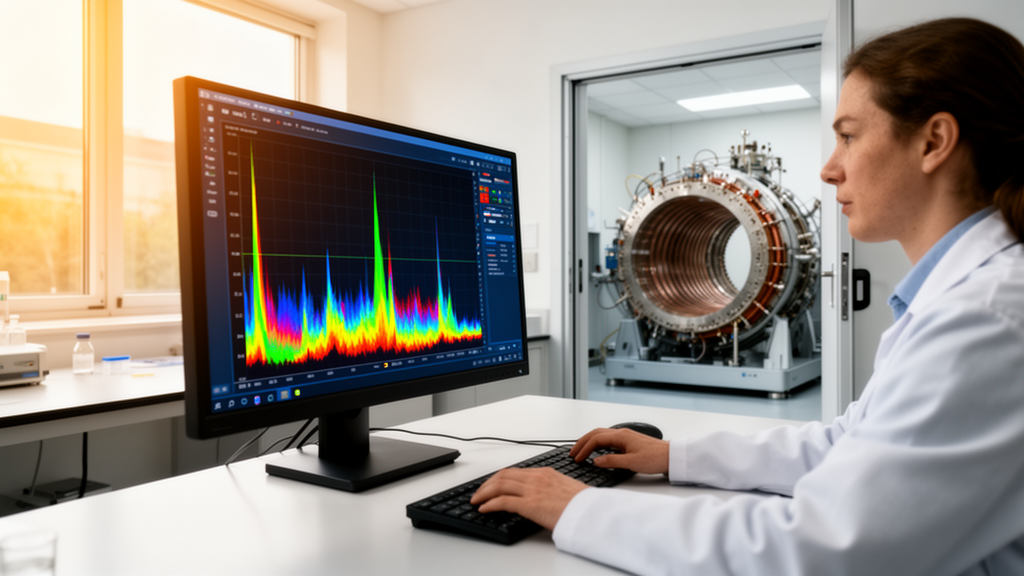
Nuclear magnetic resonance has long been a technique of superlatives: giant superconducting magnets, cryogenic liquids, million-dollar spectrometers and proprietary software suites that only trained specialists can navigate. Yet a quieter revolution has been unfolding in laboratories around the world, driven by compact, low-field instruments that fit on a benchtop and cost a fraction of their high-field cousins. Now, a team of Brazilian researchers has removed one of the last remaining barriers to this democratization of magnetic resonance, launching a free, open-access web application that performs one of the most mathematically demanding steps in time-domain NMR analysis directly in a browser, with no installation, no license fees and no requirement for programming expertise.
The tool, described in the journal Magnetic Resonance by Tiago B. Moraes and colleagues at the Universidade de São Paulo and the Instituto Federal de Educação, Ciência e Tecnologia de São Paulo, automates the inverse Laplace transform, or ILT, a mathematical operation that converts raw relaxation signals into physically meaningful distributions of relaxation times. Unlike the famous Fourier transform, which turns oscillatory signals into frequency spectra, the ILT handles the monotonic, exponentially decaying signals produced by low-field relaxometry experiments. The result is a relaxogram: a curve whose peaks reveal the different populations of spins, and therefore of molecules and microscopic environments, hiding inside a sample. For foods, seeds, soils and other heterogeneous biological materials, those peaks can encode water content, oil mobility, pore structure and a host of quality parameters that matter to scientists and industry alike.
The mathematics behind the ILT is deceptively simple to state and notoriously difficult to execute. A measured relaxation signal is modeled as a weighted sum, or more precisely an integral, of exponential decays, each characterized by a relaxation time and an amplitude. Recovering the full continuous distribution of relaxation times from a finite, noisy set of data points is what mathematicians call an ill-posed inverse problem: tiny amounts of noise in the input can produce enormous, wildly oscillating artifacts in the output. This is why the ILT cannot be computed naively, and why the field has developed a family of specialized algorithms over the decades, including CONTIN, UpenWin, the Butler–Reeds–Dawson method, truncated singular value decomposition and non-negative least squares, each balancing stability, resolution and robustness in its own way.
The São Paulo team’s implementation rests on a well-established combination: non-negative least squares constrained optimization, Tikhonov regularization and singular value decomposition. Tikhonov regularization adds a smoothing penalty to the inversion, suppressing the spurious oscillations that noise would otherwise amplify, while the non-negativity constraint enforces the physical reality that amplitudes in a relaxation distribution cannot be negative. The regularization parameter, alpha, controls the trade-off between resolution and stability: larger values produce broader, smoother peaks that are less sensitive to noise, while smaller values sharpen features at the risk of amplifying artifacts. In the current version of the WebApp, the user selects alpha manually, guided by knowledge of the sample and the signal-to-noise ratio, with typical values ranging from 0.01 to 10. The authors note that automated selection strategies, such as the L-curve method, may be incorporated in future releases.
What sets the new platform apart is not the underlying mathematics, which the group had previously implemented as a local routine for OriginLab software, but its accessibility and generality. The WebApp is built in Python using the NumPy numerical library and Plotly visualization tools, deployed via Docker on secure servers at the University of São Paulo. It runs entirely platform-independently and accepts data from instruments of any manufacturer, a meaningful point in a market now served by companies including Bruker, Magritek, Oxford, Nanalysis, SpinLock, FIT and Niumag. Users upload a simple text file containing a time axis and one or more signal columns, choose the experiment type, set a handful of parameters and receive relaxation time distributions, fit curves, residuals and downloadable data within seconds or minutes.
The platform supports the three pulse sequences that dominate practical time-domain NMR: Carr–Purcell–Meiboom–Gill, or CPMG, which probes transverse relaxation, and inversion recovery and saturation recovery, which probe longitudinal relaxation. Each sequence corresponds to a different kernel function in the integral equation, describing how the exponential components grow or decay in the raw signal. The interface also offers practical pre-processing options that experienced practitioners know are essential: baseline correction to eliminate offsets that would otherwise generate artificial peaks, signal normalization, removal of corrupted initial points caused by spectrometer dead time, and flexible definition of the relaxation time window and its discretization. Multiple signals sharing a common time axis can be processed in a single batch, which is particularly convenient for monitoring dynamic processes such as drying, hydration or aging.
Validation was carried out with both simulated and real data, and the results are reassuring. Synthetic signals were generated from known log-Gaussian distributions of relaxation times, with Gaussian white noise added at levels of 1, 2 and 5 percent. Up to 2 percent noise, the recovered distributions accurately reproduced the true peak positions, widths and relative amplitudes, with deviations of peak centers remaining within a few percent, consistent with established ILT software. At 5 percent noise, the characteristic ill-posedness of the problem began to manifest as spurious peaks, a well-documented limitation of all ILT methods rather than a flaw specific to this implementation. The authors also provide practical guidance for users: acquire signals with a full decay and a stable baseline, watch the signal-to-noise ratio, choose the relaxation time window carefully, and keep processing parameters consistent when comparing multiple samples.
The experimental demonstration is a vivid illustration of what the technique can reveal. The team measured nine maize seeds on an 11.3 MHz benchtop spectrometer using a CPMG sequence, first when the seeds were dry with less than 10 percent moisture, then after 24 hours of water absorption, and finally after several days when germination had begun. In the dry seeds, the dominant relaxation peak sat at around 1 millisecond, with smaller features near 40 and 150 milliseconds. After a day of imbibition, the main peak had shifted to 3 milliseconds and broadened, while the minor peaks also moved and widened, reflecting water uptake and the growing heterogeneity of the seed’s internal structure. In germinated seeds, the peaks shifted and broadened further, tracking changes in molecular mobility and compartmentalization. These trends match previously published TD-NMR studies of maize seed vigor, confirming that the web tool reproduces established scientific findings.
The same core algorithm has already proven its worth across a striking range of applications by the research group and collaborators: food analysis, beef aging and color prediction, physiological disorders in poultry and mangoes, plant and seed science, enzymatic activity in cassava roots, and even the forensic detection of counterfeit spirits through analysis of bottle caps. By wrapping this validated machinery in a free, browser-based interface, the authors have effectively lowered the cost of entry to advanced relaxometry analysis to zero. For laboratories in developing regions, for small research groups without budgets for proprietary analysis software, and above all for students encountering NMR for the first time, the WebApp transforms a forbidding numerical procedure into a few clicks. The developers offer example data files on the home page and a video tutorial demonstrating the workflow, and uploaded data are processed temporarily and automatically discarded, never stored or logged. As compact NMR instruments continue to spread through agro-industry, food science and education, tools like this one may prove as important to the field’s growth as the magnets themselves, turning a specialized mathematical technique into a shared resource for anyone curious about what lies inside a seed, a fruit or a drop of oil.
Subject of Research: An open-access WebApp for inverse Laplace transform analysis of time-domain nuclear magnetic resonance signals
Article Title: An open-access WebApp for inverse Laplace transform analysis of time-domain nuclear magnetic resonance signals
Article References: Moraes, T. B., Von Atzingen, G. V., Mazzero, L. P., Mendes, W. S., Zacharias, M. B., & Cardinali, M. C. B. (2026). An open-access WebApp for inverse Laplace transform analysis of time-domain nuclear magnetic resonance signals. Magnetic Resonance, 7(1), 39-51. https://doi.org/10.5194/mr-7-39-2026
Image Credits: AI Generated
DOI: 10.5194/mr-7-39-2026
Keywords: nuclear magnetic resonance, inverse Laplace transform, TD-NMR, relaxometry, WebApp, open-access software, Tikhonov regularization, non-negative least squares, CPMG, low-field NMR, food science, seed analysis
Cite Scienmag News
Bethany Barker. (October 9, 2026). Free Web Tool Brings Powerful NMR Data Analysis to Any Browser. Scienmag. https://scienmag.com/free-web-tool-brings-powerful-nmr-data-analysis-to-any-browser/
Bethany Barker. "Free Web Tool Brings Powerful NMR Data Analysis to Any Browser." Scienmag, 9 October 2026, https://scienmag.com/free-web-tool-brings-powerful-nmr-data-analysis-to-any-browser/. Accessed 9 October 2026.
Bethany Barker. "Free Web Tool Brings Powerful NMR Data Analysis to Any Browser." Scienmag. October 9, 2026. https://scienmag.com/free-web-tool-brings-powerful-nmr-data-analysis-to-any-browser/


