


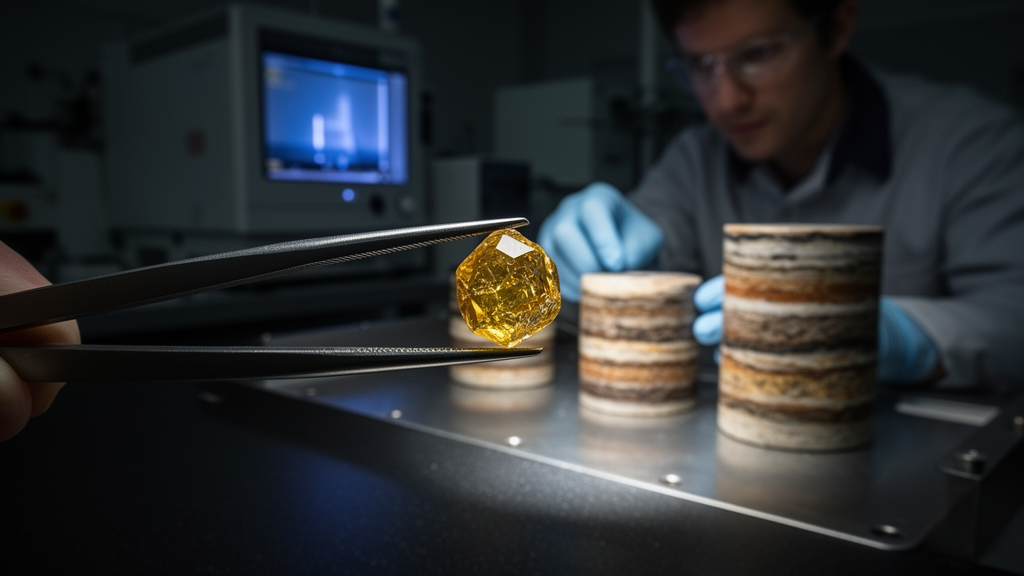
Beneath the Grand Canyon and across the ancient cores of continents lies one of geology’s most haunting features: the Great Unconformity, a boundary in the rock record where nearly a billion years of Earth’s history simply vanished. Sediments that should record the slow unfolding of the Precambrian are absent, truncated, and overlain by much younger layers. For more than 125 years, scientists have argued about what erased this immense stretch of time. Was it the grinding ice of global glaciations, or the slow, diachronous uplift and erosion driven by tectonics? A new study published in the journal Geochronology now warns that one of the most important tools used to answer that question may be far less precise than the community has assumed, and that the uncertainty lies not in the rocks themselves but in the microscopic physics of how helium moves through zircon crystals.
The tool in question is zircon (U-Th)/He thermochronology, often abbreviated ZHe. The method exploits a simple but powerful principle. Zircon crystals incorporate uranium and thorium when they grow, and these radioactive elements decay over time, producing helium atoms as daughter products. At high temperatures, helium diffuses out of the crystal almost as fast as it is produced, so the clock stays open. As a rock cools below a characteristic temperature range, diffusion slows dramatically and helium begins to accumulate. The measured age therefore records how long the crystal has resided at relatively low temperatures, typically below about 200 to 250 degrees Celsius for zircon. Because erosion brings rocks closer to the cool surface, these ages can be read as a thermal archive of mountain building, burial, and denudation over billions of years.
What makes the zircon helium system both remarkably powerful and notoriously complicated is radiation damage. Every decay event that produces a helium atom also sends a heavy alpha particle recoiling through the crystal lattice, leaving a trail of atomic-scale disruption. Over hundreds of millions of years, this damage accumulates at a rate governed by the crystal’s uranium and thorium content. Crucially, damage is not permanent: at elevated temperatures it can anneal, healing the lattice in a process described by fission-track annealing kinetics. The result is that two zircon grains from the same hand sample, sharing an identical thermal history, can behave entirely differently as thermochronometers simply because they contain different amounts of uranium and thorium and therefore different degrees of radiation damage. At low damage levels, increasing damage raises the closure temperature; at high damage levels, the trend reverses and the closure temperature falls.
To capture this complex behaviour, researchers rely on the Zircon Radiation Damage and Annealing Model, or ZRDAAM, developed by William Guenthner and colleagues in 2013. The model treats a crystal as a mixture of undamaged and damaged domains whose combined diffusion kinetics shift as damage accumulates and anneals through time. Both camps in the Great Unconformity debate have used ZRDAAM to interpret their zircon helium data. One influential analysis argued for a broadly synchronous, glacially driven origin tied to Neoproterozoic snowball Earth events, while another concluded that the unconformity developed diachronously through regional tectonic processes long before the glaciations. In the Eastern Grand Canyon, one team even reconstructed a thermal history spanning 1700 million years, reporting temperature constraints to within less than 10 degrees Celsius for intervals between 700 and 250 million years ago. The new study, led by Matthew Fox of University College London together with Adam Smith, Pieter Vermeesch, Kerry Gallagher, and Andrew Carter, asks a deceptively simple question: how well do we actually know the parameters that make such precise reconstructions possible?
The answer hinges on the Arrhenius relationship, the fundamental equation describing how diffusivity depends on temperature. Two parameters define it: the activation energy, which sets the slope of the relationship, and the frequency factor, which sets its intercept. These are extracted from step-heating experiments in which zircon crystals are progressively degassed under vacuum, and the two parameters are strongly correlated with one another. The original ZRDAAM calibration combined these parameters into single diffusivity or closure-temperature values, discarding information about their correlation. Worse, the kinetics of the theoretical minimally damaged crystal were obtained by extrapolating measured frequency factors down two orders of magnitude using a power-law relationship, a procedure that introduces uncertainties with no obvious way to quantify them. The kinetics of the extremely damaged end member rested on a single crystal, sample N17.
Fox and colleagues re-analysed the very same diffusion dataset using a fundamentally different statistical approach. Rather than fitting straight lines through individual Arrhenius plots and extrapolating, they modelled the measured diffusivities directly through the radiation damage framework, fitting four parameters representing the two hypothetical end-member crystals. They then sampled the full range of parameter values consistent with the data using a Bayesian Markov Chain Monte Carlo algorithm, tuning the proposals so that roughly 20 percent of candidate models were accepted and running the chain until one million parameter sets had been collected. Because the degassing experiments contained different numbers of heating steps, the team weighted the misfit of each experiment so that longer experiments would not dominate the calibration. The result is not just a single best-fit model but a full posterior probability distribution, complete with a covariance matrix that preserves the correlations between parameters.
The correlations turned out to be extreme. Within each end-member crystal, the activation energy and frequency factor are almost perfectly correlated, with correlation coefficients of 0.999 for the damaged end member and 0.991 for the pristine one. In contrast, the parameters of the two end members are essentially independent of each other. This structure matters enormously, because the strong correlations mean that many combinations of parameters produce nearly identical diffusion behaviour, while the residual scatter around the best fit reveals genuine irreducible uncertainty. Neither the original calibration nor the new one fits every data point perfectly, and the new maximum-likelihood parameters for the minimally damaged crystal differ noticeably from the original values, even though the original values still fall along the same correlation trend.
When the team propagated these uncertainties forward through a representative billion-year thermal history, mimicking conditions recorded by ancient rocks in Minnesota, the consequences were striking. Twenty simulated zircon crystals spanning effective uranium concentrations from 31 to 2828 parts per million were aged a thousand times over, each time with different diffusion parameters drawn from the posterior distribution. For a specific amount of radiation damage, the predicted ages dispersed by hundreds of millions of years. At an effective uranium concentration of about 1600 parts per million, predicted ages ranged from roughly 50 to 550 million years for the same thermal history. Adding realistic variation in grain size, parent-isotope zonation, inclusions, or broken grains would widen that spread further. In other words, the age-eU patterns that researchers routinely interpret as fingerprints of specific cooling events carry an intrinsic scatter that has largely gone unaccounted for.
The team also tested the effect inside a full thermal-history inversion by modifying the widely used QTQt software to resample the four diffusion parameters from their joint posterior distribution during the search. Applying the method to the Grand Canyon dataset of McDannell and colleagues, they found that the broad shape of the inferred thermal history survived, but the credible intervals widened, and the posterior distribution split into two distinct families of solutions, one including and one excluding a second cooling episode around 400 to 350 million years ago. The practical implication is sobering: thermal histories reconstructed with zircon helium data may be less well resolved than previously appreciated, and the tight temperature constraints sometimes reported for deep time may partly reflect overconfidence in the adopted kinetic parameters rather than genuine resolving power in the data.
What can be done? The authors outline a path forward. More diffusion experiments are needed to characterise helium kinetics across a wider range of radiation damage values, including replicate measurements to quantify dispersion. Natural laboratories, regions whose thermal histories are independently well constrained, could be used to calibrate diffusion parameters against observed ages and complementary thermochronometers. In the meantime, forward modelling offers a pragmatic workaround: predicting the expected age spread for a plausible thermal history and folding that spread into the uncertainties used in inversions. Screening crystals with ramped heating experiments or zircon helium-4/helium-3 thermochronology could identify anomalous diffusion behaviour before it contaminates a dataset. And because capturing the true age spread at a given uranium concentration may require 40 or more grains per sample, far more than the 5 to 30 typically analysed, the field may need to rethink its sampling strategies. The Great Unconformity’s missing billion years remain as enigmatic as ever, but this study makes clear that resolving them will demand a more honest accounting of the uncertainties hidden inside the crystals themselves.
Subject of Research: Uncertainty in helium diffusion kinetics in zircon and its impact on thermochronologic reconstruction of the Great Unconformity
Article Title: Uncertainty in helium diffusion in zircon limits thermochronologic resolution: application to the Great Unconformity
Article References: Uncertainty in helium diffusion in zircon limits thermochronologic resolution: application to the Great Unconformity. (n.d.). https://doi.org/10.5194/gchron-8-463-2026
Image Credits: AI Generated
DOI: 10.5194/gchron-8-463-2026
Keywords: thermochronology, zircon, helium diffusion, Great Unconformity, radiation damage, ZRDAAM, Geochronology, thermal history modeling, Grand Canyon, Precambrian, Markov Chain Monte Carlo, closure temperature
Cite Scienmag News
Violet Maxwell. (October 9, 2026). Hidden Uncertainty in Zircon Clocks Clouds the Story of Earth’s Great Unconformity. Scienmag. https://scienmag.com/hidden-uncertainty-in-zircon-clocks-clouds-the-story-of-earths-great-unconformity/
Violet Maxwell. "Hidden Uncertainty in Zircon Clocks Clouds the Story of Earth’s Great Unconformity." Scienmag, 9 October 2026, https://scienmag.com/hidden-uncertainty-in-zircon-clocks-clouds-the-story-of-earths-great-unconformity/. Accessed 9 October 2026.
Violet Maxwell. "Hidden Uncertainty in Zircon Clocks Clouds the Story of Earth’s Great Unconformity." Scienmag. October 9, 2026. https://scienmag.com/hidden-uncertainty-in-zircon-clocks-clouds-the-story-of-earths-great-unconformity/


