


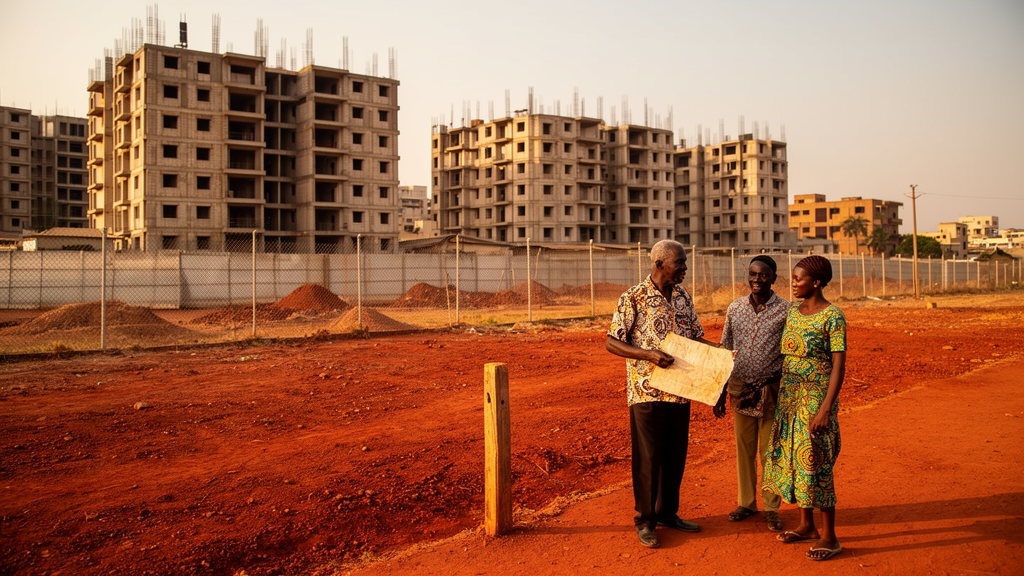
On the western fringe of Abidjan, where the sprawl of one of West Africa’s largest metropolises collides with farmland still held under customary tenure, a confrontation has unfolded that challenges long-standing assumptions about who controls urban land in Africa. A study published in Geographica Helvetica by Adjoba Marthe Koffi-Didia of the Institut de Géographie Tropicale at Université Félix Houphouët-Boigny documents how the Ébrié customary landowners of Songon-Kassemblé, a village roughly thirty kilometers from central Abidjan, turned a broken compensation agreement into a lever of genuine political power against the Ivorian state. The research, based on more than a decade of fieldwork between 2013 and 2024, reveals a striking inversion of the classic center-periphery model in which the state dictates terms and peripheral communities comply. Instead, at Songon-Kassemblé, it was the periphery that imposed conditions on the center.
The origins of the conflict lie in an ambitious housing policy. In 2012, the Ivorian government launched the Presidential Emergency Program, fulfilling a 2010 campaign promise by President Alassane Ouattara to build social and economic housing for low-income households, defined as those earning no more than 400,000 CFA francs per month. The program marked the state’s return to direct housing production after decades of withdrawal; between 1960 and 1980, the state had financed, promoted, and managed more than 90,000 dwellings in Abidjan before stepping back under pressure from international lenders. Annual housing needs around Abidjan were estimated at 22,000 units, roughly 80 percent of them social and economic housing. To secure land for the program’s largest site, the state’s Land Management Agency negotiated directly with the holders of customary rights at Songon-Kassemblé, and in 2013 a contract was signed for the cession of 439 hectares.
The financial architecture of that agreement was precise. Under Decree 2013-224 of March 2013, which regulates the purging of customary land rights for public utility, compensation for the loss of usage rights was set at 2,000 CFA francs per square meter in the Abidjan autonomous district. For the 439.27 hectares in question, the total came to 8.7 billion CFA francs, payable in three installments: 40 percent within two to six months of handing the site to developers, followed by two payments of 30 percent each at three-month intervals, a full settlement within twelve months. Compensation for destroyed crops, including rubber, oil palm, and cassava, added another 1.8 billion CFA francs, calculated by the Ministry of Agriculture under a 1995 scale, bringing the total to more than 10.5 billion CFA francs, roughly 16 million euros.
What followed was a systematic breach of that schedule. Construction began in March 2013 with more than twenty real estate companies, yet between July 2013 and 2015 the landowners received only 20.17 percent of the 8.8 billion CFA francs due, about half of the first installment the state had committed to pay within six months. The state did not settle its accounts in full until October 2020, seven years after signing. As researchers Tonan and Nassa had already observed, the payment schedules established by the state were simply not followed: developers occupied the land while rights-holders waited, sometimes for years, for money owed. The delay ignited a grievance that the Ébrié landowners, drawing on lessons from earlier conflicts in their ethnocultural area, converted into a coordinated strategy of publicization, site blockade, and negotiation.
The protest tactics were direct and disruptive. In May 2015, March 2016, November 2016, and September and November 2019, young villagers whose lineage lands had been sold organized protest marches with chants demanding their money, blocked roads, and occupied the main access route to the construction site, erecting barricades that forced developers to halt work. One young demonstrator explained to fieldworkers in September 2019 that his family had lost about four hectares of cassava and rubber land without being consulted, and that stopping the state’s works was the only way to secure the funds owed. The president of the village youth declared that the site would remain closed until the authorities delivered the second installment, six months overdue, and accused the sub-prefect and officials in Abidjan of making endless empty promises. These were not spontaneous riots but calculated acts of visibility designed to make the landowners audible to the state and to public opinion.
The consequences for the housing program were severe and measurable. The repeated blockages disrupted construction schedules, halted private investment and financing, and pushed delivery dates far beyond the three-year average originally planned. Several real estate companies, unable to absorb the unexpected costs, abandoned the project altogether. The first official handover of homes to subscribers took place only in March 2023, ten years after the program launched. Of an initial target of 60,000 units at the site, only about 15,000 had been built according to the Songon town hall’s technical service, and a February 2024 site visit found scattered clusters of houses interspersed with scrub, unbuilt plots, unfinished structures, and abandoned construction sites. The housing minister himself acknowledged in a 2019 interview that the program had a mixed record, citing the lack of flexibility of customary rights-holders in delaying works and insufficient budgetary resources as two of the major explanations for missing the original 150,000-unit national target.
Beneath the practical disruption, the study identifies a deeper restructuring of power. The negotiation arena at Songon-Kassemblé was dominated by a dyad of the state and the customary landowners, while private developers were sidelined and, remarkably, the village chieftaincy itself was pushed to the margins. The chiefs were excluded from negotiations because the land in question was family property managed by lineage heads under custom, not communal land under chiefly authority, a situation that contrasts sharply with other Ébrié villages such as Anono and Yopougon-Kouté, where chieftaincies signed protocols with the state for major urban projects in 1970 and 1971. The legitimacy of the individual lineage rights-holders gave them a preponderant role, redefining center-periphery relations: decisions were no longer dictated from the capital outward, but renegotiated from the periphery toward the center.
The study frames this reversal through the concept of autochthony capital. The Ébrié, officially recognized as the indigenous people of the Abidjan metropolitan area, have mobilized their identity since the 1970s to defend land rights against urban expansion, and at Songon-Kassemblé that immaterial resource proved decisive, reinforcing their legitimacy in negotiations and their influence over planning decisions. The parallel with Accra is instructive: there, customary actors remain central to land governance, with 80 percent of land held under customary tenure. As the scholar Kobo observed decades ago, the purging of customary rights is far from a mere formality; it is an essential phase of urbanization and one of the focal points of social struggle over land in Côte d’Ivoire and across Africa. At Songon-Kassemblé, the state’s repeated failures over decades of compensation payments placed it in a position of weakness, producing an inversion of roles in which landowners dictated terms through protest.
The resolution of the crisis came through institutionalized bargaining. To contain repeated public disorder, a multiparty working group was created comprising the chieftaincy, landowners, planters, the Ministry of Construction, and the real estate structures, tasked with monitoring both the construction site and outstanding compensation commitments. Community mobilization ultimately secured individual indemnification of the landowners, but without any collective counterpart for the village as a whole, a mechanism that unsettled the internal functioning of the Ébrié community. The monetization of customary land rights, the study concludes, has enabled peripheral actors to assert and price their power in land transactions, even against state authority, transforming a seemingly routine state-landowner dispute into a case study of how urbanization in the Global South can redistribute governance from the center to the fringe.
For scholars of urban land governance, Songon-Kassemblé offers a technically detailed demonstration that peri-urban land production is not a top-down process but a contested arena where customary legitimacy, protest capacity, and state fiscal weakness interact. The case shows that when compensation schedules are breached, the resulting conflict can permanently alter the geography of power, elevating lineage-based landholders into central negotiators and forcing the state to accommodate norms it once sought to supersede. As Abidjan’s expansion continues to absorb villages across the Songon sub-prefecture, whose 627 square kilometers of land capital made it a privileged reservoir for the 1998 Greater Abidjan master plan, the lessons of this decade-long conflict will shape every future negotiation over who pays for the city, and on whose terms.
Subject of Research: Conflict between the Ivorian state and customary landowners over compensation for a peri-urban social housing site in Songon-Kassemblé near Abidjan
Article Title: Logements sociaux et économiques à Songon-Kassemblé: Conflit et recomposition des rapports de pouvoir entre l'État et les propriétaires de droits fonciers coutumiers
Article References: Koffi-Didia, A. M. (2026). Logements sociaux et économiques à Songon-Kassemblé: Conflit et recomposition des rapports de pouvoir entre l'État et les propriétaires de droits fonciers coutumiers. Geographica Helvetica, 81(3), 453-462. https://doi.org/10.5194/gh-81-453-2026
Image Credits: AI Generated
Keywords: customary land rights, Côte d'Ivoire, Abidjan, peri-urbanization, social housing, land governance, Ébrié, land conflict, urbanization, compensation, autochthony, Songon
Cite Scienmag News
Courtney Benton. (October 9, 2026). How Customary Landowners Outmaneuvered the Ivorian State Over a Social Housing Megaproject. Scienmag. https://scienmag.com/how-customary-landowners-outmaneuvered-the-ivorian-state-over-a-social-housing-megaproject/
Courtney Benton. "How Customary Landowners Outmaneuvered the Ivorian State Over a Social Housing Megaproject." Scienmag, 9 October 2026, https://scienmag.com/how-customary-landowners-outmaneuvered-the-ivorian-state-over-a-social-housing-megaproject/. Accessed 9 October 2026.
Courtney Benton. "How Customary Landowners Outmaneuvered the Ivorian State Over a Social Housing Megaproject." Scienmag. October 9, 2026. https://scienmag.com/how-customary-landowners-outmaneuvered-the-ivorian-state-over-a-social-housing-megaproject/


