


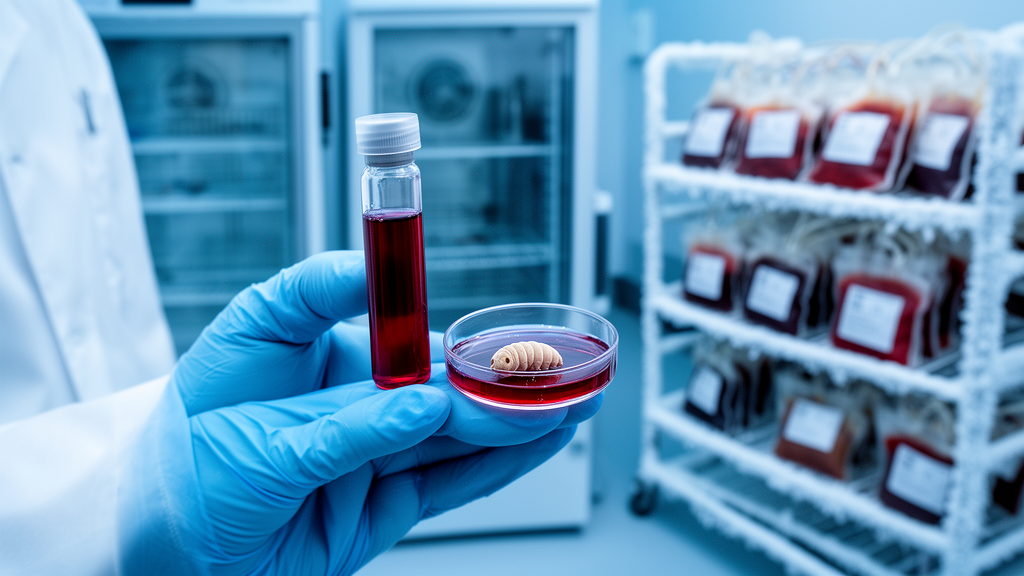
Tardigrades, the microscopic animals affectionately known as water bears, have long captivated scientists with their almost absurd resilience. These eight-legged creatures, barely visible to the naked eye, can survive being frozen solid, dried out for years, bombarded with radiation, and even exposed to the vacuum of space. Now, that legendary toughness is being put to work in medicine. A research team reporting in ACS Applied Materials & Interfaces has borrowed a molecular trick from tardigrades and turned it into a practical strategy for preserving human red blood cells, one that could simplify how blood banks store rare blood types and reduce damage associated with the current gold-standard method.
The challenge the researchers set out to address is a real and persistent one in transfusion medicine. Red blood cells can be stored refrigerated for only a limited window before they lose quality, which is why cryopreservation, freezing cells at ultra-low temperatures, is used to keep rare blood types available for years until a matching patient needs them. The conventional approach relies on glycerol, a chemical that penetrates the cells and prevents the formation of ice crystals, the sharp structures that would otherwise pierce and shred cell membranes during freezing and thawing. Glycerol works, but it comes with a catch: before a frozen unit of blood can be transfused, the glycerol must be washed out of the cells, and that removal step itself inflicts damage on a fraction of the precious cells it was meant to protect.
Enter the tardigrade. When conditions turn lethal, these animals deploy a suite of protective molecules, including a remarkable family of proteins known as CAHS, short for cytosolic abundant heat-soluble proteins. These proteins help tardigrades endure extreme dehydration and freezing by forming protective structures inside their cells. What makes CAHS proteins especially interesting for biotechnology is their unique interaction with trehalose, a naturally occurring sugar that stabilizes cell membranes and proteins. Trehalose is already familiar in other industries; it is commonly used to reduce freezer burn in frozen foods, a testament to its ability to shield biological material from the stresses of low temperatures. Hui Yang, Leming Sun, and their colleagues reasoned that if tardigrades use CAHS proteins and trehalose together to survive the unsurvivable, the same combination might protect mammalian cells in the freezer.
“This study was our first attempt to translate a lesson from an extraordinarily resilient organism into a practical cell-preservation strategy,” explains Sun, one of the corresponding authors of the study. “If further developed, it could make the process simpler after thawing, reduce concerns associated with residual glycerol, and help preserve the quality of stored cells.” That framing captures the spirit of the work: rather than inventing a protective chemistry from scratch, the team reverse-engineered a solution that evolution had already validated in one of nature’s most extreme survivors.
The technical details of the approach reveal careful optimization. Rather than working with the full-length CAHS protein, the researchers determined that a specific section, or motif, of the protein was sufficient to deliver the protective effect they needed. This kind of reduction matters for practical applications, since shorter peptide segments are easier and cheaper to produce, characterize, and quality-control than large, complex proteins. The team combined this CAHS-derived segment with trehalose at low temperature, a step that encourages the sugar to load into the cells, and then plunged the samples into liquid nitrogen for freezing.
What happened at the molecular level during that freeze is the heart of the discovery. The combination of the CAHS motif and trehalose changed the way ice formed and melted within and around the cells, suppressing the ice damage that normally destroys frozen blood. In other words, the tardigrade-derived system did not simply replace glycerol as an antifreeze additive; it actively restructured the freezing process itself, creating a gentler environment for the delicate red blood cell membranes. And when the cells were thawed, the protective cocktail proved easy to remove: a simple wash by centrifugation was enough to clear away the CAHS-trehalose mixture, eliminating the multi-step glycerol removal that burdens the conventional workflow.
The numbers tell a compelling story. Up to 89 percent of mouse red blood cells preserved with the new tardigrade-inspired method recovered fully after freezing and thawing, compared with roughly 82 percent of cells frozen using the standard glycerol protocol. That seven-percentage-point improvement may sound modest, but in the context of a blood supply, where every unit matters and rare types can be desperately hard to match, recovering more usable cells from each frozen unit translates directly into more transfusions for patients. It also means less waste of donated blood, a resource that depends entirely on volunteer donors and cannot be manufactured.
Recovery rates alone, however, are not enough to justify a new clinical approach. Transfused cells must be safe as well as abundant. To test this, the team evaluated whether the cryopreserved blood cells remained biocompatible after being frozen, thawed, and washed. The answer was encouraging on both counts. In a live-animal model, anemic mice that received transfusions of the cryopreserved blood showed significantly improved red blood cell counts and hemoglobin levels, confirming that the thawed cells were not just intact but functionally capable of doing their oxygen-delivery job. Just as importantly, the transfusions did not trigger an inflammatory response, a critical safety signal indicating that the treated cells did not provoke the immune system of the recipients.
The implications reach beyond the blood bank. The researchers hope their work will inform the design of better cryopreservation strategies more broadly, potentially protecting other cell types and tissues that are currently difficult to freeze without heavy losses. They also point toward an even more ambitious goal: protective strategies that could keep blood viable at room temperature, which would transform logistics in regions where maintaining a cold chain, let alone a liquid nitrogen supply, is expensive or impractical. A tardigrade-inspired formulation that guards cells across temperature extremes is a natural starting point for that vision, since the proteins it derives from evolved precisely to bridge the gap between wet and dry, frozen and thawed.
For now, the work stands as a striking example of biomimicry at the molecular scale, a reminder that some of the best engineering solutions have already been debugged by nature over hundreds of millions of years. The study received funding from the National Natural Science Foundation of China, the Guangdong Basic and Applied Basic Research Foundation, and the Natural Science Basic Research Plan in Shaanxi Province of China. From here, translating the mouse results into human blood banking will require further development and validation, but the conceptual leap is complete: a protein motif from an animal that shrugs off the vacuum of space has shown it can help something as ordinary, and as vital, as a bag of donated blood survive the deep freeze. If the tardigrade’s trick continues to perform as it scales, the water bear may soon earn a place in hospitals, quietly keeping rare blood types ready for the patients who need them.
Subject of Research: Tardigrade-derived CAHS proteins for glycerol-free cryopreservation of red blood cells
Article Title: A trick from tardigrades could help human blood withstand freezing
Article References: A trick from tardigrades could help human blood withstand freezing. (n.d.). Original publication
Image Credits: AI Generated
DOI: Not provided
Keywords: tardigrades, cryopreservation, red blood cells, CAHS proteins, trehalose, glycerol, blood banking, transfusion medicine, ice crystal formation, biomimicry, ACS Applied Materials & Interfaces, anemic mice
Cite Scienmag News
Bethany Barker. (October 9, 2026). Tardigrade Proteins Offer a Simpler Way to Freeze Human Blood for Transfusion. Scienmag. https://scienmag.com/tardigrade-proteins-offer-a-simpler-way-to-freeze-human-blood-for-transfusion/
Bethany Barker. "Tardigrade Proteins Offer a Simpler Way to Freeze Human Blood for Transfusion." Scienmag, 9 October 2026, https://scienmag.com/tardigrade-proteins-offer-a-simpler-way-to-freeze-human-blood-for-transfusion/. Accessed 9 October 2026.
Bethany Barker. "Tardigrade Proteins Offer a Simpler Way to Freeze Human Blood for Transfusion." Scienmag. October 9, 2026. https://scienmag.com/tardigrade-proteins-offer-a-simpler-way-to-freeze-human-blood-for-transfusion/


