


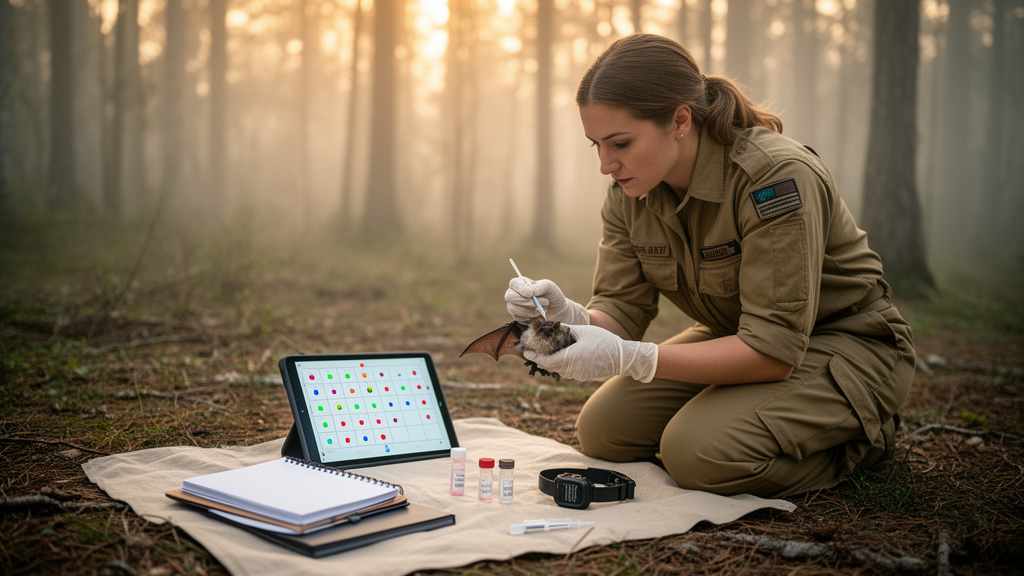
The risk of zoonotic disease spilling over from wildlife into human populations is rising as land-use change and climate change reshape the distributions of animals and the pathogens they carry. Yet for most of the globe, public health authorities lack actionable information about which pathogens circulate in which wildlife populations, making it extraordinarily difficult to prevent zoonotic diseases before they emerge. A new study published in PLOS Ecosystems addresses this gap with a practical protocol that integrates biodiversity science into the design of wildlife disease surveillance programs, helping researchers decide where to sample and what to sample in order to extract the maximum amount of useful information from limited budgets.
The research, led by Michael D. Catchen, Francis Banville, and Timothée Poisot together with an international team of disease ecologists and biodiversity informatics specialists, starts from a deceptively simple observation: biosurveillance is expensive, and historically it has been conducted opportunistically rather than strategically. Samples have been collected where access is easy, where past outbreaks occurred, or where funding happened to flow, with little systematic guidance drawn from what is already known about the geographic distributions of the hosts that harbor zoonotic pathogens. The result is a global surveillance landscape riddled with blind spots precisely in the regions where spillover risk may be highest.
To correct this, the authors borrow a concept that the biodiversity monitoring community has refined over decades: the Biodiversity Observation Network, or BON. BONs are designed to select monitoring locations that capture the status and trends of biodiversity as effectively and efficiently as possible. The new protocol adapts this logic to pathogen surveillance. Rather than asking where biodiversity is changing, the framework asks where sampling for wildlife pathogens will yield the most valuable information, given known patterns of host distribution and, where data exist, observed pathogen prevalence.
At the technical core of the protocol are host species distribution models. These models combine occurrence records of host species with environmental predictors such as climate, vegetation, and land cover to estimate the probability that a given host species is present at any location on the map. By stacking or weighting these models across the set of host species relevant to a particular pathogen group, the protocol produces a spatial picture of where the hosts of concern are likely to live, and therefore where surveillance effort is most likely to encounter them. Locations that combine high host suitability with poor existing sampling coverage rise to the top of the priority list.
A key strength of the framework is its flexibility. The protocol can target two different forms of sampling depending on what is achievable in a given context. Where pathogen testing infrastructure is limited, the protocol can prioritize the collection of host occurrence data itself, which improves the underlying distribution models and sharpens future surveillance targets. Where laboratory capacity exists, it can instead prioritize pathogen prevalence sampling, directing field teams to collect and test animals in the locations where the models indicate hosts are present but pathogen status remains unknown. This adaptive structure means the same principled workflow can serve programs at very different stages of data availability.
The authors demonstrate this flexibility through two case studies focused on rodent- and shrew-borne viruses, chosen because these small mammals are the reservoir hosts of several globally significant zoonoses. The first case study prioritizes sampling for Hantaviridae in rodents in India, representing a data-poor context in which host occurrence records are sparse and pathogen prevalence data are limited. The second targets Arenaviridae in shrews in South Korea, a comparatively data-rich setting where existing records allow the models to make finer-grained recommendations. Together, the two cases show how the protocol scales its recommendations to the evidence available rather than demanding ideal data before it can function.
The distinction between the two case studies matters because it reflects a common real-world dilemma. Many regions facing substantial spillover risk are also regions where baseline biodiversity data are thin, a problem sometimes described as the Wallacean shortfall in biogeography. A surveillance framework that only works with dense occurrence datasets would exclude exactly the places that need it most. By allowing host distribution models to be iteratively improved as new occurrence data come in, the protocol turns early, coarse surveillance into progressively sharper targeting, creating a feedback loop between fieldwork and modeling.
The public health rationale for this strategic approach is straightforward. Preventing zoonotic outbreaks is far cheaper and safer than responding to them, and prevention depends on identifying regions where spillover is most probable before it happens. Pathogens such as hantaviruses and arenaviruses cause severe hemorrhagic and pulmonary disease in humans, and their reservoir hosts often thrive in human-modified landscapes, bringing infected animals into closer contact with people. Knowing where those hosts are, and where their pathogens have and have not been surveyed, allows governments and health agencies to position preventative measures where they will do the most good.
Beyond its immediate application to rodent-borne viruses, the authors frame the protocol as a foundation for integrating long-term biosurveillance with existing biodiversity monitoring programs. Biodiversity observation infrastructure already operates across many countries, tracking species occurrences through standardized field protocols and data pipelines. Embedding pathogen surveillance priorities within that infrastructure would allow the two enterprises to share field logistics, data standards, and analytical machinery, multiplying the useful information available for public health decision making without duplicating effort. The protocol is published with sufficient methodological detail to be adopted and adapted by research groups and public health agencies working at national or regional scales.
As climate change continues to shift species ranges and land conversion keeps fragmenting habitats, the map of zoonotic risk will keep being redrawn. Static surveillance plans will fall behind. What this protocol offers is a repeatable, principled way to update those plans, using the same distribution modeling tools that ecologists already trust, and to keep asking the question that matters most for outbreak prevention: given everything we know about where hosts live and where pathogens have been found, where should we look next?
Subject of Research: A protocol for integrating host biodiversity data into strategic wildlife disease surveillance for zoonotic spillover prevention
Article Title: A protocol for biodiversity-informed wildlife disease surveillance
Article References: Catchen, M. D., Banville, F., Boutin, A. C., Brookson, C. B., Carlson, C. J., Dansereau, G., Gibb, R., Houle, M., Kaza, B., Robertson, H., Simons, D., Seifert, S. N., & Poisot, T. (2026). A protocol for biodiversity-informed wildlife disease surveillance. PLOS Ecosystems, 1(1), e0000023. https://doi.org/10.1371/journal.pesy.0000023
Image Credits: AI Generated
DOI: 10.1371/journal.pesy.0000023
Keywords: zoonotic spillover, wildlife disease surveillance, biodiversity monitoring, species distribution models, Biodiversity Observation Networks, hantaviruses, arenaviruses, rodent reservoirs, pathogen prevalence, public health, one health, PLOS Ecosystems
Cite Scienmag News
Margaret Porter. (October 9, 2026). New Protocol Puts Biodiversity Data at the Heart of Wildlife Disease Surveillance. Scienmag. https://scienmag.com/new-protocol-puts-biodiversity-data-at-the-heart-of-wildlife-disease-surveillance/
Margaret Porter. "New Protocol Puts Biodiversity Data at the Heart of Wildlife Disease Surveillance." Scienmag, 9 October 2026, https://scienmag.com/new-protocol-puts-biodiversity-data-at-the-heart-of-wildlife-disease-surveillance/. Accessed 9 October 2026.
Margaret Porter. "New Protocol Puts Biodiversity Data at the Heart of Wildlife Disease Surveillance." Scienmag. October 9, 2026. https://scienmag.com/new-protocol-puts-biodiversity-data-at-the-heart-of-wildlife-disease-surveillance/


