


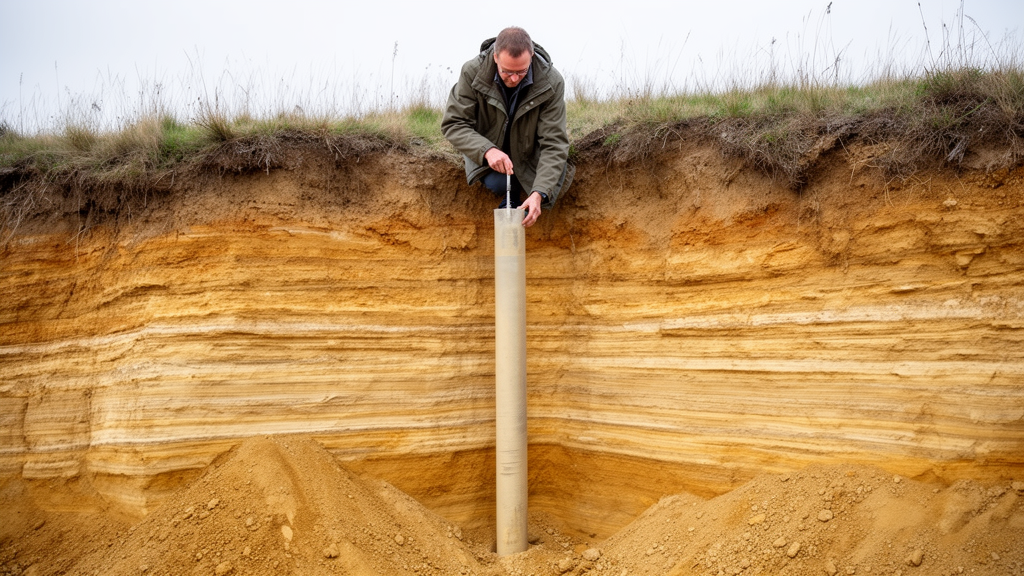
Buried beneath vineyards along the Middle Rhine Valley in western Germany lies one of the most detailed climate archives in Europe: a 30-meter-thick wall of windblown dust known as the Schwalbenberg loess deposit. A new dissertation by Mathias Vinnepand of the Institute of Geography at the University of Mainz, published as a thesis abstract in the E&G Quaternary Science Journal, describes a set of strategies for decoding the tangled chemical signals preserved in this dust. The work, supervised by Andreas Vött and co-supervised by Peter Fischer, shows how scientists can finally separate the overlapping messages written into loess by distant dust sources, long-distance transport, and thousands of years of soil formation. The payoff is a sharper picture of how terrestrial ecosystems in western central Europe responded, sometimes within mere centuries, to the abrupt climate oscillations that punctuated the last 127,000 years.
Loess-palaeosol sequences, abbreviated LPSs by researchers, are the most extensive Quaternary sediment archives of climate and environmental change on the continents. They consist of alternating layers of yellowish windblown silt, deposited during cold and arid phases, and darker fossil soils that formed during warmer, more humid intervals. Each layer is a page in a book that spans the entire Upper Pleistocene. But the book is notoriously difficult to read. The geochemical composition of any given sample is a mixture of information about where the dust particles originated, what happened to them while they were carried by the wind, and what chemical and physical alterations occurred after they settled. If these interfering signals cannot be deconvoluted, comparisons between loess deposits on different continents remain speculative. Vinnepand’s central achievement is a framework that makes such comparisons possible.
The Schwalbenberg site is an almost ideal testing ground for this framework. Located in the periglacial corridor that existed between the northern ice sheets and the Alpine glacier network during the Last Glacial Maximum, the deposit sits at the very core of the former periglacial realm of central Europe. That position made it extremely sensitive to climatic changes originating over the North Atlantic. With a thickness of 30 meters covering the entire Upper Pleistocene, it offers an unprecedented resolution for loess deposits in western central Europe, allowing researchers to resolve environmental shifts that occurred on millennial, and in some cases sub-millennial, timescales.
The first pillar of the new strategy concerns water, the key driver of chemical alteration in soils and sediments. Vinnepand and colleagues combined interpretations of organic and inorganic stable carbon isotope signatures, written as δ13C, to reconstruct soil and sediment moisture simultaneously from two independent angles. The organic signature comes from plant tissue and records drought stress: when water becomes scarce, plants partially close their stomata to reduce evapotranspiration. That closure limits the diffusion of carbon dioxide into the leaves and reduces photosynthetic efficiency, forcing plants, especially C3 plants, to increasingly take up the heavier carbon isotope 13C. Because of the difference in diffusivity between 12CO2 and 13CO2 in air, which amounts to 4.4 per mil, and the effect of partial stomatal closure, this discrimination can deviate by up to 4 per mil from the δ13C mean of C3 plants, which lies near minus 27 per mil. That deviation is a direct, quantifiable indicator of water availability during the lifetime of the ancient vegetation.
The inorganic signature, by contrast, is carried by carbonates in the soil. Primary carbonate, inherited directly from the dust, has a δ13C value close to zero per mil, while secondary carbonate precipitated in soil under C3 vegetation approaches minus 12 per mil. Using a mass balance calculation, the researchers can estimate the relative contents of primary and secondary carbonate in each sample. Combining the two isotope systems yields a far more holistic picture than either alone, particularly in environments that experienced permafrost. The REM3 core from the Schwalbenberg provides a striking example. A laminated loess layer underlying a very weak Gelic Gleysol dated to around 25,000 years ago shows low quantities of secondary carbonate, which would normally point to dry conditions or to the removal of carbonate by initially thawing permafrost. Yet the organic δ13C signature from the same section indicates moist conditions. The resolution of this apparent contradiction is that permafrost-induced moisture, trapped meltwater rather than rainfall, governed the water available to plants. A precipitation-centered interpretation of the organic signal alone would have been misleading.
The second pillar of the dissertation addresses a subtle but consequential problem in the way loess data are traditionally analyzed. Plotting element ratios down a profile is a standard first step, but Vinnepand’s work shows it can only be a first step. One and the same proxy may reflect entirely different processes in different environmental settings, for example in loess compared to palaeosols. Deriving weathering indices from element ratios is further complicated by the fact that dust sources changed through time and that ecosystems responded differently to changing conditions. To overcome this, the study integrates a suite of weathering proxies, provenance-sensitive element ratios, and grain size parameters into principal component analyses and linear discriminant analyses. Crucially, the dataset is filtered according to stratigraphic units before the statistics are applied, so that samples of the same nature, all loess or all Gelic Gleysols for instance, are processed separately. This filtering step allows like to be compared with like and strongly increases the explanatory power of the proxies.
The statistical machinery itself is elegant in its division of labor. Principal component analysis reduces the dimensionality of the data and summarizes the most relevant information along uncorrelated, first-rank-ordered axes, revealing the dominant gradients of variation. Linear discriminant analysis then works in the opposite direction: it minimizes the variance within predefined groups and maximizes the variance between them, testing whether the pre-defined stratigraphic units can be re-detected in the geochemical data. Together, the two approaches allow researchers to assess both the nature and the temporal progression of ecosystem responses to climatic changes. The strategy is currently being tested on other loess-palaeosol sequences and is considered most promising as a key for spatial analyses across continents, a goal that has long eluded loess researchers because of the signal-mixing problem.
The third pillar adds geophysics to geochemistry. Vinnepand combined elemental data, including strontium and neodymium isotopes that fingerprint dust sources, with magnetic proxies: magnetic susceptibility and its frequency dependence and anisotropy. The test case is the RP1 profile, which covers the late part of oxygen isotope stage 3, roughly 40,000 to 30,000 years ago, and the Last Glacial Maximum, roughly 24,000 to 22,000 years ago, separated by an erosional unconformity. For the older interval, sedimentological proxies indicative of wind dynamics, such as the U-ratio, and of pedogenesis, such as the finest clay fraction below 0.2 micrometers, show patterns that are comparable and mostly synchronous with dust and climate proxies from Greenland ice cores. That synchroneity vanishes in the LGM interval, where local to regional conditions dominate, testified to by an increase in particles derived from the nearby Rhenish Massif.
The RP1 record also captures a dramatic regional reorganization. Moving from the oldest to the youngest parts, a distinct shift toward increased input of so-called Rhine dust and reduced weathering intensity occurs simultaneously with an overall cooling and aridification trend in Europe toward the end of oxygen isotope stage 3. Between Greenland Interstadial 6 and Greenland Interstadial 5.1, magnetic enhancement through the accumulation of coarse iron mineral-bearing particles in the loess may testify to increasing wind vigour. Reconstructions of near-surface wind trends based on the anisotropy of magnetic susceptibility may further indicate the temporal influence of northeasterly winds alongside the overall dominance of westerlies, a combination that drove high dust accumulation rates at the site. Applying these approaches to different geographic areas and topographical contexts may allow a more comprehensive understanding of loess formation, including changes in dust composition and the associated atmospheric circulation patterns that accompanied past climate changes.
What makes this work resonate beyond the loess community is its methodological lesson: archives are only as useful as our ability to separate the signals they contain. By treating every loess sample as a composite message and designing statistical tools to unmix it, the Schwalbenberg research transforms a local German hillside into a calibrated reference section for the whole of western central Europe. The same logic now extends outward, promising continental-scale comparisons of dust-based archives and, with them, a much more precise chronology of how landscapes, soils, and vegetation coped with the abrupt climate swings of the last ice age. As the modern climate shifts with increasing speed, understanding how terrestrial systems responded in the past, and how quickly, has never been more relevant.
Subject of Research: Geochemical decoding of the Schwalbenberg loess-palaeosol sequence to reconstruct terrestrial ecosystem responses to Upper Pleistocene climate changes in western central Europe
Article Title: Decoding loess geochemical signals of the Schwalbenberg – a key to terrestrial system response to millennial-timescale Upper Pleistocene climate changes in western central Europe
Article References: Vinnepand, M. (2026). Decoding loess geochemical signals of the Schwalbenberg – a key to terrestrial system response to millennial-timescale Upper Pleistocene climate changes in western central Europe. E&G Quaternary Science Journal, 75(1), 69-72. https://doi.org/10.5194/egqsj-75-69-2026
Image Credits: AI Generated
Keywords: loess, palaeosol, geochemistry, Schwalbenberg, Upper Pleistocene, stable carbon isotopes, permafrost, dust provenance, magnetic susceptibility, principal component analysis, Last Glacial Maximum, Rhine Valley
Cite Scienmag News
Violet Maxwell. (October 9, 2026). Ancient Dust Decoded: German Loess Archive Reveals How Ecosystems Reacted to Abrupt Ice Age Climate Swings. Scienmag. https://scienmag.com/ancient-dust-decoded-german-loess-archive-reveals-how-ecosystems-reacted-to-abrupt-ice-age-climate-swings/
Violet Maxwell. "Ancient Dust Decoded: German Loess Archive Reveals How Ecosystems Reacted to Abrupt Ice Age Climate Swings." Scienmag, 9 October 2026, https://scienmag.com/ancient-dust-decoded-german-loess-archive-reveals-how-ecosystems-reacted-to-abrupt-ice-age-climate-swings/. Accessed 9 October 2026.
Violet Maxwell. "Ancient Dust Decoded: German Loess Archive Reveals How Ecosystems Reacted to Abrupt Ice Age Climate Swings." Scienmag. October 9, 2026. https://scienmag.com/ancient-dust-decoded-german-loess-archive-reveals-how-ecosystems-reacted-to-abrupt-ice-age-climate-swings/


