


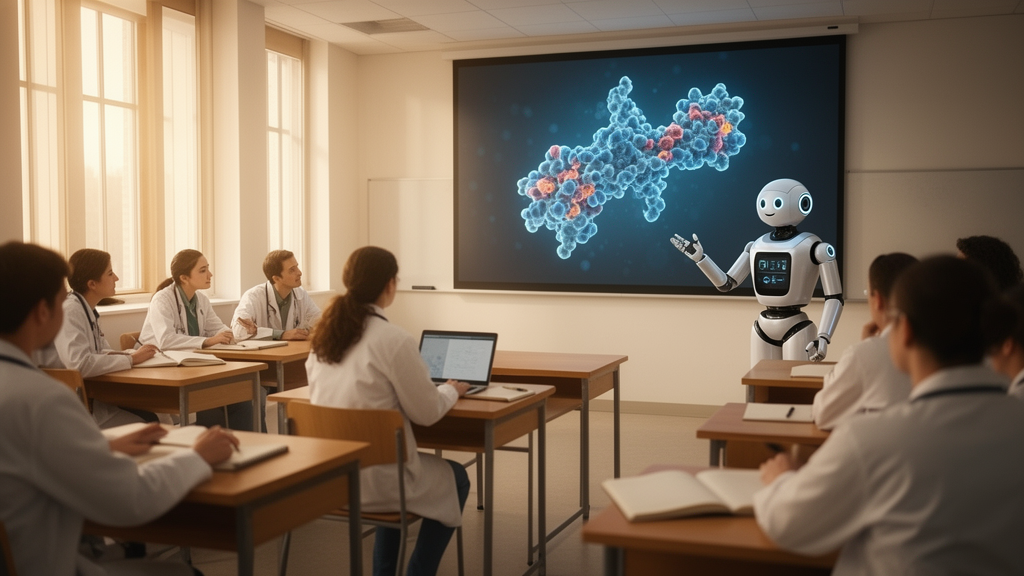
Medical educators have long wrestled with a stubborn paradox at the heart of problem-based learning. The method, in which students tackle realistic clinical cases in small groups, is prized for building the reasoning skills that doctors actually use, yet the newest learners in the pipeline, those just entering foundational science courses, often drown in it. Confronted with an unfamiliar biochemistry case, a first-year student must simultaneously decode the scenario, retrieve fragmented background knowledge, and construct an explanation from scratch, all before the group discussion has properly begun. A new quasi-experimental study published in BMC Medical Education suggests that a carefully designed generative artificial intelligence assistant can lift exactly that burden, and in doing so, deliver measurably better learning outcomes than either traditional problem-based learning or conventional lectures.
The research team, led by Meng Sheng and Yalin Liu of Changde Vocational Technical College in China, together with colleagues at Lingnan University and Changde First Hospital of Traditional Chinese Medicine, built their intervention around a framework known as cognitive apprenticeship. The idea, borrowed from the learning sciences, is that expert thinking should be made visible to novices in stages: the instructor first models how an expert approaches a problem, then coaches students as they attempt it themselves, and finally fades support as competence grows. The researchers layered a generative AI learning agent onto this scaffold, creating a model they call AI-CAS-PBL, and tested it against conventional problem-based learning and lecture-based instruction in a biochemistry unit on lipid metabolism.
The technical heart of the study is the AI agent itself. The team developed it on the Coze platform, powering it with the Doubao 1.5 Pro 32K large language model, a system with a context window large enough to hold an entire clinical case, the relevant metabolic pathways, and a running dialogue with the student. Rather than simply answering questions, the agent was positioned within the cognitive apprenticeship structure to provide one of two complementary forms of scaffolding: it could respond to student questioning at any hour, offering explanations calibrated to the learner’s current understanding, while the human instructor retained the modeling role, demonstrating expert reasoning in front of the class. The design deliberately avoided the most common failure mode of educational chatbots, which is to hand students finished answers that short-circuit the very thinking the curriculum is meant to build.
Methodologically, the study took care to hold everything constant except the instructional approach. The same instructor taught all three groups, and the learning objectives, core content, scheduled contact time, case materials, and assessment procedures were standardized across conditions. What differed was the mode of support: the AI-CAS-PBL group received the AI agent alongside the cognitive apprenticeship structure, the conventional problem-based learning group worked without AI support, and the lecture-based group received traditional instruction. This quasi-experimental design, while not a randomized trial, substantially strengthens the claim that the AI integration itself, rather than differences in teaching quality or content coverage, drove the observed effects.
The results were striking. Students in the AI-CAS-PBL group achieved significantly higher post-test scores on both lipid metabolism knowledge and case-based clinical application analysis than students in either comparison group, with all differences reaching statistical significance at the conventional threshold. In other words, the AI-supported approach did not merely help students memorize metabolic pathways better; it improved their ability to apply biochemical reasoning to clinical scenarios, which is precisely the transfer of learning that problem-based learning was invented to promote and that lectures so often fail to deliver.
Equally important were the findings on how the experience felt to learners. Using the NASA Task Load Index, a validated instrument originally developed for aviation that measures perceived mental demand, effort, frustration, and related dimensions of workload, the researchers found that students in the AI-CAS-PBL group reported significantly lower cognitive workload than their peers in conventional problem-based learning. This matters because cognitive load theory, one of the most influential frameworks in instructional psychology, holds that working memory is a severely limited resource, and that learning fails when instruction imposes demands that exceed it. The AI agent appears to have absorbed some of the extraneous load, the wasted mental effort of searching for information and struggling alone, freeing capacity for the productive kind of load that builds durable knowledge structures.
The psychological benefits extended beyond workload. Students working with the AI agent reported higher self-efficacy, measured with the New General Self-Efficacy Scale, reflecting greater confidence in their own ability to succeed at the task. Self-efficacy is not a soft outcome; decades of research link it to persistence, engagement, and ultimately achievement. A struggling novice who can test half-formed ideas against a patient, endlessly available AI interlocutor, without fear of embarrassment in front of peers, may be more willing to attempt difficult reasoning, and that willingness compounds over a course. The students also rated the agent highly on perceived usefulness and perceived ease of use, the two central constructs of the Technology Acceptance Model, indicating that the tool was not merely tolerated but genuinely embraced.
To probe the learning environment itself, the team drew on instruments tied to the cognitive apprenticeship experience, including the Maastricht Clinical Teaching Questionnaire and measures of critical thinking disposition. The theoretical claim underlying the intervention is that AI-supported questioning and instructor modeling provide complementary forms of instructional support, a dual-scaffolding arrangement in which the machine handles on-demand explanation while the human demonstrates expert strategy. The authors are appropriately careful here: because the study did not directly examine the interaction between AI support and instructor scaffolding, they present this dual-scaffolding framework as a theoretically informed interpretation rather than a confirmed causal pathway. That honesty is a model of how AI-in-education research should be reported, resisting the temptation to overclaim mechanism from outcome data.
The implications reach well beyond one biochemistry unit. Generative AI is flooding into classrooms faster than the evidence base can support, with institutions adopting chatbots on enthusiasm rather than data. This study offers something rarer: a controlled comparison showing that AI integration, when embedded in a principled pedagogical framework rather than bolted onto an existing course, can outperform both the traditional alternative and the reform method it was meant to enhance. The lesson may be that the framework matters as much as the technology. Cognitive apprenticeship gave the AI a defined pedagogical role, preventing it from becoming either a crutch that replaced thinking or an oracle that students passively consulted.
Caveats remain, and the authors name them. The study was conducted at a single institution with a single instructor, and the quasi-experimental design cannot rule out all confounding. The authors themselves call for evaluation in larger, multicenter, and multi-class studies before the model is widely adopted. Questions about long-term retention, transfer to other subject areas, and the effects of AI dependence on independent problem-solving all await future work. Yet as a proof of concept, the study lands at a propitious moment. It suggests a concrete, testable architecture for human-AI collaborative teaching, one in which the machine’s tireless availability and the teacher’s expert modeling are not competing for the same instructional space but reinforcing each other. If larger trials confirm these results, the image of the medical student lost in a case discussion, silently overwhelmed, may give way to something better: a novice with an expert’s questions at their fingertips and an expert’s thinking demonstrated before them, learning biochemistry not by memorizing pathways but by reasoning through them with less strain and more confidence.
Subject of Research: Integrating generative AI into cognitive apprenticeship-based problem-based learning in medical biochemistry education
Article Title: Integrating generative AI into cognitive apprenticeship–based problem-based learning in biochemistry: a quasi-experimental study
Article References: Sheng, M., Gong, Y., Hu, W., & Liu, Y. (2026). Integrating generative AI into cognitive apprenticeship–based problem-based learning in biochemistry: a quasi-experimental study. BMC Medical Education. https://doi.org/10.1186/s12909-026-10504-3
Image Credits: AI Generated
DOI: 10.1186/s12909-026-10504-3
Keywords: medical education, problem-based learning, generative artificial intelligence, cognitive apprenticeship, cognitive load, biochemistry, large language model, self-efficacy, quasi-experimental study, clinical reasoning, NASA-TLX, human-AI collaboration
Cite Scienmag News
Courtney Benton. (October 9, 2026). AI Tutor Meets Medical Classroom: Smarter Biochemistry Learning With Less Mental Strain. Scienmag. https://scienmag.com/ai-tutor-meets-medical-classroom-smarter-biochemistry-learning-with-less-mental-strain/
Courtney Benton. "AI Tutor Meets Medical Classroom: Smarter Biochemistry Learning With Less Mental Strain." Scienmag, 9 October 2026, https://scienmag.com/ai-tutor-meets-medical-classroom-smarter-biochemistry-learning-with-less-mental-strain/. Accessed 9 October 2026.
Courtney Benton. "AI Tutor Meets Medical Classroom: Smarter Biochemistry Learning With Less Mental Strain." Scienmag. October 9, 2026. https://scienmag.com/ai-tutor-meets-medical-classroom-smarter-biochemistry-learning-with-less-mental-strain/


