


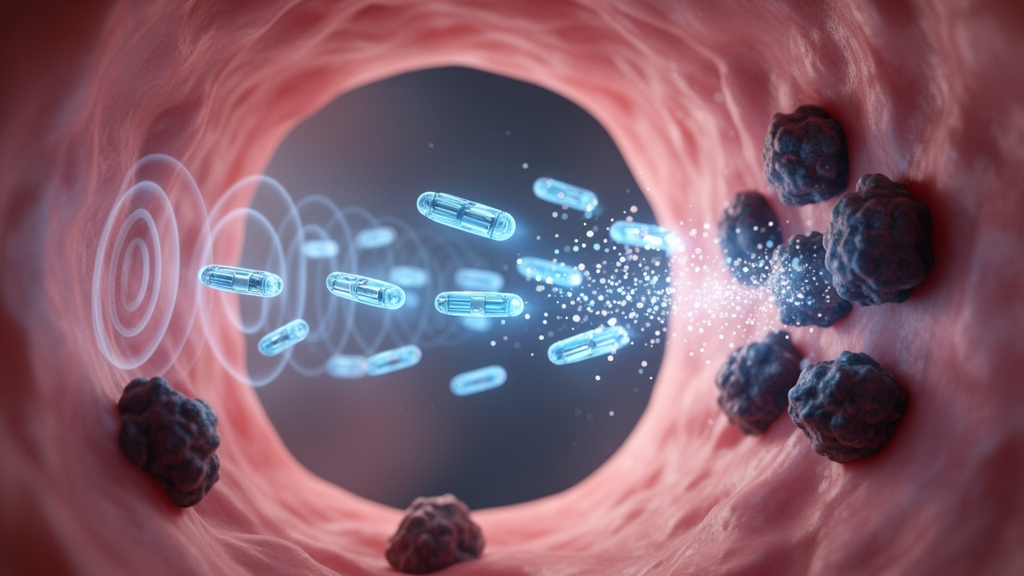
Bladder cancer remains one of the most stubborn malignancies in urology, and its most common form, nonmuscle-invasive bladder cancer, is notorious for coming back. Even after tumors are surgically removed and patients undergo intravesical therapy, recurrence rates can climb steeply over the following years, forcing repeated procedures and lifelong surveillance. A research team reporting in Science Bulletin now describes an unconventional answer to this problem: a microscopic, living machine that swims into the battlefield of the bladder tumor and dismantles it from several directions at once. The platform, designated HH-B-DM4-NT, fuses a collagen-devouring bacterium, ultrasound-responsive nanoparticles, a potent cytotoxic drug, and a molecular homing signal into a single bioactive microrobot delivered directly into the bladder.
The engineering logic behind the system addresses two of the most persistent failures of intravesical therapy. The first is physical: bladder tumors are wrapped in a dense extracellular matrix, a scaffolding of collagen and other proteins that acts like a wall, preventing drugs from penetrating beyond the tumor surface. The second is biological: most instilled agents lack any mechanism to distinguish cancer cells from healthy urothelium, so effective doses are difficult to achieve without collateral toxicity. The new microrobot was designed to breach the wall and find the target simultaneously, using living biology as the delivery chassis.
The biological core of the platform is Hathewaya histolytica, a bacterium that naturally secretes collagenolytic enzymes capable of degrading collagen, the dominant structural protein of the tumor stroma. Rather than fighting this enzymatic activity, the researchers harnessed it. Once the bacteria are instilled into the bladder and reach the tumor, they begin digesting the collagen matrix around and within the lesion. This enzymatic excavation loosens the dense tissue architecture, opening channels through which the attached therapeutic payload can diffuse deep into the tumor mass. In effect, the bacterium acts as a self-propelled demolition crew that prepares the ground for the drugs that follow.
Onto this living scaffold the team grafted synthetic components. Bismuth ferrite nanoparticles were coated onto the bacterial surface, endowing the microrobot with responsiveness to external ultrasound. When ultrasound waves are applied from outside the body, these piezoelectric nanoparticles generate reactive oxygen species, highly reactive molecules that inflict oxidative damage on nearby cancer cells. This sonodynamic mechanism gives clinicians remote, spatially controlled activation of the therapy: the drug payload works where the bacteria deliver it, while the ultrasound-triggered ROS attack can be timed and directed by the treating physician. The nanoparticles also contribute to inducing immunogenic cell death, a form of tumor cell demise that releases antigens and danger signals capable of alerting the immune system.
The third component is DM4, a microtubule inhibitor that disrupts the cytoskeleton of dividing cells. As the bacterial collagenases erode the extracellular matrix, DM4 penetrates the loosened tumor and breaks down intercellular networks, further destabilizing the tumor’s structural integrity. The fourth element is a targeting ligand, neurotensin, which binds to the NTS1 receptor that is overexpressed on bladder cancer cells. This ligand acts as a molecular address label, concentrating the microrobot and its payloads on malignant tissue rather than healthy bladder wall. Together, the four modules perform complementary functions: matrix degradation, ligand-guided targeting, cytoskeletal disruption, and ultrasound-triggered oxidative attack.
The laboratory results reported in the study are striking. In vitro, the HH-B-DM4-NT system produced measurable collagen degradation, disrupted three-dimensional tumor spheroids that mimic the architecture of real tumors, and achieved 90.8 percent cancer cell death. Mechanistic analysis revealed that the treated cells suffered mitochondrial dysfunction, DNA damage, and apoptosis, the controlled self-destruction pathway that marks cells for removal. Importantly, the treatment also stimulated dendritic cell maturation, the process by which the immune system’s sentinel cells learn to present tumor antigens to other immune players, and it shifted macrophages toward the M1, or pro-inflammatory, phenotype. Macrophage polarization is a critical determinant of tumor immunity, because M2-like macrophages tend to suppress immune responses and support tumor growth, while M1-like macrophages attack tumor tissue and recruit other immune cells.
The therapeutic promise carried over into animal models. In an orthotopic mouse model of bladder cancer, in which tumors are established inside the bladder itself rather than implanted under the skin, the combined microrobot therapy achieved 82.4 percent tumor inhibition and significantly prolonged survival compared with control groups. Examination of the treated tumors showed increased infiltration of CD8-positive T cells, the cytotoxic lymphocytes responsible for directly killing cancer cells, along with a favorable shift in the M1-to-M2 macrophage ratio. These findings indicate that the local treatment did more than destroy cells on contact; it helped remodel an immunosuppressive tumor microenvironment into one more capable of sustaining a long-term antitumor immune response.
This immunological dimension may prove to be the platform’s most valuable feature. Nonmuscle-invasive bladder cancer is currently managed with transurethral resection followed by intravesical bacillus Calmette-Guérin therapy in higher-risk patients, an approach that relies on provoking a local immune reaction but fails in a substantial fraction of cases, leaving few options short of radical surgery. A therapy that combines immediate cytotoxicity with immune priming could address both the visible tumor and the reservoir of microscopic disease that seeds recurrence. The authors also point to a practical advantage of the intravesical route: tumor debris and residual material can be physically cleared through urination, a form of natural waste removal unavailable to systemically delivered therapies.
The researchers emphasize that the system consolidates tumor targeting, extracellular matrix disruption, immune activation, and physical clearance into one integrated platform, a design philosophy that contrasts with combination regimens requiring multiple separate agents and administration schedules. By making the bacterium itself the carrier, the platform exploits motility and enzymatic secretion that synthetic carriers cannot replicate, while the nanoparticle coating and ligand conjugation add controllability and specificity that raw bacteria would lack. The synergy between bacterial collagenolysis and drug penetration is particularly notable, because stromal barriers are a recognized cause of treatment failure across many solid tumors, not only those of the bladder.
As with any living biotherapeutic, the path from mouse models to patients will demand rigorous evaluation. The authors caution that additional studies are needed to assess the safety and long-term efficacy of the system, including questions of bacterial containment, off-target collagen degradation, and the durability of the immune response. The work was supported by a grant from the Beijing-Tianjin-Hebei Natural Science Foundation Cooperation Project and the National Natural Science Foundation of China, and it appears in Science Bulletin under the title Active bacteria-delivered nanosystems for multimodal bladder cancer therapy. If those safety questions can be answered favorably, bioactive microrobots of this kind could open a new chapter in the treatment of a cancer that has long resisted conventional intravesical approaches, turning the bladder itself into a stage where engineered living machines fight the tumor on behalf of the immune system.
Subject of Research: Ultrasound-responsive bioactive microrobots for nonmuscle-invasive bladder cancer therapy
Article Title: Bioactive microrobot instillation therapy for bladder cancer
Article References: Bioactive microrobot instillation therapy for bladder cancer. (n.d.). Original publication
Image Credits: AI Generated
DOI: Not provided
Keywords: bladder cancer, microrobot, nanomedicine, sonodynamic therapy, collagenase, bismuth ferrite, DM4, neurotensin, immunotherapy, reactive oxygen species, tumor microenvironment, intravesical therapy
Cite Scienmag News
Nathaniel Bowman. (October 9, 2026). Ultrasound-Driven Bioactive Microrobots Deliver a Multi-Weapon Strike Against Bladder Cancer. Scienmag. https://scienmag.com/ultrasound-driven-bioactive-microrobots-deliver-a-multi-weapon-strike-against-bladder-cancer/
Nathaniel Bowman. "Ultrasound-Driven Bioactive Microrobots Deliver a Multi-Weapon Strike Against Bladder Cancer." Scienmag, 9 October 2026, https://scienmag.com/ultrasound-driven-bioactive-microrobots-deliver-a-multi-weapon-strike-against-bladder-cancer/. Accessed 9 October 2026.
Nathaniel Bowman. "Ultrasound-Driven Bioactive Microrobots Deliver a Multi-Weapon Strike Against Bladder Cancer." Scienmag. October 9, 2026. https://scienmag.com/ultrasound-driven-bioactive-microrobots-deliver-a-multi-weapon-strike-against-bladder-cancer/


