


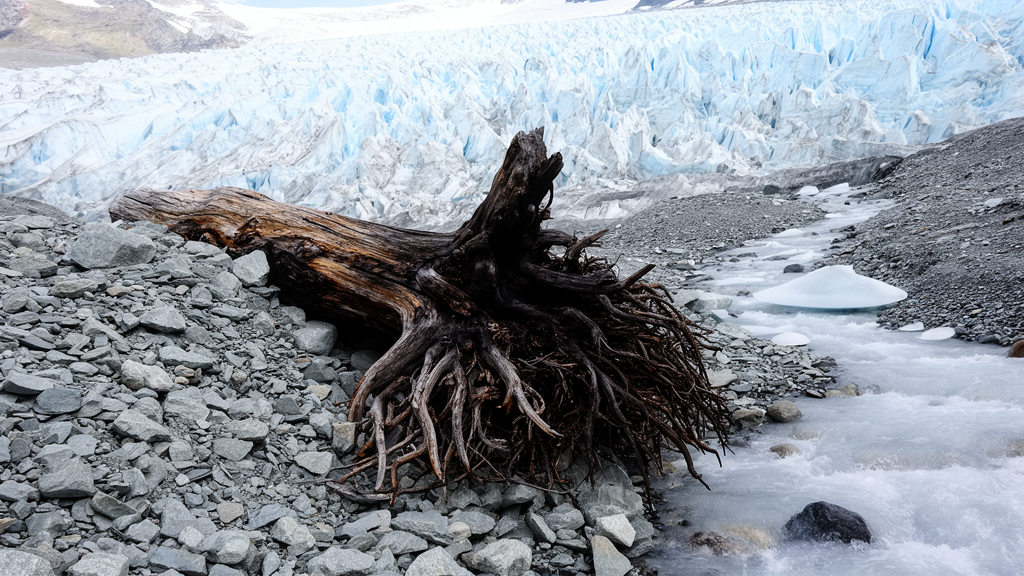
High in the Engadin Valley of southeastern Switzerland, where the Morteratschgletscher has been retreating at an accelerating pace, the ice has surrendered one of the most remarkable witnesses of the early Holocene ever recovered from an Alpine glacier forefield. A subfossil European larch, Larix decidua, was found embedded in till at an altitude of 2156 metres, less than twenty metres from the glacier terminus of summer 2025. What makes this specimen extraordinary is not merely its age, which radiocarbon dating places at roughly 10,350 years since the tree stopped growing, but its position: the trunk still carried roots attached to the sediment in which it once stood. For the first time at this glacier, researchers have recovered a tree in near-growing position, transforming a scattered collection of ice-transported wood fragments into a precise palaeoclimate and palaeoglaciological record.
The discovery is the work of Christian Schlüchter of the University of Bern and colleagues from ETH Zurich, the Swiss Federal Institute for Forest, Snow and Landscape Research, the University of Innsbruck, and the University of Copenhagen, published as an express report in the E&G Quaternary Science Journal. Their findings carry a startling implication: during the early Preboreal, the opening phase of the current interglacial, the Morteratschgletscher did not cover the sampling site at all. The glacier terminus at that time lay far back up the valley, possibly as far as the confluence of the Pers and Morteratsch glaciers, at a much higher elevation than the present-day ice front. In other words, ten millennia ago the ice retreated further up the Bernina Massif than it has in any year of the instrumental record, before later advances buried the forested ground under hundreds of metres of moving ice.
The story of how subfossil wood comes to lie in glacier forefields is itself a tale of glacial mechanics. Over the past three decades, hundreds of samples of organic detritus have been collected from the margins of Alpine glaciers, ranging from insect remains to disc-shaped clasts of compressed peat and splintered conifer logs several metres long and up to sixty centimetres in diameter. Most of these remnants were not found where they grew. They were transported subglacially and englacially, dragged along the glacier bed or frozen into its interior, and released at the terminus through the meltwater system, often during dramatic meltwater outbursts. The surge-like advance of many Alpine glaciers between 1970 and 1990, with its strong initial push, appears to have triggered subglacial erosion wherever the ice base rested on soft, deformable sediments from earlier, warmer times. Deformed wood structures and intensely compressed peat attest to this violent journey beneath the ice.
That transport history has always been the Achilles heel of glacier-forefield palaeoecology. If a log has been carried an unknown distance from its growth site, its dating tells you when and where a forest stood somewhere up-valley, but not precisely where the treeline lay or how far the ice had retreated. One adventurous researcher even travelled underneath the Glacier de Mont Miné in search of in situ wood, yet the uncertainty about true growing positions persisted. The missing link, long sought, was a subfossil tree found in growing position, ideally together with a fossil soil. Lateral moraines have yielded trees in growth position before, but a subglacial example emerging at a receding ice margin remained elusive, a matter of time as melting accelerated. The Morteratsch find now supplies exactly that link.
The specimen, catalogued as MORT-25-01, came to light during the annual autumn survey of the ice margin, a monitoring tradition that first recorded a small log at the site in 2014. Since 2015 the glacier has melted back into a basin, exposing a dominant cross-valley bedrock ridge that once acted as a mechanical obstacle to ice flow. This ridge generated a compressive flow regime in which most debris carried at the glacier base was lodged against it. The exposed bedrock landscape is a textbook of glacial morphology: roches moutonnées sculpted by ice abrasion, alignments of boulders, fluted till surfaces, glacial striae, and irregular patches of till smoothing the underlying topography. Within one of these till patches, a tree trunk of about sixty centimetres visible length lay embedded, sheared off at the top and tilted roughly forty-five degrees in the direction of ice flow.
When the team first examined and excavated the trunk on 24 June 2025, the diagnostic details were unambiguous. Roots remained attached, part of the trunk itself, while roots on the buried underside were deformed and partially sheared off by the dragging force of the glacier. The wood surface bore the compressive-pressure-induced drying cracks typical of long burial and was extremely hard, unlike the smoother surfaces of wood melted out weeks or months before discovery. The preservation of the root system indicates the tree was not dragged far, perhaps only a few metres to a few tens of metres, and it may even have been overrun and lodged at its original growth site before being sheared a short distance to its place of excavation. The chaotic sediments with weathering horizons around the roots make that latter scenario entirely plausible.
Dendrochronological analysis of the sample counted 118 tree rings, with an estimated pith offset of ten years, meaning the visible record represents only part of the tree’s life. Radiocarbon dating at the Laboratory of Ion Beam Physics at ETH Zurich returned an uncalibrated age of 9126 plus or minus 29 years before present. Calibration places the tree’s final growth rings at 8350 BCE, with an uncertainty of twenty to twenty-five years, corresponding to roughly 10,300 years before present, the youngest possible end date for its life. A second sample taken from the same trunk, MORT-25-H2, yielded a consistent radiocarbon age of 9194 plus or minus 28 years BP, and neighbouring wood fragments reinforced the picture. Samples H1, H2, and H4 from the immediate vicinity produced a combined mean of 9216 plus or minus 17 radiocarbon years BP, a statistically coherent age cluster testifying to a forest that stood at this elevation in the early Holocene.
One fragment stands out even among this ancient company. Sample MORT-25-H5, dated to 9437 plus or minus 28 radiocarbon years BP, is some two hundred radiocarbon years older than its neighbours, calibrating to between 8792 and 8627 BCE. The researchers suggest it may represent the oldest Preboreal tree yet found at Morteratsch, and possibly the oldest by radiocarbon age anywhere in the Alps. An earlier discovery in the same forefield, the trunk MORT-19-06 excavated in August 2019 about five hundred metres closer to the bedrock ridge and some fifteen metres higher, adds crucial depth to the record. That tree contained 337 counted rings, preserved bark around relict root suckers, and till-containing soil fragments, and it too had been displaced by no more than fifteen metres. Its radiocarbon age of 9198 plus or minus 29 years BP and dendrochronological end year of approximately 8350 BCE match the younger tree almost exactly.
The combined evidence permits a remarkably detailed reconstruction. The older tree, MORT-19-06, began growing around 10,800 years ago, in the early Preboreal, its seed having been blown up to the Morteratsch valley. That germination occurred only about 800 years after the end of the Younger Dryas, the last cold snap of the deglaciation, which cosmogenic nuclide dating has fixed at Julierpass roughly sixteen kilometres to the north. When that seed took root, the Morteratschgletscher front still formed end moraines near Pontresina, but the retreat from that Younger Dryas position to the ice front of 2025 and beyond was fast. Both trees stopped growing around 10,350 years ago, presumably overwhelmed by a renewed glacier advance that buried and sheared the forest floor. The timing aligns with evidence from Nicolussi and colleagues for the first Holocene glacier minimum in the Alps followed by a pronounced advance at the end of the Preboreal, and it resonates with a recent study from northwestern Greenland documenting early Holocene warming of comparable character, underscoring that the dramatic early interglacial warmth was a hemispheric phenomenon.
For a glacier that has become one of the most visited and most photographed casualties of modern climate change in the Alps, the message from its own forefield is sobering and strangely hopeful in equal measure. The ice has been here before, advancing over a forest that had flourished for centuries at 2150 metres, and it has retreated further before than any satellite has recorded. The larch trunk with its roots still clutching ancient soil is both a warning and a baseline: today’s rapid melt is exposing landscapes that the early Holocene sun last saw ten millennia ago, and every additional metre of retreat may yet yield more trees in growing position, each one a calendar page from the turbulent dawn of our current world.
Subject of Research: Early Holocene tree growth and glacier retreat history at the Morteratschgletscher forefield, Switzerland
Article Title: Tree growth at the beginning of the Holocene at an elevation of 2150 m in the Engadin Valley, Switzerland
Article References: Schlüchter, C., Hösli, L., Nicolussi, K., Korte, C., & Hajdas, I. (2026). Tree growth at the beginning of the Holocene at an elevation of 2150 m in the Engadin Valley, Switzerland. E&G Quaternary Science Journal, 75(2), 163-167. https://doi.org/10.5194/egqsj-75-163-2026
Image Credits: AI Generated
DOI: 10.5194/egqsj-75-163-2026
Keywords: Morteratschgletscher, Holocene, Larix decidua, radiocarbon dating, dendrochronology, glacier forefield, Younger Dryas, Preboreal, Engadin, palaeoclimate, subfossil wood, Swiss Alps
Cite Scienmag News
Violet Maxwell. (October 9, 2026). Melting Swiss Glacier Reveals 10,000-Year-Old Larch That Grew Where Ice Now Reigns. Scienmag. https://scienmag.com/melting-swiss-glacier-reveals-10000-year-old-larch-that-grew-where-ice-now-reigns/
Violet Maxwell. "Melting Swiss Glacier Reveals 10,000-Year-Old Larch That Grew Where Ice Now Reigns." Scienmag, 9 October 2026, https://scienmag.com/melting-swiss-glacier-reveals-10000-year-old-larch-that-grew-where-ice-now-reigns/. Accessed 9 October 2026.
Violet Maxwell. "Melting Swiss Glacier Reveals 10,000-Year-Old Larch That Grew Where Ice Now Reigns." Scienmag. October 9, 2026. https://scienmag.com/melting-swiss-glacier-reveals-10000-year-old-larch-that-grew-where-ice-now-reigns/


