


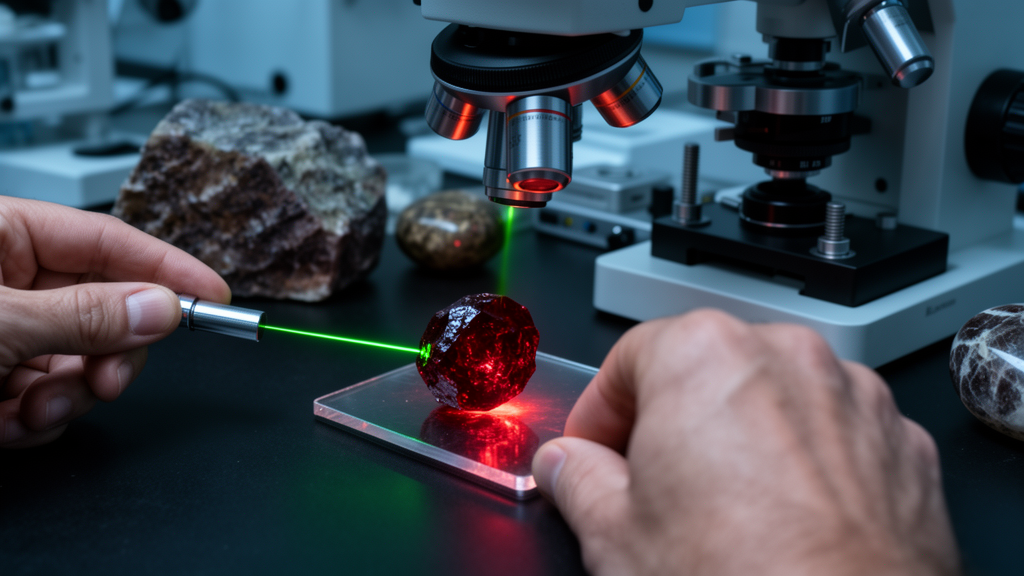
Garnet is one of the most informative minerals in metamorphic geology. It grows during mountain building, records the pressure and temperature conditions of its formation, and locks in chemical clues about the fluids and reactions that shaped the deep crust. Yet for decades, geochronologists have faced a frustrating paradox: the very garnet crystals that best record prograde metamorphism, the heating and burial phase of mountain building, usually contain so little uranium that dating them directly has been close to impossible. A new study published in the journal Geochronology by Aratz Beranoaguirre and colleagues at the Frankfurt Isotope and Element Research Center (FIERCE) at Goethe University Frankfurt now reports a way around this barrier, achieving reliable uranium-lead ages from garnet containing less than a nanogram of uranium per gram of mineral.
The technique at the heart of the study is laser ablation multi-collector inductively coupled plasma mass spectrometry, or LA-MC-ICP-MS. In essence, a laser fires at a polished garnet grain, blasting a tiny pit into the crystal and vaporising its contents into a plasma heated to thousands of degrees. The ionised atoms are then sorted and counted by a mass spectrometer. Because the method analyses material in place, it preserves the spatial context of each measurement, allowing researchers to target clean domains and avoid inclusions of other minerals. Most advances in this field have pushed toward smaller laser spots for finer spatial resolution, but the Frankfurt team deliberately went the other way, probing the lower concentration limits of the technique rather than its spatial limits.
The instrument they used, a Neptune Plus multi-collector ICP-MS, is equipped with ten Faraday cups and seven ion counters, including five compact discrete dynode electron multipliers. For garnet with moderate uranium contents, uranium and thorium can be measured on Faraday cups with high-value amplifiers while lead isotopes are counted on secondary electron multipliers. The breakthrough for ultra-low uranium garnet came from measuring uranium itself on the sensitive ion counters attached to the Faraday cups. This configuration allows the simultaneous static detection of lead-206, lead-207, lead-204 and uranium-238, with integration times short enough to track signal behaviour throughout each eighteen-second ablation.
The scale of the analytical challenge is best appreciated through raw numbers. Ablating garnet with a 193-micrometre spot for eighteen seconds removes roughly 2.3 micrograms of material. In a garnet containing about one nanogram per gram of uranium, that translates to approximately one femtogram, or a quadrillionth of a gram, of uranium per analysis. The authors calculate that this is roughly 3,500 times less uranium than is consumed in a standard spot analysis of the widely used GJ-1 zircon reference material, and up to five orders of magnitude less than in uranium-rich skarn garnet. At these levels, the signals amount to only a few hundred counts per second, placing the measurement close to the fundamental limits of counting statistics.
Background control therefore becomes decisive. Lead can creep into the system from memory effects in tubing, contamination in gas lines and cones, and, unavoidably, from the argon and helium gas supplies themselves. The team monitored the lead-207 background at their laboratory over about a year and a half and found it varied substantially from day to day. Following established detection-limit approaches, they showed that a clean session with a background near ten counts per second yields a detection limit of about six picograms per gram, whereas a poor session at 400 counts per second raises it to roughly thirty. More critically, the limit of quantification, set at ten times the background standard deviation, can degrade so severely in high-background sessions that ultra-low-uranium samples simply cannot be measured. In practice, the team only analyses such garnet when the lead-207 background stays below fifty counts per second.
To validate the method, the researchers dated garnet from a striking range of geological settings and ages. Gem-quality demantoid garnet from veins cross-cutting pyroxenites in the Cabo Ortegal Complex of northwest Spain, with uranium concentrations mostly between 0.5 and 1 nanogram per gram, yielded ages of about 255 million years in two independent sessions, reproducible within uncertainty. Garnet from a felsic granulite in the Orlica-Śnieżnik Dome of southwest Poland gave an age of 384 plus or minus 12 million years, in agreement with an independently published Lu-Hf garnet age of 387 plus or minus 5 million years for the same sample. Archean granulite xenoliths from the Kaapvaal craton in South Africa, brought up by Cretaceous kimberlite eruptions, produced ages near 3.1 billion years, with one sample reaching internal precision of about one percent. Cretaceous eclogite xenoliths from the Namaqua-Natal Belt gave ages around 103 to 105 million years.
Precision, as expected, depends on uranium and radiogenic lead contents. Garnet with less than one nanogram per gram of uranium yielded absolute age uncertainties of roughly five to six percent, while samples with two to four nanograms per gram improved to about three percent. Old samples benefit disproportionately because they have accumulated more radiogenic lead-206 and lead-207, boosting signal intensities. The authors also flag a subtle statistical issue that is usually ignored in geochronology: when only a small number of radioactive atoms are present, the random nature of radioactive decay itself introduces uncertainty. For young, uranium-poor minerals this decay variance may matter, although such samples currently remain below the detection capability of the technique.
Calibration posed its own hurdles. Standard garnet reference materials contain too much uranium and would saturate the ion counters, so the team searched for low-uranium crystals from the same localities and identified a yellow Mali garnet with only fifteen to twenty nanograms per gram of uranium to serve as the matrix-matched reference. Secondary quality-control garnets from Lake Jaco and Balochistan gave internally consistent results across sessions. The authors acknowledge that independent calibration against well-characterised low-uranium garnet reference materials will be needed once such materials become widely available, but the agreement with published Lu-Hf and other ages supports the accuracy of the new dates.
The payoff for Earth science could be substantial. Because the uranium-lead system in garnet has an exceptionally high closure temperature, potentially exceeding 1,000 degrees Celsius, garnet ages directly record crystal growth during prograde metamorphism rather than later cooling. Common alternative chronometers fall short in many settings: rutile closes at lower temperatures, apatite and monazite are vulnerable to fluid-driven alteration, and zircon often carries inherited domains that predate metamorphism. Many mafic and ultramafic rocks, including the eclogites and granulites studied here, lack these accessory minerals altogether, leaving garnet as the only viable clock. The new method even allowed dating of hydrothermal garnet veins at Cabo Ortegal that could not be dated by any other means, suggesting they formed during the same Permian extensional episode that preceded the opening of the Bay of Biscay.
Since most metamorphic garnet contains well under fifty nanograms per gram of uranium, the Frankfurt workflow brings the vast majority of such garnet within reach of in-situ dating for the first time. Combined with the speed of laser ablation, which can generate large datasets far faster than traditional mineral-separation and dissolution methods, the approach promises to transform petrochronology, letting geologists directly time garnet growth, track the burial histories of mountain belts, and read the record of deep crustal processes that older techniques could only infer indirectly.
Subject of Research: In-situ U-Pb geochronology of extremely low-uranium metamorphic garnet using laser ablation multi-collector ICP-MS
Article Title: U-Pb dating of sub-ng g−1 U garnet by LA-MC-ICP-MS
Article References: Beranoaguirre, A., Millonig, L. J., Albert, R., Marschall, H. R., & Gerdes, A. (2026). U-Pb dating of sub-ng g −1 U garnet by LA-MC-ICP-MS. Geochronology, 8(3), 495-509. https://doi.org/10.5194/gchron-8-495-2026
Image Credits: AI Generated
DOI: 10.5194/gchron-8-495-2026
Keywords: garnet, U-Pb dating, LA-MC-ICP-MS, geochronology, metamorphic rocks, petrochronology, laser ablation, mass spectrometry, uranium-lead, Kaapvaal craton, eclogite, granulite
Cite Scienmag News
Violet Maxwell. (October 9, 2026). New Laser Method Dates Garnet Crystals With Almost No Uranium, Opening Earth’s Deep Past. Scienmag. https://scienmag.com/new-laser-method-dates-garnet-crystals-with-almost-no-uranium-opening-earths-deep-past/
Violet Maxwell. "New Laser Method Dates Garnet Crystals With Almost No Uranium, Opening Earth’s Deep Past." Scienmag, 9 October 2026, https://scienmag.com/new-laser-method-dates-garnet-crystals-with-almost-no-uranium-opening-earths-deep-past/. Accessed 9 October 2026.
Violet Maxwell. "New Laser Method Dates Garnet Crystals With Almost No Uranium, Opening Earth’s Deep Past." Scienmag. October 9, 2026. https://scienmag.com/new-laser-method-dates-garnet-crystals-with-almost-no-uranium-opening-earths-deep-past/


