


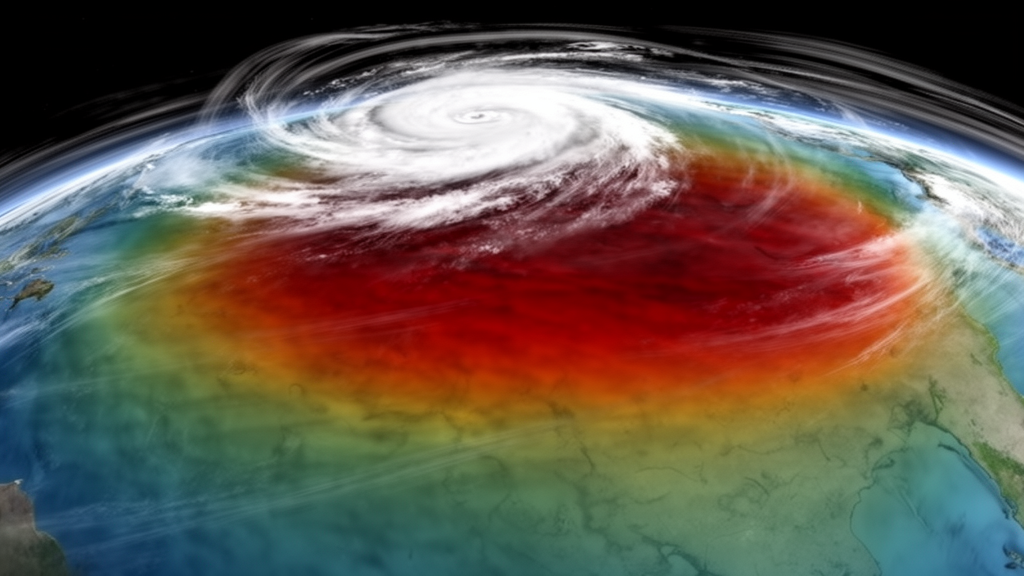
Every few years, the tropical Pacific transforms into an engine of climate chaos. Vast pools of unusually warm water slide eastward, rainfall patterns shift across continents, fisheries collapse, and global temperatures tick upward. These are the fingerprints of El Niño, the warm phase of the El Niño–Southern Oscillation, or ENSO. Yet for all the sophistication of modern climate models, one of the most dramatic ingredients behind the biggest El Niño events has long been handled with a surprisingly blunt mathematical tool: Gaussian noise. A new study published in Nonlinear Processes in Geophysics argues that this standard approach, while adequate for capturing the overall statistics of ENSO, fundamentally misrepresents the violent, sporadic wind events that help launch the most catastrophic warm episodes in the Pacific.
The events in question are westerly wind bursts, or WWBs. These are episodes lasting a week or two, spanning roughly a thousand kilometres of the equatorial Pacific, in which the normally reliable easterly trade winds reverse or weaken dramatically. They are not rare curiosities. According to the observational record, westerly wind bursts have preceded and amplified every major El Niño event ever documented. The mechanism is physically direct: a burst of westerly wind pushes warm surface water eastward and excites oceanic Kelvin waves, waves that travel along the equatorial thermocline and accelerate warming in the eastern Pacific near the coast of South America. The monster El Niños of 1997 and 2015, two of the strongest in the instrumental record, were both accompanied by multiple powerful wind bursts.
Crucially, these bursts are not purely random weather. Observational analyses have shown that westerly wind bursts tend to occur when equatorial sea surface temperatures begin to warm, and they occur more frequently during the active phase of the Madden–Julian Oscillation, a large-scale pulse of tropical atmospheric variability. This state-dependency creates a feedback loop: warming water makes bursts more likely, and the bursts amplify the warming. In simplified models of ENSO, this behaviour has traditionally been encoded as multiplicative Gaussian noise, a stochastic forcing whose amplitude grows with the sea surface temperature anomaly itself. This formulation fits the observed spectrum and probability distribution of ENSO remarkably well, which is precisely why it became the consensus choice.
But fitting the bulk statistics is not the same as capturing the dynamics. In the new work, Georg Gottwald of the University of Sydney, Eli Tziperman of Harvard University, and Alexey Fedorov of Yale University examined what the wind-burst forcing actually looks like when measured in a global climate model. They computed a time-integrated measure of wind stress from bursts in the Community Earth System Model, combining burst duration and wind speed into a single quantity that reflects the ocean’s exposure to each event. The resulting time series is striking: a quiet background punctuated by sporadic, high-amplitude peaks. That shape, the authors realised, looks nothing like smoothed Gaussian noise. It looks instead like a class of stochastic processes known as correlated additive and multiplicative noise, or CAM noise, which has previously been used to describe non-Gaussian sea surface temperature anomalies and atmospheric variability.
The mathematical distinction matters. When a Gaussian process such as the Ornstein–Uhlenbeck process, the workhorse of stochastic climate modelling, is integrated over time, the central limit theorem guarantees that the result is Brownian motion: continuous, well-behaved, and Gaussian. CAM noise behaves differently. Under certain parameter regimes, its time integral converges to an alpha-stable Lévy process, a random walk punctuated by abrupt jumps of potentially enormous size. The stability parameter alpha controls how large these jumps can be, while a skewness parameter beta controls whether they favour one direction. With parameters chosen so that only positive jumps occur, the integrated CAM noise produces exactly the kind of sporadic, one-sided jolts that a westerly wind burst delivers to the ocean. In the recharge oscillator framework, a positive wind stress anomaly shoals the western Pacific thermocline and amplifies eastern Pacific sea surface temperatures, so one-sided positive jumps translate directly into sudden warming kicks.
The recharge oscillator model itself, introduced by Fei-Fei Jin in 1997, reduces ENSO to two coupled variables: the eastern Pacific sea surface temperature anomaly and the western Pacific thermocline depth. Warm water in the east drives the winds, the winds adjust the thermocline, and the thermocline feeds back on the temperature through the Bjerknes feedback, producing a self-sustained or damped oscillation depending on the parameters. The model is crude, but it has proved remarkably durable as a conceptual laboratory for ENSO theory, and recent reviews have reaffirmed its central role. The question the new study poses is deceptively simple: what kind of random forcing should be injected into this oscillator to represent the winds realistically?
The authors compared three answers. The first was the conventional choice, multiplicative Gaussian Ornstein–Uhlenbeck noise whose amplitude scales with the temperature anomaly. The second was pure additive CAM noise, with its intermittent unbounded peaks. The third, and the study’s central contribution, was a conditional model the authors call CON: when the sea surface temperature anomaly is negative, the forcing is ordinary Gaussian noise, but once the anomaly turns positive and persists over a three-month average, the forcing switches to CAM noise. The rationale is physical. Over a cool equatorial ocean, wind variability may indeed be well described by Gaussian statistics, but as the water warms and El Niño begins to develop, the wind field reorganises, and the burst-like, non-Gaussian character of the forcing takes over.
Each model was calibrated against 153 years of observed NiNO3 index data, from 1870 to 2026, matching the empirical histogram, the power spectrum, and the variance and skewness of the temperature record. On these bulk statistics, all three models performed comparably well. Kolmogorov–Smirnov tests and Wasserstein distances between modelled and observed distributions showed the conventional Gaussian model and the conditional model in a statistical dead heat, with pure CAM noise, as expected, producing too many extreme events and a heavier tail. But the decisive test came from a finer-grained dynamical signature: the number of strong wind bursts occurring in the twelve months before an El Niño peak. In the real climate system, the largest El Niño events are preceded by a cluster of bursts, a signature of the feedback between warming water and burst occurrence. When the researchers counted large noise events preceding the strongest fifth of El Niño events in million-month-long simulations, the CAM and conditional models reproduced this clustering dramatically, while the multiplicative Gaussian model captured it only weakly.
The conditional model also achieved something that normally requires deliberate engineering: it generated the well-known asymmetry between El Niño and La Niña, in which warm events tend to be stronger than cold events, without any deterministic nonlinear terms in the temperature equation. The skewness of the simulated temperature distribution emerged entirely from the skewed, jump-rich structure of the noise itself, echoing earlier work by Martinez-Villalobos and colleagues who showed that a linear model driven by CAM noise can capture the observed asymmetry. The authors did find that including an asymmetric response of sea surface temperature to thermocline depth, with a stronger effect for positive than negative thermocline anomalies, was still needed to match the full observed histogram, but the burst clustering survived even with a symmetric response, confirming that it is the conditional noise, not the nonlinearity, doing the dynamical work.
The implications extend beyond a toy model. If extreme El Niño events are genuinely the product of a sustained sequence of wind bursts rather than a smooth random walk of forcing, then forecasts and projections that rely on Gaussian stochastic parameterisations may systematically underestimate the likelihood and potential intensity of the largest events. The authors suggest that their conditional scheme, which reproduces both the quiet background statistics of ENSO and the burst-driven dynamics of its extremes, offers a better template, and they point toward testing it in more realistic coupled climate models as the natural next step. In a warming world, where the stakes of predicting the next 1997-style event keep rising, the difference between smooth Gaussian noise and a process built from sudden jumps may turn out to be one of the most consequential details in climate mathematics.
Subject of Research: Stochastic modelling of westerly wind bursts in the recharge oscillator model of the El Niño–Southern Oscillation
Article Title: An improved noise model for representing westerly wind bursts in the recharge oscillator model of ENSO
Article References: Gottwald, G. A., Tziperman, E., & Fedorov, A. (2026). An improved noise model for representing westerly wind bursts in the recharge oscillator model of ENSO. Nonlinear Processes in Geophysics, 33(3), 373-383. https://doi.org/10.5194/npg-33-373-2026
Image Credits: AI Generated
Keywords: El Niño, ENSO, westerly wind bursts, recharge oscillator, CAM noise, Lévy processes, stochastic forcing, non-Gaussian noise, tropical Pacific, climate modelling, sea surface temperature, Madden–Julian Oscillation
Cite Scienmag News
Violet Maxwell. (October 9, 2026). Jumpy Winds, Giant El Niños: New Noise Model Captures the Storms That Supercharge the Pacific. Scienmag. https://scienmag.com/jumpy-winds-giant-el-ninos-new-noise-model-captures-the-storms-that-supercharge-the-pacific/
Violet Maxwell. "Jumpy Winds, Giant El Niños: New Noise Model Captures the Storms That Supercharge the Pacific." Scienmag, 9 October 2026, https://scienmag.com/jumpy-winds-giant-el-ninos-new-noise-model-captures-the-storms-that-supercharge-the-pacific/. Accessed 9 October 2026.
Violet Maxwell. "Jumpy Winds, Giant El Niños: New Noise Model Captures the Storms That Supercharge the Pacific." Scienmag. October 9, 2026. https://scienmag.com/jumpy-winds-giant-el-ninos-new-noise-model-captures-the-storms-that-supercharge-the-pacific/


