


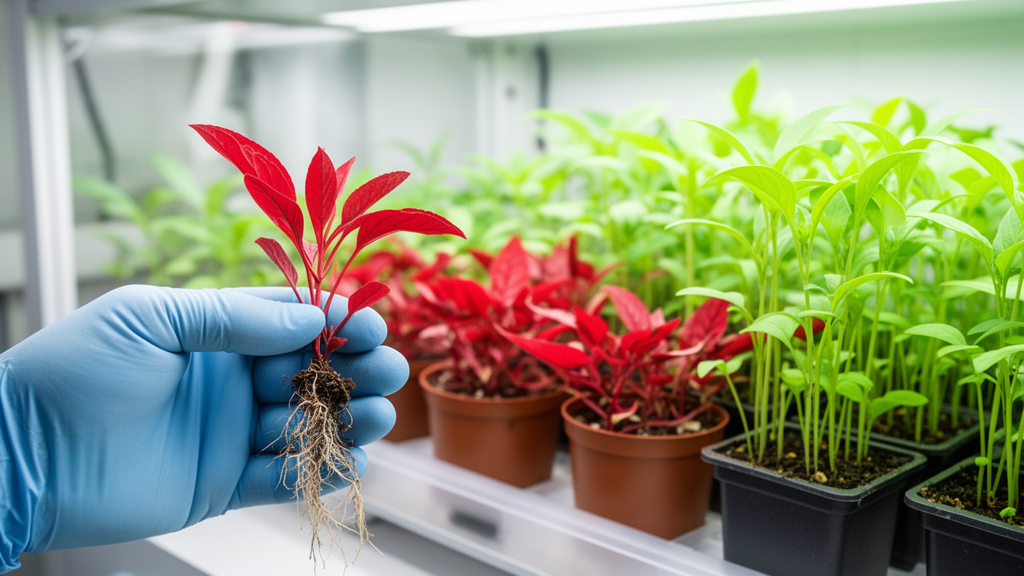
A visual reporter system that has swept through plant biology laboratories around the world in just a few years may not be as benign as researchers assumed. A new study of the betalain-based RUBY reporter in the model plant Arabidopsis thaliana shows that simply switching the reporter on can leave plants smaller, later-flowering, and far less fertile than their wild-type counterparts, while quietly rewiring their internal chemistry. The findings, published in Plant Molecular Biology, are a cautionary tale for a field that has embraced RUBY as a convenient, substrate-free alternative to fluorescent and luminescent markers.
RUBY was developed as a genetically encoded visual reporter that produces a vivid red betalain pigment, the same class of compounds that gives beets their characteristic color. Unlike green fluorescent protein or luciferase-based systems, RUBY requires no exogenous substrate, no specialized microscopy equipment, and no expensive imaging workflows. A researcher can simply look at a seedling, a leaf, or a callus and see whether a transgene is being expressed. That simplicity has made it attractive for tasks ranging from confirming transformation efficiency to screening genome-editing events, identifying haploid plants in maize and tomato breeding programs, monitoring transgene stability in lettuce, and even teaching genome editing in undergraduate classrooms.
The reporter works by reconstituting a three-enzyme betalain biosynthetic pathway borrowed from beet. The enzymes act sequentially on substrates drawn from the plant’s own tyrosine metabolism, ultimately producing the red pigment betanin. Because the pathway taps into central aromatic amino acid metabolism, the authors of the new study, led by Amandeep Cheema, Kasavajhala V. S. K. Prasad, Enamul Huq, and Anireddy S. N. Reddy at Colorado State University and the University of Texas at Austin, suspected that constitutive RUBY expression might not be metabolically neutral. Tyrosine sits at the head of the shikimate pathway, a hub that feeds the synthesis of a wide range of compounds, including the auxin precursor pool and other aromatic metabolites that influence growth.
To test that suspicion, the team generated independent transgenic Arabidopsis lines expressing RUBY and compared them with wild-type plants across the full life cycle. The differences were striking. RUBY-expressing plants were significantly smaller than controls and produced fewer leaves. They flowered later, a phenotype that in Arabidopsis often signals disruption of the hormonal and transcriptional networks that govern the transition from vegetative growth to reproduction. Perhaps most consequential for any breeding or seed-production application, the plants frequently developed malformed siliques, the seed-bearing pods of the flower, and produced a markedly reduced yield of seeds.
Below ground, the story was just as dramatic. Root architecture in the RUBY lines was severely impaired, with a pronounced reduction in the number of lateral roots. Lateral root formation is one of the most hormone-sensitive processes in plant development: auxin, the archetypal plant hormone, acts as a local morphogenetic trigger that specifies lateral root founder cells, and both auxin transport and gibberellin signaling feed into the regulatory network controlling lateral root organogenesis. A root system stripped of lateral roots is compromised in its ability to forage for water and nutrients, which likely compounds the above-ground growth defects.
One obvious hypothesis was that the plants were simply starved for auxin, and that supplementing the hormone would rescue the phenotype. The researchers tested this by applying indole-3-acetic acid, the principal natural auxin, to the RUBY-expressing plants. It did not help. The failure of IAA to restore normal development suggested that the disruption ran deeper than a straightforward hormone deficit, pointing instead to a broader perturbation of metabolic homeostasis that could not be corrected by adding back a single hormone.
Targeted metabolomic profiling of the RUBY lines confirmed that suspicion. The analysis revealed widespread alterations in amino acid and hormone pools. Levels of active indole-3-acetic acid were reduced, as were levels of gibberellins, the hormone family that promotes stem elongation, germination, and floral initiation. At the same time, the plants accumulated auxin precursors, indicating a bottleneck or diversion in the auxin biosynthetic pathway. Accumulation of indole-3-acetamide, an auxin precursor, has previously been shown to curtail growth in Arabidopsis by repressing ribosome-biogenesis and development-related transcriptional networks, and tryptophan deficiency is known to retard organ growth by slowing cell expansion. The metabolic signature of the RUBY lines is consistent with this kind of precursor-driven growth inhibition, layered on top of a gibberellin shortfall that would plausibly explain the delayed flowering and reduced stature.
The most convincing piece of evidence came from a genetic dissection of the reporter itself. The team disrupted RUBY expression by suppressing the third enzyme in the pathway, a glucosyltransferase that catalyzes the final step in betanin production. When that step was blocked, the RUBY-associated developmental phenotypes were restored to wild type. In other words, it is not the presence of the transgene or the act of transformation that damages the plants, but the flux of metabolites through the complete betalain pathway. Interrupting the pathway at its final step abolishes both the visible pigment and the collateral metabolic damage, cleanly linking the reporter’s biochemistry to its developmental side effects.
The study is not the first hint that heterologous betalain production can shake up plant metabolism. Recent work in tobacco showed that heterologous biosynthesis of betanin triggers broad metabolic reprogramming, and the relaxation of tyrosine pathway regulation is known to underlie the evolution of betalain pigmentation in the Caryophyllales, the plant order to which beets belong. What makes the new results consequential is the sheer breadth of RUBY’s adoption. The reporter has been built into T-DNA vectors for maize transformation, adapted into split-assay formats for detecting protein-protein interactions and DNA-protein interactions in planta, and used as a visual splicing reporter. If constitutive RUBY expression perturbs hormone and amino acid homeostasis in Arabidopsis, researchers using the system for developmental studies, particularly studies of growth, flowering time, or root architecture, may be measuring the reporter’s side effects alongside the biology they intended to study.
The authors argue that the way forward is not to abandon RUBY but to tame it. Because the damage is caused by pathway flux rather than by the reporter construct itself, regulated expression systems, such as inducible promoters or tissue-specific promoters that confine betalain production to a small subset of cells or a defined time window, should dramatically reduce the metabolic burden while preserving the reporter’s visual punch. Such strategies would let researchers keep the convenience that made RUBY famous, the naked-eye readout with no substrates and no instruments, while avoiding the hidden trade-offs now documented in Arabidopsis. For a tool that has been celebrated for making plant biology visible to the naked eye, the lesson of the new study is that some of what it reveals may be an artifact of its own chemistry, and that the next generation of RUBY experiments will need to be designed with that in mind.
Subject of Research: Metabolic and developmental side effects of the betalain-based RUBY visual reporter in Arabidopsis thaliana
Article Title: RUBY expression alters development and metabolism in Arabidopsis
Article References: Cheema, A., Prasad, K. V. S. K., Huq, E., & Reddy, A. S. N. (2026). RUBY expression alters development and metabolism in Arabidopsis. Plant Molecular Biology, 116(5), Article 102. https://doi.org/10.1007/s11103-026-01764-0
Image Credits: AI Generated
DOI: 10.1007/s11103-026-01764-0
Keywords: RUBY reporter, betalain, Arabidopsis thaliana, auxin, gibberellin, plant hormones, lateral roots, metabolomics, plant biotechnology, genetically encoded reporters, tyrosine metabolism, plant development
Cite Scienmag News
Drew Townsend. (October 9, 2026). Popular RUBY plant reporter shown to disrupt growth and hormone balance. Scienmag. https://scienmag.com/popular-ruby-plant-reporter-shown-to-disrupt-growth-and-hormone-balance/
Drew Townsend. "Popular RUBY plant reporter shown to disrupt growth and hormone balance." Scienmag, 9 October 2026, https://scienmag.com/popular-ruby-plant-reporter-shown-to-disrupt-growth-and-hormone-balance/. Accessed 9 October 2026.
Drew Townsend. "Popular RUBY plant reporter shown to disrupt growth and hormone balance." Scienmag. October 9, 2026. https://scienmag.com/popular-ruby-plant-reporter-shown-to-disrupt-growth-and-hormone-balance/


