


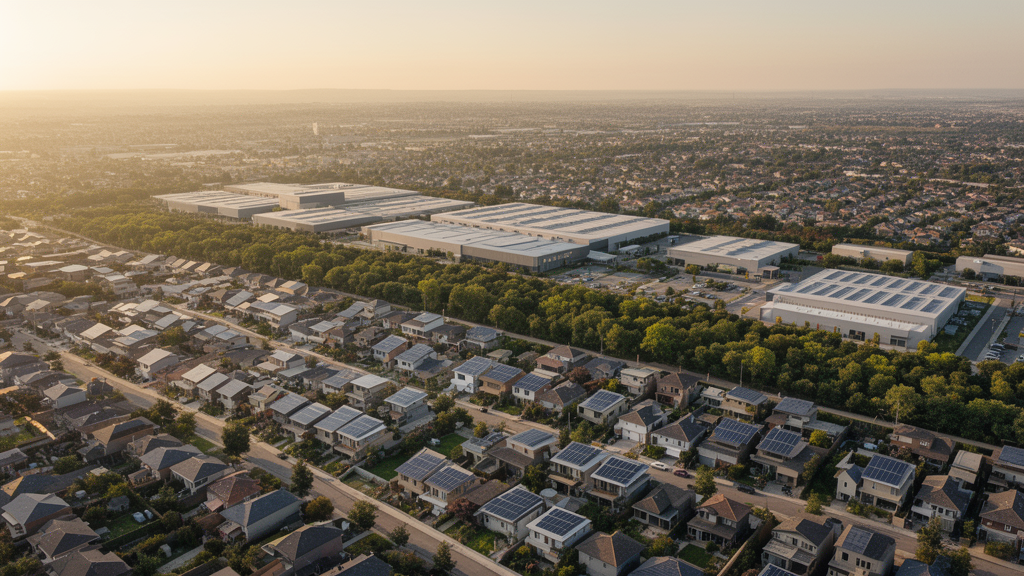
For more than a decade, urban planners and climate scientists have argued about one of the most consequential questions in city design: does building denser cities actually reduce carbon emissions? The intuitive case seems straightforward. When people live closer together, they drive shorter distances, public transit becomes viable, and shared walls and heating systems waste less energy. Yet the empirical evidence has stubbornly refused to cooperate, with studies reporting everything from strong emission savings to no effect at all, and occasionally even increases in carbon output associated with denser urban form. A new study published in npj Urban Sustainability offers a compelling explanation for this confusion, and in doing so delivers a finding that could reshape how cities in China and beyond plan their growth.
The research, conducted by Chenyu Song and Ran Tao of the Chinese University of Hong Kong, Shenzhen, together with Cong Zhang of the Harbin Institute of Technology, argues that the problem lies not in the theory of compact cities but in how researchers have been measuring density itself. In rapidly urbanizing China, the boundaries between residential neighborhoods, industrial parks, and the transitional zones at the urban fringe have become increasingly blurred. When scientists calculate population density by dividing the number of residents by the total built-up area of a city, that denominator silently mixes together two fundamentally different kinds of space: the commercial and residential districts where people actually live, work, and shop, and the industrial land where factories, warehouses, and power facilities operate. The result is a statistical blur that can wash out or even reverse the true relationship between compact living and emissions.
To cut through this ambiguity, the team developed an approach they describe as functional land-use separation. Rather than treating all urbanized land as equivalent, they used points-of-interest data, a rich geographic record of businesses, services, and facilities, to classify urban land into functionally distinct zones, isolating the commercial-residential areas from industrial and peri-urban transition land. They then measured population density only within those functionally relevant living spaces. This is a deceptively simple adjustment with profound implications: it asks whether crowding people into the places where people actually live, rather than into a statistical mixture of apartments and smokestacks, is associated with lower emissions per person.
The empirical foundation of the study is a gridded panel dataset covering 278 Chinese cities over the period from 2013 to 2019, a window that captures some of the most intense urban expansion in human history. The researchers combined fossil-fuel carbon dioxide emissions from the Multi-resolution Emission Inventory for China, a widely used bottom-up inventory that allocates emissions by sector and location, with high-resolution population counts from the WorldPop project at the University of Southampton. By aggregating these data onto a grid of roughly 0.1-degree cells, they could link emissions and population at a spatial resolution fine enough to distinguish the carbon profile of a dense residential district from that of an adjacent industrial zone.
The headline result is striking in its clarity. A 1 percent increase in population density within commercial-residential areas is associated with a 0.09 percent reduction in per capita carbon dioxide emissions. While the elasticity may sound modest, its implications compound dramatically at the scale of a nation. China’s urban population exceeds 900 million people, and its cities collectively account for the majority of national energy consumption. If compact commercial-residential development systematically reduces per capita emissions even fractionally, the aggregate effect across hundreds of expanding cities represents a meaningful contribution to national mitigation goals, achieved not through costly new technology but through the geometry of urban form itself.
Crucially, the finding survives a battery of robustness checks designed to rule out statistical artifacts. The researchers tested alternative thresholds for defining what counts as commercial-residential land, imposed spatial restrictions on the analysis to guard against spillover effects between neighboring grid cells, and employed city-by-year fixed effects, a demanding econometric specification that absorbs any time-varying shocks specific to each city, such as local economic booms, policy interventions, or weather anomalies. The negative relationship between functional density and per capita emissions remained stable across all of these variations. This consistency matters because the density-emission literature has been plagued by fragility, with conclusions often flipping when methodological details change. Here, the effect persists precisely because the measurement has been sharpened to target the mechanism at work.
That mechanism deserves close attention, because it explains why the functional separation approach reveals a signal that earlier studies missed. Industrial land is a major emissions hotspot in China, hosting coal-fired power plants, steel mills, cement kilns, and chemical facilities whose carbon output is driven by production technology and industrial policy, not by the number of nearby residents. When such land is folded into the denominator of a density calculation, cities with large industrial footprints appear less dense, and their high emissions get statistically attributed to low density, contaminating the relationship. By excluding industrial zones from the density measure, the researchers effectively removed this confounding influence, allowing the genuine emission-saving effects of compact living, shorter commutes, viable transit, efficient building energy use, to emerge from the data.
The policy implications extend well beyond academic methodology. China’s national strategy for carbon peaking and neutrality depends heavily on decarbonizing energy supply and industry, but the demand side of the equation, how cities are physically organized, has remained an open question. The study suggests that compact commercial-residential development can serve as a complement to technological mitigation strategies, offering planners a low-cost lever that operates through everyday behavior rather than capital-intensive infrastructure. For city governments weighing whether to encourage sprawling suburban expansion or denser mixed-use districts, the evidence points toward the latter, particularly in the fast-urbanizing regions of central and western China where the bulk of future growth is expected to occur.
The findings also carry a cautionary message about how urban carbon research is conducted in other rapidly developing regions. Much of the existing evidence on density and emissions comes from wealthy, functionally mature cities in Europe and North America, where land-use boundaries are relatively stable and industrial activity has largely migrated out of urban cores. Applying those findings, or the measurement conventions behind them, to cities in the Global South, where industrial zones interleave with residential districts and urban boundaries shift annually, can produce misleading conclusions. The functional land-use separation framework offers a transferable template: before measuring density, ask what function the land serves, and measure within the zones where that function actually operates.
There remain open questions that future research will need to address. The study covers fossil-fuel carbon dioxide emissions through 2019, and the subsequent acceleration of electric vehicles, renewable energy deployment, and remote work in China may alter the density-emission relationship in the years ahead. The 0.09 percent elasticity is an average across 278 cities, and the benefits of compaction likely vary with city size, industrial structure, and transit provision. Yet the core insight stands as one of the more actionable findings in urban sustainability science to emerge in recent years: the carbon benefits of compact cities are real, but they only become visible when we stop measuring density in places where people do not live. In the race to bend the global emissions curve, the humble decision of where to draw the line between a neighborhood and a factory may matter far more than anyone realized.
Subject of Research: The relationship between functional urban density and per capita CO2 emissions in Chinese cities
Article Title: Functional land-use separation reveals the CO₂-emission benefits of compact living spaces in urbanizing China
Article References: Song, C., Tao, R., & Zhang, C. (2026). Functional land-use separation reveals the CO₂-emission benefits of compact living spaces in urbanizing China. npj Urban Sustainability. https://doi.org/10.1038/s42949-026-00479-x
Image Credits: AI Generated
DOI: 10.1038/s42949-026-00479-x
Keywords: urban density, carbon emissions, China, land use, compact cities, urbanization, CO2 mitigation, commercial-residential areas, urban planning, sustainability, gridded data, emissions inventory
Cite Scienmag News
Sloane Callahan. (October 9, 2026). Compact Living Cuts Carbon: Why Separating Homes from Factories Changes the Math. Scienmag. https://scienmag.com/compact-living-cuts-carbon-why-separating-homes-from-factories-changes-the-math/
Sloane Callahan. "Compact Living Cuts Carbon: Why Separating Homes from Factories Changes the Math." Scienmag, 9 October 2026, https://scienmag.com/compact-living-cuts-carbon-why-separating-homes-from-factories-changes-the-math/. Accessed 9 October 2026.
Sloane Callahan. "Compact Living Cuts Carbon: Why Separating Homes from Factories Changes the Math." Scienmag. October 9, 2026. https://scienmag.com/compact-living-cuts-carbon-why-separating-homes-from-factories-changes-the-math/


