


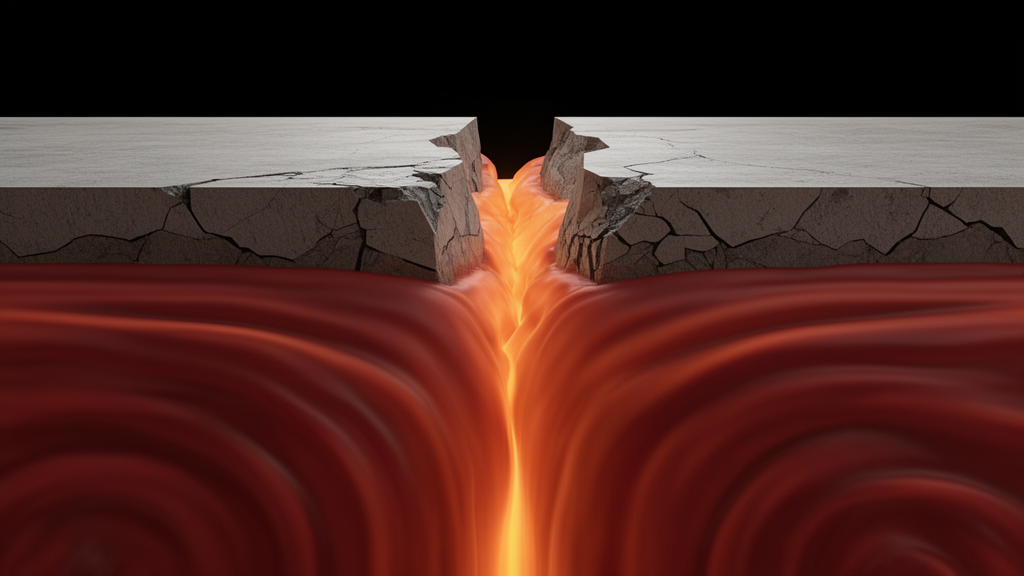
Earth’s tectonic plates look deceptively simple from the surface: rigid slabs of rock gliding over the planet’s interior, separated by narrow seams where earthquakes and volcanoes concentrate. But one of the deepest puzzles in geodynamics is how those seams form in the first place. A plate must somehow transform from an enormously strong, coherent shell into a localized zone of failure, and it must do so using only the physics of hot, slowly flowing rock. A new study published in Solid Earth by Etienne Van Broeck of the University of Montpellier and colleagues tackles this problem head-on with high-resolution numerical simulations, and its central finding is striking: the secret ingredient is a form of creep in mantle minerals that most large-scale models have long ignored.
The team built two-dimensional thermo-mechanical simulations of upper-mantle extension, essentially digital experiments in which a stretch of oceanic or continental plate is pulled apart at a controlled rate. Their model domain spans 1200 kilometers wide and 400 kilometers deep, filled entirely with mantle material. By deliberately excluding the crust, the researchers isolated the behavior of the lithospheric mantle itself, the strong, cold outer layer where the decisive battle between strength and weakness plays out. The simulations solve the equations of mass, momentum, and energy for a creeping fluid whose viscosity depends dramatically on both temperature and strain rate, using an adaptive mesh that resolves features as fine as a few hundred meters where deformation concentrates.
The crux of the problem lies in olivine, the dominant mineral of the upper mantle. Under the cold conditions of the lithosphere, conventional high-temperature creep laws predict flow stresses of hundreds of megapascals, far beyond the roughly 2 to 50 teranewtons per meter of force that plate tectonics can actually deliver. In other words, a purely viscous plate should be unbreakable, which is why many mantle convection models cheat slightly: they impose an artificial yield stress, a cap on how strong the plate can get, typically below 200 to 300 megapascals. That cap works, but it corresponds to friction coefficients far below what laboratory experiments on rock friction actually measure, leaving an uncomfortable gap between model convenience and physical reality.
Van Broeck and colleagues tested an alternative rooted in real mineral physics. Recent dislocation-dynamics modeling has produced a unified flow law for olivine that bridges classical high-temperature power-law creep and the low-temperature, high-stress regime known as Peierls creep. This low- to high-temperature dislocation creep formulation allows olivine to keep deforming, and to keep weakening, at temperatures as low as about 800 kelvin, where older flow laws would predict near-rigid behavior. The researchers ran a suite of simulations comparing diffusion creep alone, diffusion creep plus dislocation creep, and combinations with and without a yield-stress cap, across plate ages from 10 to 100 million years and extension rates from 0.2 to 5 centimeters per year.
The results reveal a remarkably consistent two-stage pathway to plate-boundary formation. In every simulation that successfully localized deformation, the first stage was dominated by lateral focusing: the width of the deforming zone shrank rapidly, at average rates of up to 14 centimeters per year in the reference case, while the plate thinned only modestly, from about 100 to 82 kilometers over 6.5 million years. Then came a dramatic switch. In the second stage, hot asthenospheric mantle welled up beneath the focused zone, driving rapid thinning from 82 down to roughly 10 kilometers in just 5.5 million years, while the tectonic force required to keep the plates separating collapsed. The boundary between the two diverging plates had effectively been born.
Crucially, the team developed new diagnostics that partition viscosity reduction into two contributions: mechanical weakening driven by increasing strain rate, and thermal weakening driven by rising temperature. This accounting exposed exactly why different rheologies behave so differently. In simulations without dislocation creep, weakening below the shallow yielding layer was almost entirely thermal, which limited the feedbacks and slowed everything down. When dislocation creep was included, the transition from brittle-like yielding to ductile creep shifted to lower temperatures, around 800 kelvin instead of 1300 kelvin, allowing both mechanical and thermal weakening to operate through a much thicker portion of the lithosphere and accelerating localization roughly twofold.
Perhaps the most provocative result concerns what happens when the yield stress is restricted to realistic brittle temperatures. Oceanic seismicity suggests brittle failure extends only to about 600 degrees Celsius, or 900 to 1000 kelvin. When the researchers capped yielding at 950 kelvin while using only high-temperature dislocation creep, a thin stiff layer less than 4 kilometers thick formed in the mid-lithosphere, a bottleneck between the cold brittle plate above and the warm creeping mantle below. Even this sliver of strength dramatically delayed plate-boundary formation, and lowering the cutoff to 900 kelvin prevented localization altogether within the simulated window. The lesson is that localization depends not on the average weakness of the plate but on the strength of its stiffest region, and on whether that region can itself weaken.
The comparison with natural rift systems is where the study becomes genuinely exciting. Reconstructions of the Atlantic and Australia-Antarctica rifts show a familiar pattern: tens of millions of years of slow extension followed by an abrupt acceleration of break-up over just 2 to 10 million years. The model’s two-stage trajectory mirrors this record, with the transition between stages marking a geodynamic tipping point at which thermal weakening takes over and the plate boundary develops rapidly. The authors propose that rifting acceleration in nature may correspond to exactly this kind of tipping point, where warming of the lithospheric mantle beneath the focused deformation zone triggers a runaway loss of plate strength.
The implications ripple outward to how scientists model the entire planet. Whole-mantle convection simulations routinely rely on yield-stress caps combined with diffusion creep to produce plate-like behavior. If dislocation creep genuinely accelerates localization by extending weakening into colder, shallower levels, then those simplified rheologies may systematically overestimate how long it takes for plates to break apart and new boundaries to form. Including the unified creep law would also allow modelers to use higher, more laboratory-consistent yield stresses while still generating realistic plate tectonics, narrowing the long-standing gap between numerical convenience and experimental rock mechanics.
The study is not without caveats, which the authors are careful to enumerate. Their mantle-only configuration ignores crustal layering, which in real rifts promotes faster, narrower localization through crust-mantle coupling, so the absolute timescales reported here, such as 14 and 26 million years to transition and break-up in the fastest model, should be read as end-member values for a simplified system. Elasticity is neglected, which affects shallow stress magnitudes and fault geometry, though supplementary tests suggest the two-stage weakening scenario is robust. Shear heating, excluded from the main runs, could add a further moderate boost to thermal weakening. Even so, the core message stands: what matters most for forging a new plate boundary is not simply how weak the plate is on average, but how deeply and how broadly thermo-mechanical weakening can penetrate the lithospheric mantle, and dislocation creep turns out to be the mechanism that makes that penetration possible.
Subject of Research: Strain localization and plate-boundary formation in the lithospheric mantle controlled by olivine dislocation creep
Article Title: From strong plates to weak boundaries: strain localization in the lithospheric mantle with low- to high-temperature dislocation creep
Article References: Van Broeck, E., Garel, F., Thoraval, C., Arcay, D., & Davies, D. R. (2026). From strong plates to weak boundaries: strain localization in the lithospheric mantle with low- to high-temperature dislocation creep. Solid Earth, 17(8), 947-977. https://doi.org/10.5194/se-17-947-2026
Image Credits: AI Generated
Keywords: plate tectonics, lithospheric mantle, olivine rheology, dislocation creep, strain localization, continental rifting, yield stress, mantle convection, thermo-mechanical modeling, asthenospheric upwelling, plate break-up, geodynamics
Cite Scienmag News
Violet Maxwell. (October 9, 2026). How the Mantle’s Hidden Creep Turns Strong Plates into Weak Boundaries. Scienmag. https://scienmag.com/how-the-mantles-hidden-creep-turns-strong-plates-into-weak-boundaries/
Violet Maxwell. "How the Mantle’s Hidden Creep Turns Strong Plates into Weak Boundaries." Scienmag, 9 October 2026, https://scienmag.com/how-the-mantles-hidden-creep-turns-strong-plates-into-weak-boundaries/. Accessed 9 October 2026.
Violet Maxwell. "How the Mantle’s Hidden Creep Turns Strong Plates into Weak Boundaries." Scienmag. October 9, 2026. https://scienmag.com/how-the-mantles-hidden-creep-turns-strong-plates-into-weak-boundaries/


