


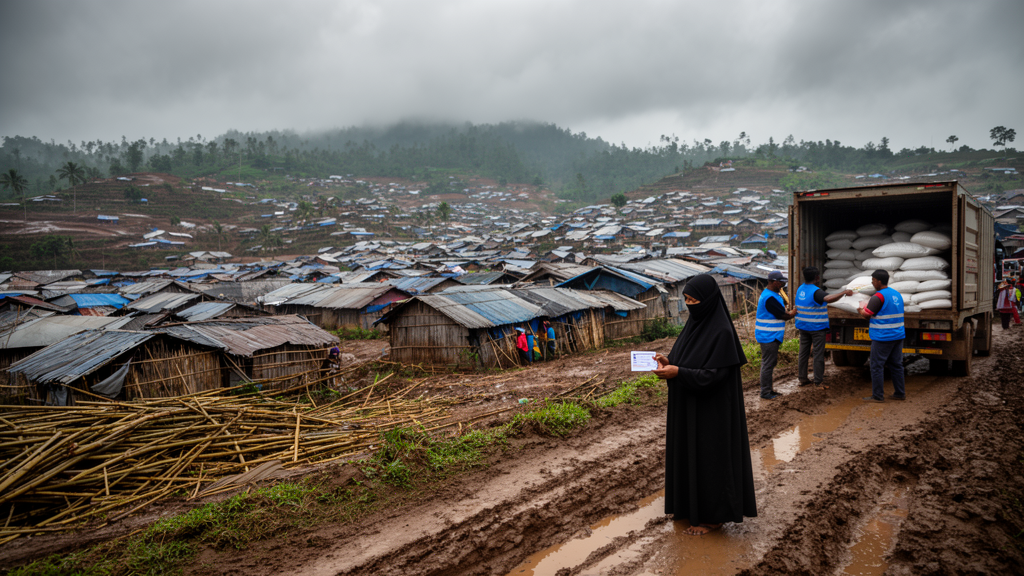
When nearly three-quarters of a million Rohingya refugees crossed from Myanmar into Bangladesh between August 2017 and December 2018, fleeing a brutal military crackdown in Rakhine State, the world responded with an unprecedented humanitarian mobilization. Cox’s Bazar became the largest refugee settlement on Earth, and by January 2024 an estimated 975,650 Rohingya were living in camps across the district. Yet a new study argues that the very system designed to help them has instead entrenched their suffering. Published in Discover Global Society, the research by Mohammad Wasim Newaz of the University of Cincinnati applies postcolonial and dependency theories to dissect what is known as the humanitarian-development nexus, or HDN, and finds that its neoliberal underpinnings have actively prolonged the displacement of one of the world’s most persecuted peoples.
The humanitarian-development nexus is the framework through which emergency aid and long-term development assistance are meant to be bridged, providing complementary support for people affected by crises. On paper, it sounds like common sense: immediate relief saves lives, while development programs build futures. But the study points out that humanitarian action and development work rest on fundamentally different logics. Humanitarian intervention traditionally follows apolitical, needs-based approaches that are not centered on the state, whereas development follows longer-term, political, rights-based approaches that are. Forcing these two paradigms together, the research argues, has created a space in which neoliberal interests, privatization, and the political and economic ambitions of transnational elites can flourish under the banner of compassion.
Newaz’s central question is deceptively simple: why and how has a neoliberal version of the humanitarian-development nexus been implemented in refugee crises? To answer it, the study employs a qualitative, desk-based methodology combined with a systematic literature review. Using the PICO technique, which structures inquiry around population, intervention, comparison, and outcome, the researcher searched databases including Google Scholar and Web of Science with terms spanning humanitarian response, Rohingya relocation, and refugee resistance. The analysis drew on the Rohingya Joint Response Plans, government and nongovernmental reports, documentaries, and news coverage, triangulated with existing interview data. The desk-based approach was chosen partly for ethical reasons: vulnerable refugees are difficult to access directly, and secondary analysis reduces the risk of harm to research participants.
The theoretical backbone of the study is explicitly postcolonial. Postcolonial scholarship links contemporary migration to colonialism and imperialism, deconstructing hegemonic Western knowledge and warning against treating migrants as a homogenous group of voiceless victims. The study draws on scholars such as Lemberg-Pedersen, who has shown how displaced populations in the Global South are monetized through technological financialization, including biometric surveillance and remote sensing, to benefit corporate and donor actors. Arat-Koc’s work on decolonizing refugee studies is also central: she argues that northern-led humanitarian interventions operate within a charity framework that denies Western responsibility for producing refugees in the first place, while expecting rewards for protecting them. Dependency theory completes the framework, explaining how unequal exchanges between the Global North core and the Global South periphery generate what Latin American theorists famously called the development of underdevelopment.
The empirical findings paint a troubling picture of the Rohingya response. After an initial wave of local and national solidarity, the crisis entered a protracted phase at the end of 2018 when the first repatriation attempt failed. Resentment grew within host communities, who saw their lands and markets absorbed by camp settlements while humanitarian assistance flowed only to refugees. The study documents how local elites and business people exploited the crisis to change their fortunes overnight, and how the protection regime, relying on what the author calls neoliberal humanitarianism rather than genuine humanitarian principles, worked to prolong displacement. Humanitarian organizations were found to prioritize pleasing the state over pursuing durable solutions, while the government increasingly treated the Rohingya as outsiders, fueling anti-Rohingya sentiment and bureaucratic measures that eroded fundamental rights.
The pivot toward the humanitarian-development nexus came formally with the Joint Response Plan of 2020, which set targets based on HDN concepts, and deepened in the 2022 plan focused on relocating refugees to Bhasan Char, a remote island in the Bay of Bengal. Here the study uncovers striking gaps in accountability. The 2022 plan, with an estimated budget of 99.7 million dollars for Bhasan Char interventions, provided no clear picture of how the government devised the relocation scheme or who financed it. The following year’s plan reduced the budget to 67.4 million dollars while emphasizing climate vulnerability and self-reliance, yet the roles of government and global agencies in implementation remained opaque. A memorandum of understanding signed in October 2021 between Bangladesh and the UN, on behalf of UNHCR, was kept confidential, and a leaked copy revealed that the promised free movement of refugees between the island and the mainland was in fact contingent on needs determined by the signing authority.
The Bhasan Char project itself embodies the study’s critique of securitized, privatized humanitarian governance. Construction began before the 2017 influx, first proposed in 2015, with flood embankments designed by a Chinese engineering firm and a British consultancy, both of which declined to release information and referred inquiries to the Bangladesh Navy. The Navy became the main implementing authority, surrounding the island with watchtowers, radar stations, perimeter fences, helipads, and police encampments housing dozens of armed personnel. Meanwhile, reports emerged of plans to develop the island as a tourist destination, complete with proposals for mini airports and even, according to an unverified newspaper report, a five-star hotel for UN officials. A senior official defended movement restrictions bluntly, saying refugees would have to stay in the camps until they returned to Myanmar, since the state was providing everything they needed.
For the refugees themselves, the reality has often been grim. Relocated Rohingya described life on the island as prison-like, with restricted movement preventing visits to relatives in Cox’s Bazar. Protests followed UNHCR visits, and roughly 700 refugees were reported to have fled the island. One woman who witnessed many escapes said that if people stayed there for a couple of years, all of them might start having mental issues. Another refused relocation outright, declaring she would only go to the country where she and her father and grandfather were born, even if offered milk and rice on a golden plate. There were also allegations of detainees being beaten and tortured, families harassed for bribes in exchange for information about missing relatives, and threats of extrajudicial crossfire killings. Yet the picture is not uniform: some refugees voluntarily relocated, drawn by concrete buildings, solar systems, hospitals, and mosques, and many have built livelihoods through trading, agriculture, and skills training, demonstrating resilience that the study insists should not be mistaken for consent to permanent encampment.
The discussion section situates these findings within a broader pattern. The author argues that states facing legitimacy crises, such as Bangladesh’s government at the time, respond to humanitarian emergencies within neoliberal frameworks that serve both internal and external power structures. Citing work on Jordan and Northern Uganda, the study shows that similar humanitarian-development transitions elsewhere have also undermined humanitarian principles while satisfying national and local authorities. The relocation of the Rohingya to Bhasan Char is characterized by other scholars as refugee warehousing, a practice with a long history in Asia and the Pacific, and one that was never conceived as a temporary solution. Local NGOs, meanwhile, reported being subordinated under international agencies, with one staff member stating that in the name of localization they were receiving an imposed international doctrine designed to counterfeit localization commitments.
The study’s conclusion is a call for fundamental change rather than technical tinkering. Newaz argues that the plight and protracted displacement of the Rohingya have been shaped by the collaborative intervention of global, national, and local actors who benefit from refugee victimhood while overlooking long-term needs. Any durable solution must begin with understanding how refugees themselves perceive their situation, including their attachment to an imagined homeland, and must ensure a safe, voluntary, and dignified repatriation to Myanmar. That, in turn, requires holding UNHCR more accountable for advancing repatriation, which one cited study describes as an illusion under the current governance framework, and requires Bangladesh to engage strategically with major powers whose competing interests shape the region. Ultimately, the research contends that genuine progress depends on decolonizing the humanitarian-development nexus itself, dismantling the neoliberal logic that transforms compassion into a mechanism of control, dependency, and profit.
Subject of Research: Postcolonial analysis of neoliberal humanitarian-development governance in the Rohingya refugee crisis in Bangladesh
Article Title: Postcolonial perspectives on neoliberal humanitarian governance and the Rohingya refugee crisis in Bangladesh
Article References: Newaz, M. W. (2026). Postcolonial perspectives on neoliberal humanitarian governance and the Rohingya refugee crisis in Bangladesh. Discover Global Society, 4(1), Article 267. https://doi.org/10.1007/s44282-026-00444-0
Image Credits: AI Generated
DOI: 10.1007/s44282-026-00444-0
Keywords: Rohingya refugees, humanitarian-development nexus, neoliberalism, postcolonial theory, Bangladesh, Bhasan Char, UNHCR, forced migration, aid dependency, refugee governance, dependency theory, Cox's Bazar
Cite Scienmag News
Courtney Benton. (October 9, 2026). How Neoliberal Aid Governance Prolongs the Rohingya Refugee Crisis. Scienmag. https://scienmag.com/how-neoliberal-aid-governance-prolongs-the-rohingya-refugee-crisis/
Courtney Benton. "How Neoliberal Aid Governance Prolongs the Rohingya Refugee Crisis." Scienmag, 9 October 2026, https://scienmag.com/how-neoliberal-aid-governance-prolongs-the-rohingya-refugee-crisis/. Accessed 9 October 2026.
Courtney Benton. "How Neoliberal Aid Governance Prolongs the Rohingya Refugee Crisis." Scienmag. October 9, 2026. https://scienmag.com/how-neoliberal-aid-governance-prolongs-the-rohingya-refugee-crisis/


