


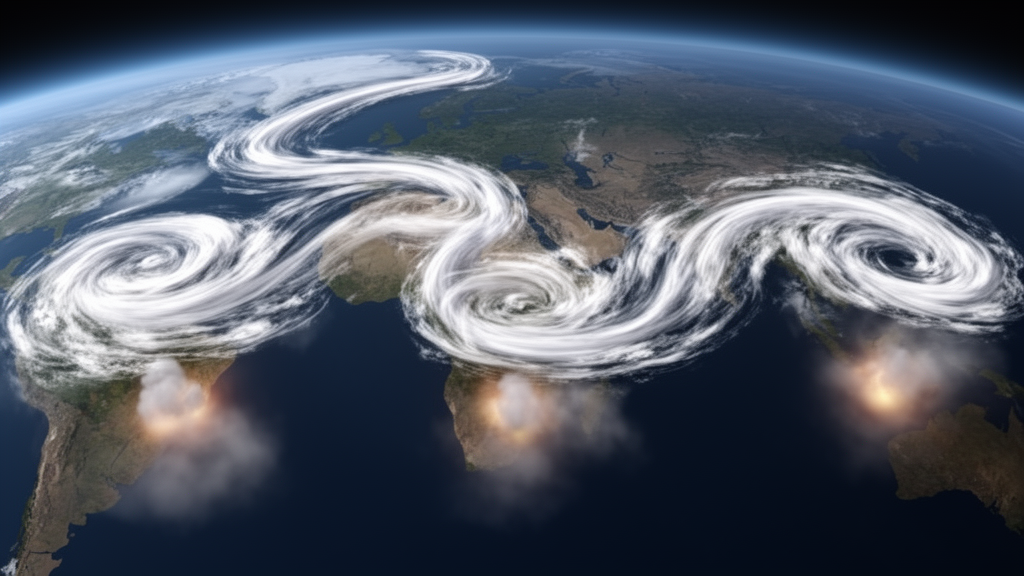
In the late spring of 2023, the Northern Hemisphere seemed to lurch from one catastrophe to the next. Canada burned through its worst wildfire season on record, East Asia endured weeks of relentless rain, and northwestern Europe sweltered under an exceptional June heatwave. A new study published in Weather and Climate Dynamics by Zhixiang Li, Jianhua Lu, and Yimin Liu argues that these were not three unrelated misfortunes but chapters of a single, connected atmospheric story: a relay race of high-pressure blocking systems linked by the downstream dispersion of Rossby wave energy across thousands of kilometers.
Atmospheric blocking occurs when a persistent anticyclone, or high-pressure ridge, parks itself over a region and deflects the usual eastward march of weather systems. Blocks are among the most consequential features of the extratropical circulation, yet predicting them more than two weeks ahead has long been considered near the edge of what is possible. The challenge is especially acute during transitional seasons, when the large-scale circulation is shifting rapidly between winter and summer regimes and the background flow is unusually volatile. The May–June 2023 sequence offered the researchers a rare natural experiment: three successive blocking episodes over Canada, the Ural Mountains, and Europe, each tied to a distinct surface disaster.
To untangle the dynamics, the team combined ERA5 reanalysis data, the Tibaldi–Molteni blocking index for identifying large-scale blocks, and a relatively new diagnostic technique based on the Hilbert transform. This method allows scientists to compute local wave parameters—phase speed, amplitude, and zonal wavenumber—at every grid point and every moment, rather than relying on hemispheric averages that wash out regional detail. They supplemented this with the Takaya–Nakamura wave activity flux, which traces the horizontal propagation of quasi-stationary Rossby wave energy, and with the stationary wavenumber, a theoretical reference scale at which waves tend to become quasi-stationary in a given background flow.
The diagnostics revealed a clear chain of causation in the wave energy budget. During the first episode, from 1 to 19 May, wave activity flux originating over the North Pacific converged over Canada, sustaining a strong quasi-stationary ridge there. When that Canadian blocking collapsed in mid-May, its energy did not simply dissipate; instead, it dispersed downstream toward the Ural Mountains and Europe, promoting the establishment of the ridges that dominated the second episode from 20 May to 5 June. In the third episode, from 6 to 20 June, wave energy propagating across the North America–North Atlantic sector split into two branches, one heading southeast toward the northwestern Atlantic and the other northeast via Greenland, and both converged over Europe, where a new blocking event formed between 11 and 16 June.
The local wave parameters told an equally striking story. All three blocks were dominated by planetary-scale Rossby waves with zonal wavenumbers of roughly 2 to 4, about one wavenumber lower than the climatological average. Because larger-scale disturbances feel the scale effect—broad waves propagate westward relative to the mean flow more readily than narrow ones—these anomalously low wavenumbers translated into exceptionally slow phase speeds, sometimes even westward motion. The result was a circulation that barely moved for weeks, baking Canada, funneling cold air southward into East Asia alongside the Ural ridge and the East Asian trough, and holding Europe under sustained subsidence and clear skies that marine heatwave feedbacks further amplified.
Perhaps most remarkable were the abrupt regime transitions the diagnostics exposed. At the onset of each block, the wave field flipped within just a few days from eastward-propagating, small-amplitude synoptic-scale waves—wavenumbers above six—to quasi-stationary or westward-propagating, large-amplitude planetary-scale waves. Phase speed dropped sharply, in the Canadian case from more than 3 meters per second to negative values, while amplitude surged past one standard deviation and the wavenumber fell below the stationary value. During decay, the sequence ran in reverse. Comparing the diagnosed wavenumber with the stationary wavenumber provided a useful rule of thumb: blocks stayed put when the two were similar, moved westward when the wavenumber was smaller, and resumed rapid eastward progression once it exceeded that threshold.
The second half of the study turned to forecast skill, evaluating the 50-member real-time ensemble of the ECMWF subseasonal-to-seasonal prediction system. The headline finding is genuinely encouraging: for all three episodes, forecasts initialized 15 to 19 days ahead showed high predictability, with 40 to 65 percent of members correctly predicting 500 hPa geopotential height anomalies exceeding one standard deviation and more than 80 percent predicting above-normal heights. Predictability dipped for forecasts made during the following week before recovering strongly at lead times of 2 to 5 days. The Ural episode proved the most skillful, with the best ensemble members reproducing both the intensity and duration of the ridge.
What separated successful forecasts from failures was not luck but wave dynamics. Comparing the ten strongest and ten weakest members for each episode, the researchers found that good forecasts captured the upstream quasi-stationary troughs—a trough over the North Pacific for the Canadian block, and one over the North Atlantic for the Ural and European blocks—along with the subsequent downstream energy dispersion that built the planetary-scale trough-ridge patterns. Poor forecasts, by contrast, let synoptic-scale waves run eastward along the subtropical or mid-latitude jet without ever amplifying into a blocking pattern, and their predictions drifted back toward climatology. Even the best members underestimated the amplification of wave amplitude and spatial scale, particularly for the Canadian and European blocks, a systematic shortfall that points to a concrete target for model improvement.
The study also uncovered a window of opportunity with real operational implications. Because the three blocks were dynamically chained, getting the first one right paid dividends downstream. In forecasts initialized on 17 April, members that correctly predicted the strong Canadian ridge went on to anticipate a stronger Ural ridge in late May, at a lead time exceeding 33 days, while members that missed the Canadian block also missed the Ural block. In other words, the collapse of the Canadian blocking and the associated shift toward a North Atlantic Oscillation-like regime acted as a predictable precursor, extending the horizon of useful guidance well beyond the conventional two-week barrier.
The authors are careful to note the limits of their analysis. The role of vertical planetary wave propagation, stratospheric processes, and lower-boundary forcing remains unexplored, and three case studies cannot establish how generally the wave-parameter transitions apply across seasons and regions. Future work, they suggest, should extend the Hilbert-transform diagnostics to larger blocking samples and probe why models consistently fail to amplify wave amplitude and scale to observed levels. Still, the central message is clear and actionable: the key to subseasonal prediction of persistent, high-impact blocking lies in correctly capturing upstream Rossby wave precursors and the quasi-stationary energy they dispatch downstream. For forecasters and disaster planners alike, the atmosphere’s worst weeks may be legible weeks in advance—if one knows where to look for the wave train.
Subject of Research: Subseasonal predictability and Rossby wave dynamics of atmospheric blocking events in May–June 2023
Article Title: Subseasonal predictability and Rossby wave dynamics of blocking high during transitional seasons: insights from three successive events in May–June 2023
Article References: Li, Z., Lu, J., & Liu, Y. (2026). Subseasonal predictability and Rossby wave dynamics of blocking high during transitional seasons: insights from three successive events in May–June 2023. Weather and Climate Dynamics, 7(3), 1821-1836. https://doi.org/10.5194/wcd-7-1821-2026
Image Credits: AI Generated
Keywords: atmospheric blocking, Rossby waves, subseasonal prediction, wave activity flux, Canadian wildfires, European heatwave, East Asian precipitation, ECMWF S2S, ERA5 reanalysis, phase speed, planetary waves, transitional seasons
Cite Scienmag News
Sloane Callahan. (October 8, 2026). How Three Stuck Jet Stream Blocks Fueled a Chain of Disasters in 2023. Scienmag. https://scienmag.com/how-three-stuck-jet-stream-blocks-fueled-a-chain-of-disasters-in-2023/
Sloane Callahan. "How Three Stuck Jet Stream Blocks Fueled a Chain of Disasters in 2023." Scienmag, 8 October 2026, https://scienmag.com/how-three-stuck-jet-stream-blocks-fueled-a-chain-of-disasters-in-2023/. Accessed 9 October 2026.
Sloane Callahan. "How Three Stuck Jet Stream Blocks Fueled a Chain of Disasters in 2023." Scienmag. October 8, 2026. https://scienmag.com/how-three-stuck-jet-stream-blocks-fueled-a-chain-of-disasters-in-2023/


