


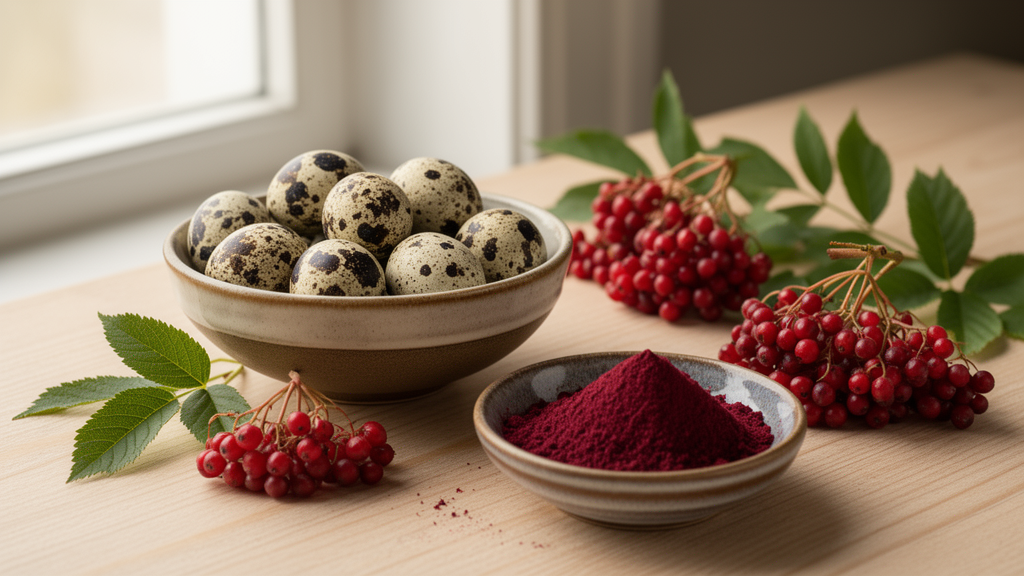
In the rolling agricultural heartland of central Anatolia, a tart red berry that Turkish families have pressed into juice and folk remedies for generations is now being measured out in carefully weighed grams into the feed troughs of laying quails. The fruit is Viburnum opulus, known locally as gilaburu and botanically as the European cranberrybush, and a new controlled feeding trial from Kırşehir Ahi Evran University suggests that when its dried, powdered fruit is mixed into the diets of laying Japanese quails, it can quietly reshape some of the most commercially and nutritionally important properties of the eggs those birds produce. The study, published in the journal Archives Animal Breeding, is among the first rigorous attempts to move this phytochemically rich fruit from the realm of traditional medicine and human nutrition science into the practical world of poultry feed formulation.
The research team, led by Ayşe Gül Filik and corresponding author Gökhan Filik of the university’s Agricultural Biotechnology Department, together with Olgay Kaan Tekin, set out to answer a question that has become increasingly urgent in modern animal science: can native plant resources rich in bioactive compounds serve as effective, natural alternatives to synthetic feed additives? Consumer pressure for so-called clean label animal products, combined with rising feed costs and concerns over chemical residues, has pushed researchers worldwide to screen local flora for phytogenic additives — plant-derived compounds that might improve animal health and product quality without pharmaceutical inputs. Viburnum opulus, which grows wild across Europe, North Africa, northern Asia, and particularly in the Turkish provinces of Kayseri, Sivas, Tokat, Kırşehir, and Ankara, presented an attractive candidate because of its unusually dense phytochemical profile.
That profile is what makes the fruit scientifically compelling. Analyses of Viburnum opulus berries have revealed high concentrations of polyphenols, flavonoids, tannins, carotenoids, and vitamin C. The dominant phenolic compound is chlorogenic acid, which can account for between 54 and 96 percent of the fruit’s total phenolic content and is regarded as a powerful antioxidant and antimicrobial agent. The fruit is also rich in organic acids, particularly malic and quinic acids, and contains notable concentrations of free amino acids such as aspartic and glutamic acid. Previous laboratory and pharmacological studies have linked Viburnum opulus extracts to lipid metabolism regulation, reductions in free fatty acids, cholesterol homeostasis effects, and even anticancer and antidiabetic activity, but almost none of this work had examined the plant as a direct dietary supplement in poultry. The Turkish team’s experiment was designed to fill that gap with a dose-response approach.
The trial involved 176 laying Japanese quails aged 30 weeks, a species favored in poultry nutrition research for its short generation interval and high egg production capacity. The birds — 132 females and 44 males — were randomly allocated into four dietary treatment groups, each with 11 replicate cages containing three females and one male. The cage, not the individual bird, served as the experimental unit for all performance and production measurements, a design choice that guards against pseudo-replication in statistical analysis. The control group received a standard basal diet formulated to meet quail nutritional requirements with 177 grams per kilogram of crude protein and 2800 kilocalories per kilogram of metabolizable energy. The three treatment groups received the same basal diet supplemented with Viburnum opulus fruit powder, abbreviated VOFP, at inclusion levels of 5, 10, and 15 grams per kilogram of feed. The fruit itself was harvested at full maturity from the university’s research fields, air-dried for a week, finished in a ventilated oven at 65 degrees Celsius for 48 hours, and ground through a one-millimeter sieve in an ultra-centrifuge mill to ensure homogeneous mixing. The feeding experiment ran for eight weeks under a 16:8 light-dark photoperiod with feed and water available ad libitum.
Over the 56-day trial, the researchers tracked body weight, body weight gain, feed intake, and feed conversion ratio weekly, collected eggs twice daily, and subjected eggs gathered on the third day of each week to a battery of quality analyses. External parameters included egg weight, dimensions measured with digital calipers, shape index, shell thickness at three points along the shell, and breaking resistance determined with a texture analyzer. Internal quality was assessed through albumen and yolk heights, albumen and yolk indices, and the Haugh unit, the internationally recognized standard for egg interior quality. Yolk color was quantified spectrophotometrically using CIELAB parameters. Critically, the team also monitored cholesterol metabolism by analyzing yolk cholesterol concentrations at the start of the trial and during weeks two, four, six, and eight, using a spectrophotometric extraction method adapted from earlier phytogenic additive research. Data were analyzed with general linear models, and orthogonal polynomial contrasts were applied to detect dose-response relationships across the supplementation levels.
The headline finding on performance was reassuring: dietary VOFP supplementation produced no statistically significant adverse effects on body weight, body weight gain, or feed conversion ratio, indicating that the birds tolerated even the highest inclusion level well. There were, however, subtle shifts in feeding behavior. Total feed intake was highest in the 5 gram per kilogram group at 7888.0 grams, while the 15 gram per kilogram group consumed the least at 7115.6 grams, a statistically significant difference. The authors suggest this reduction at the highest dose may reflect the fruit’s acidic profile — its abundant malic and quinic acids may slightly inhibit palatability — though the free amino acids in the fruit could simultaneously support protein metabolism. Egg production itself was statistically unchanged across groups, but the 5 gram per kilogram group achieved the highest total egg weight at 1828.60 grams and produced notably more afternoon-laid eggs than the control and highest-dose groups.
The most striking results emerged in egg internal quality. Supplementation at 5 grams per kilogram significantly increased egg yolk height, which reached 13.55 millimeters, and elevated the yolk index compared with controls, both indicators of a richer, more standing yolk. Albumen weight and albumen index were also highest at this dose. Among yolk color parameters, the b* value, which reflects yellowness, peaked at 19.74 in the 10 gram per kilogram group — an attribute with real market value, since consumers associate deeper yolk color with superior eggs. Shell characteristics told a more nuanced story: shell weight decreased with supplementation, reaching its lowest value of 1.22 grams in the 5 gram per kilogram group, yet shell thickness and breaking resistance were unaffected, suggesting that mineral metabolism and structural integrity were preserved even as shell mass shifted. The Haugh unit remained statistically unchanged across all treatments.
The cholesterol results are the most tantalizing and the most cautiously framed. Across the trial, average yolk cholesterol concentrations declined numerically in all supplemented groups, but statistical significance appeared only once: in the sixth week, when cholesterol in the 15 gram per kilogram group fell to 41.04 milligrams per gram of yolk, down from 52.31 milligrams per gram in the control group. The authors interpret this as a potential time-dependent effect of the fruit powder on cholesterol metabolism, plausibly connected to the phenolic compounds that earlier cell studies have linked to lipid accumulation and fatty acid metabolism pathways. Yet they are careful to note that the specific phytochemical composition of the powder used in this trial was not characterized, so the mechanism remains hypothetical rather than confirmed. The transient nature of the effect — significant in week six but not sustained across the full eight weeks — underscores how much remains unknown about how plant bioactives interact with avian physiology over time.
What the study ultimately delivers is preliminary but valuable evidence that Viburnum opulus fruit powder is a viable, well-tolerated phytogenic feed additive for laying quails, with the low dose improving selected internal egg quality traits and the high dose showing a potential, if inconsistent, cholesterol-modulating effect. The researchers call for follow-up work incorporating phytochemical characterization, hepatic cholesterol metabolism markers, antioxidant status measurements, and gut microbiota analyses to pin down the mechanisms at play. They also point to food science findings showing that encapsulation can stabilize the fruit’s bioactive compounds, hinting at strategies to enhance and prolong its effects in feed. For a fruit long celebrated in Anatolian folk tradition and now attracting attention in pharmacology laboratories worldwide, the journey from village juice press to scientific feed supplement is still at its beginning — but these quail eggs offer an early, measurable sign that the berry’s bioactive promise may extend from human health into the food chain itself.
Subject of Research: Effects of dietary Viburnum opulus fruit powder supplementation on performance, egg quality, and yolk cholesterol in laying Japanese quails
Article Title: The effects of Viburnum opulus L. fruit powder on the performance, egg traits, and egg cholesterol of laying Japanese quails
Article References: Filik, A. G., Filik, G., & Tekin, O. K. (2026). The effects of Viburnum opulus L. fruit powder on the performance, egg traits, and egg cholesterol of laying Japanese quails. Archives Animal Breeding, 69(3), 507-515. https://doi.org/10.5194/aab-69-507-2026
Image Credits: AI Generated
Keywords: Viburnum opulus, Japanese quail, phytogenic feed additive, egg quality, egg yolk cholesterol, poultry nutrition, chlorogenic acid, clean label, feed conversion ratio, Haugh unit, Anatolia, animal science
Cite Scienmag News
Daisy Hatcher. (October 8, 2026). Quail Eggs Get a Berry Boost: Tart Viburnum Powder Reshapes Egg Quality and Cholesterol. Scienmag. https://scienmag.com/quail-eggs-get-a-berry-boost-tart-viburnum-powder-reshapes-egg-quality-and-cholesterol/
Daisy Hatcher. "Quail Eggs Get a Berry Boost: Tart Viburnum Powder Reshapes Egg Quality and Cholesterol." Scienmag, 8 October 2026, https://scienmag.com/quail-eggs-get-a-berry-boost-tart-viburnum-powder-reshapes-egg-quality-and-cholesterol/. Accessed 8 October 2026.
Daisy Hatcher. "Quail Eggs Get a Berry Boost: Tart Viburnum Powder Reshapes Egg Quality and Cholesterol." Scienmag. October 8, 2026. https://scienmag.com/quail-eggs-get-a-berry-boost-tart-viburnum-powder-reshapes-egg-quality-and-cholesterol/


