


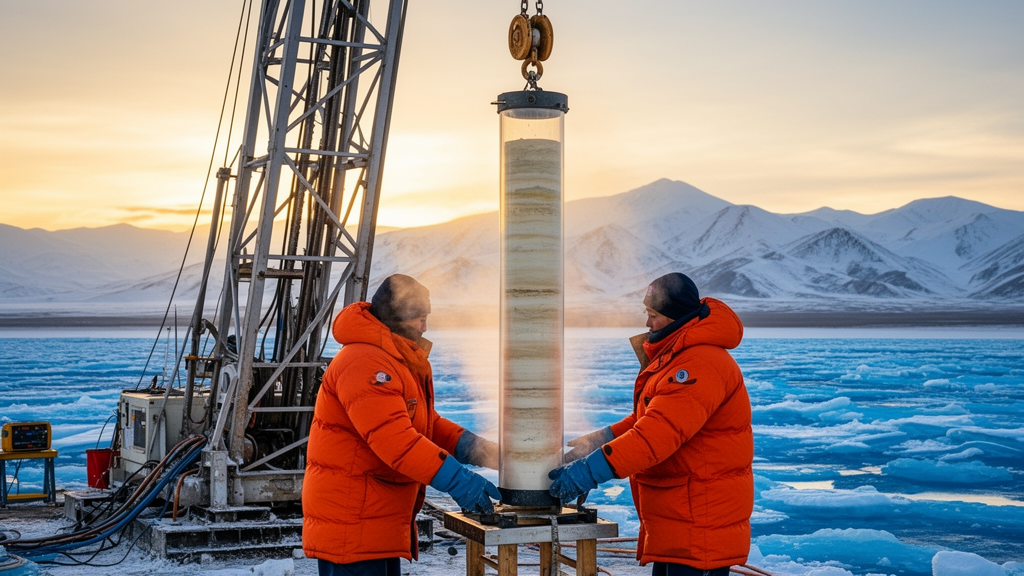
At 4,718 meters above sea level, where the air holds barely half the oxygen of the lowlands and the lake freezes solid for roughly three months each year, an international team of scientists has pulled off one of the most ambitious continental drilling campaigns ever attempted. The ICDP Nam Co Drilling Project, known as NamCore, recovered 950.77 meters of sediment from beneath Nam Co, one of the largest and deepest lakes on the Tibetan Plateau, reaching a maximum depth of 510.2 meters below the lake floor. The record, described in the journal Scientific Drilling, is expected to span roughly the last million years of Earth’s history, making it one of the longest continuous sedimentary archives ever recovered from this high-altitude region often called the Third Pole.
The stakes of the project extend far beyond the lake itself. The Tibetan Plateau and its surrounding ranges, including the Hindu Kush, Karakoram, and Himalayas, store the largest volume of ice outside the polar regions, earning the region its nickname as an Asian Water Tower. Meltwater and precipitation feeding the Brahmaputra, Mekong, Yangtze, Yellow, Indus, and Ganges river systems supply freshwater to nearly two billion people downstream. Understanding how this water tower has responded to natural climate cycles in the past is therefore essential for predicting how it will behave under future warming, and Nam Co’s sediments offer a way to read that history directly.
The lake sits in a closed basin whose water balance is governed almost entirely by precipitation and evaporation, with smaller contributions from permafrost thaw, glacial meltwater, and groundwater. Its climate is modulated by the interplay of the Indian Summer Monsoon, the East Asian Monsoon, and the mid-latitude Westerly Jet, and one of NamCore’s central goals is to pin down the timing and magnitude of monsoon variability and its interaction with the Westerlies across multiple glacial-interglacial cycles. A long-standing scientific debate concerns whether precession, eccentricity, or obliquity dominates the orbital forcing of Asian monsoon strength, and a terrestrial record of this length from the plateau itself should help settle the question.
Getting the core was an operational feat. Drilling ran from 6 June to 17 July 2024 as ICDP Expedition 5073, using a barge positioned over the deepest part of the lake at a water depth of about 93 meters. In total, 1,415.45 meters were drilled and 1,175.99 meters cored across seven holes at a single site, with an overall sediment recovery of 80.8 percent. Site selection drew on roughly 1,500 kilometers of seismic profiles acquired during four Sino-German hydro-acoustic surveys between 2005 and 2016, which revealed several hundred meters of well-stratified sediment infill and helped the team steer clear of steep faults that slice through the basin.
The drilling itself proved harder than anticipated. Pre-site surveys had suggested predominantly fine-grained sediments, but the recovered sequence turned out to be interrupted by sand beds up to a meter thick that repeatedly collapsed into the borehole, demanding large volumes of bentonite- and polymer-conditioned drilling fluids and continuous use of rotary coring tools. The Hydraulic Piston Corer worked only in the upper 12 meters of soft mud; below that, only the Alien Coring Tool could advance through the increasingly consolidated sediments. The team abandoned plans for additional shallower sites along the original transect when seismic data hinted at even more extensive coarse-grained strata near shore, and instead concentrated all effort on the single deep site.
Initial analysis of core catcher material has already revealed a strikingly dynamic lake. The sediment sequence divides into five major lithological units built from four recurring lithologies: calcareous mud, non-calcareous mud, calcareous mud with ferric staining, and sand. The deepest unit, between 510.12 and 435.58 meters below the lake floor, shows highly consolidated silty to sandy calcareous mud with shear strengths exceeding 600 kilonewtons per square meter, carbonate contents peaking at 61 percent, and organic geochemical signals suggesting strong terrigenous input, possibly tied to a very low lake level in an early stage of the basin’s evolution.
Higher in the core, between roughly 321 and 242 meters depth, the sediments change character dramatically, with sand contents reaching up to 77 percent. The team interprets this as evidence of a significant environmental shift, potentially reflecting lower lake levels, increased glacier melt, or enhanced fluvial input, though the researchers caution that these partly competing explanations require a fuller dataset to resolve. Above this sandy interval, the record settles into alternating calcareous and non-calcareous muds, and in the uppermost unit carbonate content climbs steadily toward the top of the sequence, tracing the lake’s gradual chemical evolution toward its present slightly alkaline, saline, oligotrophic state.
The biological signals in the core are equally revealing, if unusual. Diatoms, the workhorse algae of most lake-based paleoclimate studies, are almost entirely absent, found only as fragments in 12 of 84 examined samples, likely because growing or preservation conditions were unsuitable. Ostracods, tiny bivalved crustaceans, step into the gap: six taxa were identified, including Leucocytherella sinensis and species of Leucocythere and Ilyocypris, with abundances swinging from complete absence to more than 1,000 valves per sample. Shifts in the ostracod assemblage, including a transition toward a fauna broadly comparable to the modern one in the upper section, appear to track changing environmental conditions, while intervals with a very poor record may indicate sedimentation in deep, cold, poorly oxygenated waters.
Organic geochemistry adds another layer of environmental detail. Analyses of n-alkanes, waxy molecules produced by plant cuticles and aquatic organisms, show systematic shifts in chain length through the core. The ratio favoring aquatic macrophyte input ranges from 0.10 to 0.73 and varies in ways that may reflect lake-level fluctuations and glacial-interglacial cycles, while the average chain length of long-chain n-alkanes, which tends to lengthen under drier conditions as plants synthesize longer waxes to conserve water, oscillates between 28.7 and 30.9. The terrestrial-to-aquatic ratio peaks above 30 in the lower part of the record, pointing to episodes of strong terrestrial input, possibly from lake shrinkage or intensified runoff.
The work has only begun. Samples collected during successive core-opening and sampling parties in Beijing will feed a chronology built from radiocarbon, cosmogenic beryllium-10, magnetostratigraphy, luminescence dating, and amino acid racemization, alongside biomarker, palynological, and sedimentary ancient DNA analyses. The project also targets the deep biosphere, probing how microbial communities in these mostly carbonate-rich sediments exploit tectonically derived fluids, and will use microfluidic laboratory experiments to mimic redox processes in the sediment’s pore spaces. Paleomagnetic U-channels, extracted down to about 12 meters before the sediments became too consolidated, will chart secular variation of Earth’s magnetic field. Together, these analyses promise to transform a frozen lake on the roof of the world into one of the most detailed terrestrial chronicles of climate change ever assembled, with direct implications for the billions of people who depend on the water it stores.
Subject of Research: A 510.2-meter lake sediment core from Nam Co, Tibet, recording monsoon variability, glacial-interglacial cycles, and high-altitude ecosystem evolution over the late Quaternary
Article Title: The ICDP Nam Co Drilling Project (NamCore), Tibet: a 510.2 m sedimentary record from the Third Pole
Article References: Adolph, M.-L., Wang, J., Zhu, L., Clarke, L. J., Henderson, A. C. G., Vogel, H., Daut, G., Frenzel, P., Ju, J., Kou, Q., Michaelis, D., Schmitz, O., Schwarz, A., Spiess, V., Ulfers, A., Zhaxi, C., Ariztegui, D., Barbolini, N., Bauersachs, T., … Haberzettl, T. (2026). The ICDP Nam Co Drilling Project (NamCore), Tibet: a 510.2 m sedimentary record from the Third Pole. Scientific Drilling, 35(1), 99-117. https://doi.org/10.5194/sd-35-99-2026
Image Credits: AI Generated
Keywords: NamCore, Tibetan Plateau, Nam Co, ICDP, scientific drilling, paleoclimatology, Indian Summer Monsoon, Westerlies, ostracods, n-alkanes, glacial-interglacial cycles, Third Pole
Cite Scienmag News
Violet Maxwell. (October 8, 2026). Deep Beneath Tibet’s Nam Co, a 510-Meter Core Captures a Million Years of Climate History. Scienmag. https://scienmag.com/deep-beneath-tibets-nam-co-a-510-meter-core-captures-a-million-years-of-climate-history/
Violet Maxwell. "Deep Beneath Tibet’s Nam Co, a 510-Meter Core Captures a Million Years of Climate History." Scienmag, 8 October 2026, https://scienmag.com/deep-beneath-tibets-nam-co-a-510-meter-core-captures-a-million-years-of-climate-history/. Accessed 8 October 2026.
Violet Maxwell. "Deep Beneath Tibet’s Nam Co, a 510-Meter Core Captures a Million Years of Climate History." Scienmag. October 8, 2026. https://scienmag.com/deep-beneath-tibets-nam-co-a-510-meter-core-captures-a-million-years-of-climate-history/


